Silent and Failsafe Overflow System

Very similar idea, but entirely different implementation from what I was thinking. I was thinking more along the lines of building a coast-to-coast around the entire edge of the tank. Although, essentially, the water overflowing it would be doing so no differently than a zero edge / waterfall edge tank. The "physics" would be about the same, it's just how you're draining the water away that differs.

In either case, it lends more proof that "better than C2C" has already been done, and is totally possible. It's beyond baffling people will try to sit and tell me something is not possible when it clearly is...Seems how many of my arguments start on here, lol.

My point from before, if we wanted to argue what physics shows is technically best, then we would be going to extremes like zero-edge or every-edge overflows, but they're either impractical, difficult to do correctly, involve waterfalls over the edge, or an overflow that's blocking the viewing panes of the tank in a very unsightly way. Some people may see C2C's in that same light and would rather just build a smaller overflow that can handle the flow rate and has "good enough" skimming. To many, that's already more than enough, and C2C is overkill. Otherwise, hey, overflows everywhere right? Moar is bettar?

We make compromises everywhere when building a tank. Again, unless you're building the actual ocean, your tank is always compromising something. Not everyone does a C2C, even if they are custom building an overflow. Not everyone thinks it's necessary, even if it's technically better. In light of that, questions about building an overflow shorter than coast-to-coast and how they should handle a given flow rate, are perfectly valid questions, and I don't think people should be shamed for trying to help them come up with an answer.
 
Last edited:
attachment.php


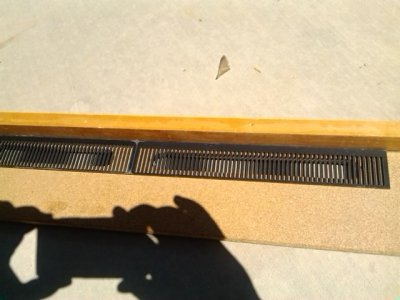
Here is a picture of the grates sitting on the router jig.

The slots are 3 mm wide and the grate verticals are 2mm wide so 60% of the length should count. The tanks will have mostly SPS corals and will have very large powerheads controlled by my apex plus a wavebox. I have two DC12000 pumps for the return. There will be tons of flow.

I appreciate everyone's inputs. I am trying to strike a balance and trying to avoid mistakes.

Thanks again for the comments.
-Paul
 

Attachments

  • IMG_20160910_113156.jpg
    IMG_20160910_113156.jpg
    91 KB · Views: 9
btw, to answer your original question, my friend just made his external overflow box 7" tall, i think 8-10" like you said should be fine especially given your tank is larger, the extra height gives you some more room to play with.

if for some reason the teeth were reducing the flow too much, you could always bust out a few teeth, hah. Are the teeth gonna be removable? You arguably don't even need em, but if you're trying to prevent stuff from getting in there, then it's fine. I have teeth on mine and it's fine.

60% of a 40"x1" slot is 24" and well, i'm pretty sure it should handle the flow fine, it's just a matter of how far up the teeth the water level will rise.

if you think about a 1" pipe and how much flow it can handle, say, 300-400gph through a durso or maybe 1200-1600gph+ as a siphon, and then adjust that for 24" x 1", even a worst case scenario is like 7200gph? I'm thinking you'll be OK flow rate wise, however if it's rising too far up the teeth then it will reduce the effectiveness of the skimming, in which case spacing the teeth out more (or just busting out a few) would help reduce that.
 
btw, to answer your original question, my friend just made his external overflow box 7" tall, i think 8-10" like you said should be fine especially given your tank is larger, the extra height gives you some more room to play with.

if for some reason the teeth were reducing the flow too much, you could always bust out a few teeth, hah. Are the teeth gonna be removable? You arguably don't even need em, but if you're trying to prevent stuff from getting in there, then it's fine. I have teeth on mine and it's fine.

60% of a 40"x1" slot is 24" and well, i'm pretty sure it should handle the flow fine, it's just a matter of how far up the teeth the water level will rise.

if you think about a 1" pipe and how much flow it can handle, say, 300-400gph through a durso or maybe 1200-1600gph+ as a siphon, and then adjust that for 24" x 1", even a worst case scenario is like 7200gph? I'm thinking you'll be OK flow rate wise, however if it's rising too far up the teeth then it will reduce the effectiveness of the skimming, in which case spacing the teeth out more (or just busting out a few) would help reduce that.

I had not thought of removing teeth. I am going to try to make the teeth attached by magnets so I could easily remove them or remove teeth. So far the only magnet I've found that looks like it will work is the Avast Marine "Magnet Pair; DIY Holder". It is sealed in ABS and each one is 2"x1.25"x.5".
I am planning on using 1.5" bulkheads and plumbing. The sump will be close to directly below the overflow about 44" from sump water level to tank water level.
I don't plan on maxing out the flow on the two DCT12000 (the power supplies seem to die faster that way) so based on what I have read in this tread it sounds like I should have plenty of capacity?

Thanks again for the help!
-Paul
 
I had not thought of removing teeth. I am going to try to make the teeth attached by magnets so I could easily remove them or remove teeth. So far the only magnet I've found that looks like it will work is the Avast Marine "Magnet Pair; DIY Holder". It is sealed in ABS and each one is 2"x1.25"x.5".
I am planning on using 1.5" bulkheads and plumbing. The sump will be close to directly below the overflow about 44" from sump water level to tank water level.
I don't plan on maxing out the flow on the two DCT12000 (the power supplies seem to die faster that way) so based on what I have read in this tread it sounds like I should have plenty of capacity?

Thanks again for the help!
-Paul

according to this:
http://www.beananimal.com/articles/hydraulics-for-the-aquarist.aspx

you would have about 5078gph through the 1.5" pipe @ 44" of drop. if you're not running the 2xDCT12000 on max i suspect this will be OK. I kind of suspect the bulkhead size will limit your GPH before the weir teeth ever do....

hope you got the wallet ready for the 1.5" gate valves lol they are like $60 but it's all i'd use (spears sch80 gate valve threadxthread). I use the threaded ones cause I don't like the notion of gluing a $60 valve and ruining it hah.

I use the zoomed magclips for a lot of stuff, but not sure I'd recommend them, i noticed once if you put em in there without the clip on, i saw rust creeping out of the threaded hole for the clip. Yeaah. I might be looking for a new solution. Avast is good stuff though, I have their spyglass reactor. I'd trust them
 
Thanks for the info.
I was thinking of using the "economy" gate valve from BRS. It costs half as much as the spears. It looks like the main difference is that you cannot take it apart for cleaning.

Has anyone tried that one?
 
Thanks for the info.
I was thinking of using the "economy" gate valve from BRS. It costs half as much as the spears. It looks like the main difference is that you cannot take it apart for cleaning.

Has anyone tried that one?

I haven't, I only use the spears ones. I use the threaded ones so you can re-use them if you screw anything up...
 
You get what you pay for in a valve. Sure, you will pay a couple bucks for the name, but there is a rather significant quality difference betwen a Spears valve, and a "budget" valve. I don't know the branding of the "budget" gate valves sell, however, They do appear to be KBI. (Matching patent numbers.) KBI is U.S. made, so the quality will be higher than imported budget valves.

The most obivious difference, other than "quality" (very subject) is in the ease of disassembly. They both disassemble, it is just a lot easier to get a Spears apart in place, than the KBI is. The KBI is more prone to stem leaks than the Spears. However, both the stem seal, and the "gate" are replaceable items. ETSS used the KBI sch40 gates with their high end equiment, and KBI is probably the most common gate in the hobby (at some point WalMart was selling them.) If wanting to service it in place I would strongly recommend you spend the bucks the first time around.

Another thing I noticed is you are planning on running two DC pumps full open, for a 375 gallon tank. The whole point of running a DC pump, is the energy savings, but still have good flow at a reasonable head loss. However, running two pumps is always (I am sure an exception can be found, but that is not the point) less efficient than running a single larger pump that will do the job on its own.

In your case you are planning on running 2 DC12000 pumps, to service a 375 gallon tank. These are good pumps, when used where it is "appropriate," however the two together will eat up 278 watts, (I believe it is closer to 150watts per pump due to AC/DC conversion, but 278 makes the point.) Depending on how much you do or do not engineer your plumbing, you will probably get ~ 3200gph plus or minus total with both pumps running. (from flow curves, using around 6' - 7' total head, the mid-point on the flow curve: the point where the losses have eaten up half your theoretical max.)

A Barracuda will pump 3843gph @ 4' (236watts) and 3333 @ 8' (248watts,) and will also be more "reliable," because there are no electronics involved. Clear winner for everything that counts: Barracuda.

When even the RLC calculator says you need a minimum of 45" of overflow for 3000gph, 24" (60% of 40") comes up way short... Because you don't have a good amount of overflow, and are channeling the flow (both with 4 seperate slots, and each slot further channeled with "grates" you are most likely not going to enjoy the noise, which is part of the reason one would use a silent drain system, I would think.

I built a 300gallon + tank around 6 years ago, with an internal external setup, full length internal full length external. Never had the external box dump the entire volume into the sump (the plumbing does not allow it.) If I stop and think about it, it was pretty much a waste of time as the standard BA setup would have been just fine, and there was no real benefit.

Acrylic tanks present more of a problem due to the euro-brace, however I do think that you will be better off installing an internal weir and using through holes as a pass through to the plumbing.
 
Last edited:
You get what you pay for in a valve. Sure, you will pay a couple bucks for the name, but there is a rather significant quality difference between a Spears valve, and a "budget" valve. I don't know the branding of the "budget" gate valves sell, however, They do appear to be KBI. (Matching patent numbers.) KBI is U.S. made, so the quality will be higher than imported budget valves.

The most obvious difference, other than "quality" (very subject) is in the ease of disassembly. They both disassemble; it is just a lot easier to get a Spears apart in place, than the KBI is. The KBI is more prone to stem leaks than the Spears. However, both the stem seal, and the "gate" are replaceable items. ETSS used the KBI sch40 gates with their high end equipment, and KBI is probably the most common gate in the hobby (at some point WalMart was selling them.) If wanting to service it in place I would strongly recommend you spend the bucks the first time around.
Good information.Thanks.
Another thing I noticed is you are planning on running two DC pumps full open, for a 375 gallon tank. The whole point of running a DC pump, is the energy savings, but still have good flow at a reasonable head loss. However, running two pumps is always (I am sure an exception can be found, but that is not the point) less efficient than running a single larger pump that will do the job on its own.

In your case you are planning on running 2 DC12000 pumps, to service a 375 gallon tank. These are good pumps, when used where it is "appropriate," however the two together will eat up 278 watts, (I believe it is closer to 150watts per pump due to AC/DC conversion, but 278 makes the point.) Depending on how much you do or do not engineer your plumbing, you will probably get ~ 3200gph plus or minus total with both pumps running. (from flow curves, using around 6' - 7' total head, the mid-point on the flow curve: the point where the losses have eaten up half your theoretical max.)

A Barracuda will pump 3843gph @ 4' (236watts) and 3333 @ 8' (248watts,) and will also be more "reliable," because there are no electronics involved. Clear winner for everything that counts: Barracuda.
I am currently running the two DCT12000 pumps on my 240g both at a low setting. I had a DC12000 fail when I was on vacation and luckily I got my friend to come over and fix it when the tank sitter noticed it. After that I separated the plumbing and installed the second pump. The system will operate with either pump failed and I feel much safer with the redundancy. Eventually I would like to get them on separate circuits as well. Also I prefer submersible pumps. I can see your point about the efficiency of one pump though.

When even the RLC calculator says you need a minimum of 45" of overflow for 3000gph, 24" (60% of 40") comes up way short... Because you don't have a good amount of overflow, and are channeling the flow (both with 4 separate slots, and each slot further channeled with "grates" you are most likely not going to enjoy the noise, which is part of the reason one would use a silent drain system, I would think.
I built a 300gallon + tank around 6 years ago, with an internal external setup, full length internal full length external. Never had the external box dump the entire volume into the sump (the plumbing does not allow it.) If I stop and think about it, it was pretty much a waste of time as the standard BA setup would have been just fine, and there was no real benefit.
Acrylic tanks present more of a problem due to the euro-brace, however I do think that you will be better off installing an internal weir and using through holes as a pass through to the plumbing.
I will consider adding a small grate covered removable weir to the inside of the tank and keep the plumbing in the overflow box. I imagine I could make something not much bigger than the grate I pictured in the earlier post and perhaps as thin as 1/2 inch or so.

Thanks,
Paul
 
Redundancy: a part in a machine, system, etc., that has the same function as another part and that exists so that the entire machine, system, etc., will not fail if the main part fails. E.G. the probability of the "redundant" part failing is at or near zero under normal conditions, and the probability only increases if the "main" part fails. In other words the "redundant part" is not in use.

In a system with both identical pumps running, the failure probability of the pumps is equal. That is not redundancy, as both pumps together are the "main part."

A second backup, or second failsafe is a redundant failsafe, used only if the primary backup/failsafe fails.

These pumps have a "rep" for failing, though it is not so widespread as claims state. Just the same, with both running it is just as likely that both will fail at the same time, as it is that only one will fail. You would need a third pump not running, to actually get to where you feel you are. The third pump would be the actual primary failsafe, not a redundant failsafe.

This is the same thing as the misconceptions concerning the wet secondary used in a Herbie, and why it is not really safe.

On the overflow: I don't know what you define as "small." I do know how some others define it, so this is generalized. The concepts discussed are very significant to the functionality of a system. The concepts directly affect the gas exchange and organic removal, via surface renewal. This directly affects the performance of the skimmer, and any other method where concentrations of organics in the water drives the removal rates. "Small" usually tends to indicate a left hand turn from a path that is known to be "best" for the system, based on how this stuff actually works.
Just sayin...
 
The probability of failure for me has been high. Some failures were electrical and some mechanical.
The probability of them both failing on the same day or week or while I'm on vacation is significantly reduced.
I have already had it save me from a prolonged outage in the year I've been running both of them at the same time.


What I mean by small is the height and thickness of the internal part of the overflow. I was not referring to the length.
 
Redundancy: a part in a machine, system, etc., that has the same function as another part and that exists so that the entire machine, system, etc., will not fail if the main part fails. E.G. the probability of the "redundant" part failing is at or near zero under normal conditions, and the probability only increases if the "main" part fails. In other words the "redundant part" is not in use.

In a system with both identical pumps running, the failure probability of the pumps is equal. That is not redundancy, as both pumps together are the "main part."

A second backup, or second failsafe is a redundant failsafe, used only if the primary backup/failsafe fails.

These pumps have a "rep" for failing, though it is not so widespread as claims state. Just the same, with both running it is just as likely that both will fail at the same time, as it is that only one will fail. You would need a third pump not running, to actually get to where you feel you are. The third pump would be the actual primary failsafe, not a redundant failsafe.

I would consider it 'partially redundant,' in the same way using 2 smaller heaters instead of one big one. The system may not be fully functional at the same level of flow as it would with both, but it would still have some flow, even if at a reduced level, which beats no flow at all.
 
in the computer world we would call it "hot/hot" or "active/active" redundancy as opposed to "master/slave" or "active/failover" redundancy.

both methods are valid approaches, however sometimes "staggering" components is smart with active/active, if you buy all the parts at once, they have a higher chance to all fail around the same time. in practice this is rarely done and usually any failures would be spaced out enough not to matter.
 
Staggering would make sense if it there were issues with a particular batch of devices since you could theoretically get devices from different batches and avoid having problems with all of them. If the failure is intrinsic to the device, though, the only way it would matter is if the MTBF is accurate to a time frame less than that needed to fix the broken device before the backup/secondary failed (meaning pump 2 would fail before pump 1 could be replaced in this case,) but we digress from the thread...

Relating redundancy to the Bean system, the reason it is so reliable is because it has that redundancy. With a return pump, partial redundancy is acceptable since the system should still survive without any catastrophes at half flow should one pump fail. With an overflow system that's not necessarily the case.

Take the 'wet Herbie' as an example - full siphon on one pipe with a trickle on the second and no dry emergency like the bean has. By design, the siphon cannot handle the full flow of the return pump and will flood if the trickle pipe gets blocked. In other words it has a single potential failure point. Many people argue that this is unlikely to happen and/or take precautions to make it less likely to happen, and are comfortable with the risks, which is fine. Safety is about reducing risks to an acceptable level and balancing the risks, the costs of mitigating the risks and the costs of a failure (i.e. will the flood be in your living room, or in an unfinished basement?) Ultimately you should understand the risks, though.

The Bean takes the Herbie system one or 2 steps further by adding redundancy - both the dry emergency is always ready if needed, and the airline tubing for the open channel can convert it to a full siphon, increasing it's capacity. In this case, both these systems provide full redundancy - the open channel and the dry emergency can potentially handle the entire flow of the system without a flood. I believe that both Uncle and Bean have had cases where both the siphon and the open channel have gotten clogged, meaning they were saved by the dry emergency, so although it may be an uncommon occurrence, it can happen.
 
Its always good to test as many scenarios as you can. Its better to happen while you have some control then when you just left out of town for several days to weeks.

I test by closing up the siphon. Then test closing up just the open. Turning of and back on the return pump.

Then close the siphon and the open. Again turning off and on the return pump.

See what happens.
 
Back
Top