
You are using an out of date browser. It may not display this or other websites correctly.
You should upgrade or use an alternative browser.
You should upgrade or use an alternative browser.
Silent and Failsafe Overflow System
- Thread starter JohnL
- Start date
Hello,
I need some advice on which size pipe, where to put the overflow, how many i need on my new project tank.
It is a bowfront 86x29x29 (24 at end). It will be a freshwater tank.
Thanks

Anyone ?
I read and think to go with a Coast to coast overflow.
And I have some question:
What size of pipe will you use on my setup ? 1,5'' / 2'' ?
Do you think that the efficiency will be the same if I put the pipe at one end instead of the center? If not, why and what do you suggest ?
I will not have access to the back of the aquarium and I want a reliable and hassle free setup.
Thanks!
Boran
Here a more picture


Vinny Kreyling
Premium Member
My calculations come to around 300 gallons.
1.5 should be plenty. Many people have end overflows, mostly on a peninsula style tank.
A Bean Animal drain will be the quietest (3 pipes).
Plenty of information here if you do a search.
1.5 should be plenty. Many people have end overflows, mostly on a peninsula style tank.
A Bean Animal drain will be the quietest (3 pipes).
Plenty of information here if you do a search.

DougSupreme
New member
It really depends on what your flow through rate is going to be. I have just under 3000 gallons per hour flooring through my overflow. I have 1.5" drains and I wish I went 2"
Sent from my SM-G965U using Tapatalk
Sent from my SM-G965U using Tapatalk
My calculations come to around 300 gallons.
1.5 should be plenty. Many people have end overflows, mostly on a peninsula style tank.
A Bean Animal drain will be the quietest (3 pipes).
Plenty of information here if you do a search.
In the BA overflow box esternal the syphon and the other drain are not at the same level.
Does in a C2C internal overflow, it is better to drill hole in the back at différent height ? The full syphon 1'' lower than the 2 others pipe ?
Thanks
It really depends on what your flow through rate is going to be. I have just under 3000 gallons per hour flooring through my overflow. I have 1.5" drains and I wish I went 2"
Sent from my SM-G965U using Tapatalk
I have no idea on thé flow, it will be a freshwater altum tank CO2 highlight tank.
Vinny Kreyling
Premium Member
If I remember flow with Altum"s should be slow to moderate at most.
I would try getting a baseline from someone keeping them or an article written on them.
I would still use 1.5 in case the focus changes later on.
I would try getting a baseline from someone keeping them or an article written on them.
I would still use 1.5 in case the focus changes later on.
I would still use 1.5 in case the focus changes later on.
What is the best between my drawing of the C2C internal overflow / Drill hole in the back with BA or the original BA drawing?
Does the full syphon need to be lower like my drawing or is it not necessary ?
How many inch need the space between the top of the overflow and the emergency ? 1.5'' is it enought without flooding the floor ?
Thanks,


Vinny Kreyling
Premium Member
Unfortunately I am not well versed in this design. I understand it, & the principal behind it, but not on the nuts & bolts of how it works because I run something different.
This is a long thread here on RC that can probably answer all your questions.
I would go back to the first page & go on from there.
This is a long thread here on RC that can probably answer all your questions.
I would go back to the first page & go on from there.
Ok so my Question is about gatevalve placement. I'm running a calflo overflow on a 2 ft high tank. The stand is 3 ft high. I would like to put my gatevalve about the bottom of the tank which is about halfway to the sump. I've read about it being ok at the top and bottom but cant find anything about how it works in the middle. The reason I'd like it there is I plan on switching to clear vynil tubing after the gatevalve and if I place it at bottom of tank/top of stand i can secure it very well to the stand. Any input is greatly appreciated.
You can get the flow you want with that setup, but if you can increase the size of the drain pipe to 2", you'll be better off in the long run since biofouling will slow it down a bit over time. I have a 30' horizontal run with 5' of drop. Using 2" drain pipe with 6 sweep els. I have plenty of flow to support 1500 gph +. I run 1300 gph (measured with the apex flow meter) and have the drain valve closed more than 1/4 of the way.
When I first set up my tank I ran 1.5" drain pipe and within a year it was having a hard time keeping up with the return pump. My guess is that it was draining around 1200 gph max.
Your 12' of drop will help substantially and you probably will get away with 1.5" pipe, but I'd go with the 2" for the extra headroom.
So I have a similar situation as this with one wrinkle. I'm building a house that has been designed around a 300 gallon peninsula reef tank. I will have a fish room in the basement with about a 40 horizontal feet. I estimate total head pressure at 18-20 feet (estimated using the head pressure calculator on this site).
Some of the framing of the house is steel that I have to make my way past. We were thinking of dropping the pipe under the steel to keep a downward flow. However, that will drop the pipe very low over a finished bathroom resulting in the shower stall being 6'6 in height.
My question is - would it work to plumb the pipe above the steel. That would result in a peatrap effect with the pipe running something like this:
___ ______
. | |
. |____________|
Do you think that would work on both the drain pipes and return? I know a larger iwaki can handle the extra pressure but wondering about something like that interfering with the drain. Please let me know your thoughts.
Edit - since my drawing doesn't make sense due to the way the forum gets rid of spaces I can go by the house this week and get pictures if my description doesn't make sense.

acesq
Premium Member
I'm not sure I understand how the pipe would run if it is above the steel, but I wouldn't be too concerned about a horizontal run with your 12' of total drop even if it has a small rise in the middle. Keep in mind that the flow will be dictated by your return so I would keep that at around 1500 gph there shouldn't be much of any buildup of detritus in the drop area. I would use 2" pipe for the drain to give yourself a good sized margin of error.
You can eliminate the small risk of an overflow in the tank from the unlikely event that the drains get clogged by designing your sump so that the total volume of the return section is less than the unused volume of the tank when normally operating. In my case, the return area is about 10gals and I calculated that I have almost 15 gallons of space between the normally operating water level and the very top of the tank.
The other side of the equation is to make sure your sump can handle all of the water draining from the tank in the event the return pump stops. With 40' of 2" pipe and whatever the return lines will siphon back, that's a good amount of water you have to account for.
You can eliminate the small risk of an overflow in the tank from the unlikely event that the drains get clogged by designing your sump so that the total volume of the return section is less than the unused volume of the tank when normally operating. In my case, the return area is about 10gals and I calculated that I have almost 15 gallons of space between the normally operating water level and the very top of the tank.
The other side of the equation is to make sure your sump can handle all of the water draining from the tank in the event the return pump stops. With 40' of 2" pipe and whatever the return lines will siphon back, that's a good amount of water you have to account for.
I'm not sure I understand how the pipe would run if it is above the steel, but I wouldn't be too concerned about a horizontal run with your 12' of total drop even if it has a small rise in the middle. Keep in mind that the flow will be dictated by your return so I would keep that at around 1500 gph there shouldn't be much of any buildup of detritus in the drop area. I would use 2" pipe for the drain to give yourself a good sized margin of error.
You can eliminate the small risk of an overflow in the tank from the unlikely event that the drains get clogged by designing your sump so that the total volume of the return section is less than the unused volume of the tank when normally operating. In my case, the return area is about 10gals and I calculated that I have almost 15 gallons of space between the normally operating water level and the very top of the tank.
The other side of the equation is to make sure your sump can handle all of the water draining from the tank in the event the return pump stops. With 40' of 2" pipe and whatever the return lines will siphon back, that's a good amount of water you have to account for.
Thanks for the fast response. Here is a picture of the area in question:
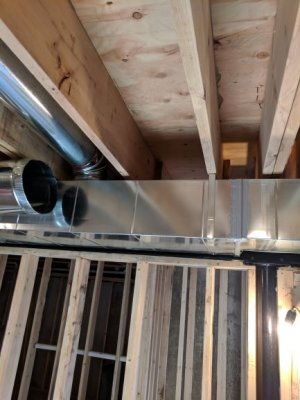
The pipes would all run perpendicular to the joists until the area in question. They would then make a 90 degree turn using a sweep and route up into the joist and over the air conditioning lines and steel support beam.
The other option is to have the pipes run under everything but that makes the ceiling very low in the impacted areas.

mcgyvr
New member
1-What is the purpose of the Tee with the cap at the back of the internal box design?
2- Also, I was wondering if instead of the airline on the open channel, would a hole drilled in the top of the 90 inside the tank work the same?
1-To allow you to open it up and perform routine cleaning/plunging of the pipes if/as needed to remove sponge growth,etc... over the years.. You can use a 90 if you want but you loose that feature..
2-Yes in a perfect world (tip: This ain't a perfect world and never will be) BUT the airline gives you far more flexibility/adjustability so you can pinpoint the exact height in which the open channel converts over to full siphon.. Do the airline..
mcgyvr
New member
Ok so my Question is about gatevalve placement. I'm running a calflo overflow on a 2 ft high tank. The stand is 3 ft high. I would like to put my gatevalve about the bottom of the tank which is about halfway to the sump. I've read about it being ok at the top and bottom but cant find anything about how it works in the middle. The reason I'd like it there is I plan on switching to clear vynil tubing after the gatevalve and if I place it at bottom of tank/top of stand i can secure it very well to the stand. Any input is greatly appreciated.
The location of the valve doesn't seem to matter during normal operation.
It can cause minor differences with startup I believe but put it where you want to put it and don't look back..
mcgyvr
New member
In the BA overflow box esternal the syphon and the other drain are not at the same level.
Does in a C2C internal overflow, it is better to drill hole in the back at différent height ? The full syphon 1'' lower than the 2 others pipe ?
Thanks
All 3 bulkheads can be at the same height and thats how it was originally setup.. Some felt that the system worked more consistently when they had the full siphon lower but its not required at all..
If it were me, I would do it without worry. It's not going to impact the flow and I doubt it would increase the chance of a clogging over time. You could put a clean out at the drop if you wanted for extra peace of mind.
Thanks!
393 pages....wow. So I just got my tank and have been doing my leak tests with some dry fit plumbing. Got my BA overflow system installed and running. You'd think after I'd read 392 pages I'd know exactly how to get it working but instead I spent an hour scratching my head trying to work out why it wasn't working....UNTIL I remembered you had to tune the siphon with a valve...et voila!
My question is and I'm sure I read this 100 + pages ago...when the BA system is working as intended, the only sounds you should hear is water trickling down the non-siphon channel. Is that correct?
Also, I'm getting a few micro bubbles from the siphon into the sump...I'm guessing that's because somewhere I have an air leak in the plumbing along the line?
Thanks all...awesome and epic thread!
My question is and I'm sure I read this 100 + pages ago...when the BA system is working as intended, the only sounds you should hear is water trickling down the non-siphon channel. Is that correct?
Also, I'm getting a few micro bubbles from the siphon into the sump...I'm guessing that's because somewhere I have an air leak in the plumbing along the line?
Thanks all...awesome and epic thread!
Similar threads

- Replies
- 3
- Views
- 288
- Replies
- 2
- Views
- 2K

- Replies
- 4
- Views
- 1K

