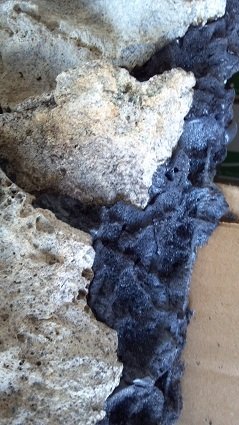
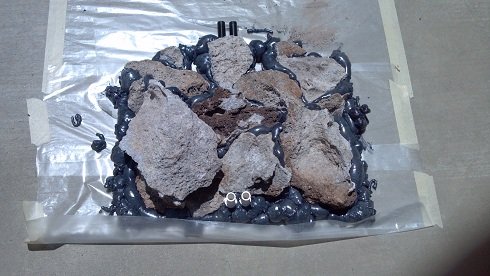
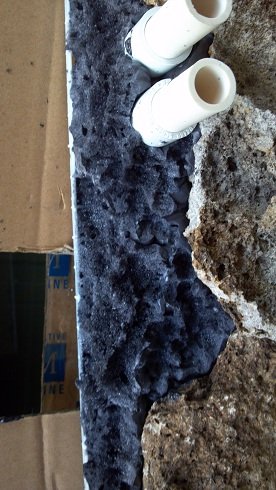
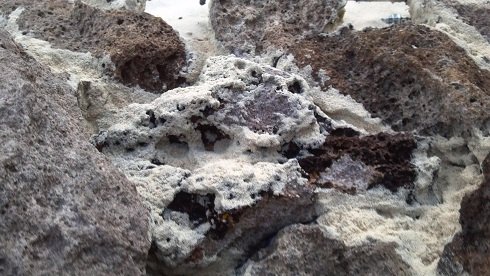
Trying to show photos of my foam after tearing out chunks. Never done this before. Hope you can see the detail compared to the expanded/smooth foam. Rock walls are great in hiding pvc returns or closed loops.

You are using an out of date browser. It may not display this or other websites correctly.
You should upgrade or use an alternative browser.
You should upgrade or use an alternative browser.
The Foam/rock Projects Here Thread
- Thread starter yousmellsfishy
- Start date

Thank you for the inspiration...
Thank you for the inspiration...
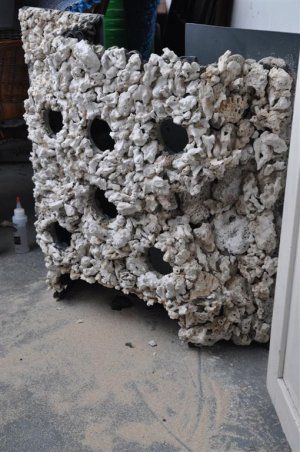
Here is my foam/rock/sand combo for my 130gallon tank...
I used black foam and I noticed that if you left foam out in the sun it became dark grey whit irregular patterns.
So I had mine out for 2 days and the foam is less obvious now, but I allso used some sand.
The holes are for my Tunze pumps and I plan to make covers for the ones that wont be in use.
Thank you for the inspiration...
Here is my foam/rock/sand combo
for my 130gallon tank...I used black foam and I noticed that if you left foam out in the sun it became dark grey whit irregular patterns.
So I had mine out for 2 days and the foam is less obvious now, but I allso used some sand.
The holes are for my Tunze pumps and I plan to make covers for the ones that wont be in use.
Attachments
as anyone tried using the pond foam for obvious reasons (UV protection) and then instead of epoxy just use the PVC cement (the food grade one in a white and gold can I think) to apply the sand. We are already using this stuff in our plumbing with no I'll effects so I don't see why this wouldn't work for this application and just toss the sand on top it.
Any thoughts on this idea or has anyone tried this yet?
Any thoughts on this idea or has anyone tried this yet?

biecacka
Active member
Here is my foam/rock/sand combo
I used black foam and I noticed that if you left foam out in the sun it became dark grey whit irregular patterns.
So I had mine out for 2 days and the foam is less obvious now, but I allso used some sand.
The holes are for my Tunze pumps and I plan to make covers for the ones that wont be in use.
Good idea here, but a heads up because I did it too. I ran the cords to my Tunze behind my foam wall and now I can't move them as stuff grows out not can I remove the pumps to clean them or anything.
My foam wall is getting coralline growing on it finally!

Corey
Hey biecacka, how long did the coraline take to get started on the foam areas?
I guess I can assume no one has tried PVC cement instead of epoxy? Does anyone know are all hobby shop 2 part epoxy good to use, or I have heard of a product called z poxy finishing resin, does anyone have expierence with this? Or has anyone tried just 100% silicone to put the sand on? 100% silicone is reef safe right?
Sorry for all the questions just don't want to take a uninformed risk.
I guess I can assume no one has tried PVC cement instead of epoxy? Does anyone know are all hobby shop 2 part epoxy good to use, or I have heard of a product called z poxy finishing resin, does anyone have expierence with this? Or has anyone tried just 100% silicone to put the sand on? 100% silicone is reef safe right?
Sorry for all the questions just don't want to take a uninformed risk.
I did suspect something like this might become an issue so I planed ahead.Good idea here, but a heads up because I did it too. I ran the cords to my Tunze behind my foam wall and now I can't move them as stuff grows out not can I remove the pumps to clean them or anything.
My foam wall is getting coralline growing on it finally!
Corey
The pumps can be removed thru an opening in the top of the foam-wall, with room to spare.
Here is photo of addition of first coat of sand to the torn up foam between the dry rock. The sand is lighter in color than most of the actual rock. Plan to add a 2nd and 3rd coats of sand to fill in where sand did not adhere.
You might also consider having a additional pump in the sump or a closed loop with an external pump and the return built into the foam rock wall. This way the pump is always accessible. As you can see I have hidden 2 pvc pipes in my wall and could easily had one to return water in the middle of the wall.
You might also consider having a additional pump in the sump or a closed loop with an external pump and the return built into the foam rock wall. This way the pump is always accessible. As you can see I have hidden 2 pvc pipes in my wall and could easily had one to return water in the middle of the wall.
Attachments
it took a few months, it just showed up one day on there and it is slowly filling it in. its not covered yet but its looking better.
what do you want to use the epoxy or PVC cement for?
corey
I was thinking due to the high cost of the epoxy and nobody knowing which one is "100%" reef safe over time, that you could use PVC cement or GE 100% silicone I door/window which have both been proven to be reef safe and a ton cheaper than epoxy.
What products have been used to apply the sand to the foam successfully with no Ill effects?


AquaticEngineer
New member
I"m wondering of those who have built their wall with the black Pond Foam, will it stand up without the epoxy coating in a marine environment?
Yes. I've had mine in a 200 gallon for over a year and its doing fine.
How much of a time window is there to pack in the salt before the foam becomes too hard? I am tring to figure out the best way to build up a wall for a 7 foot tank :worried:
A few minutes usually. Depends on how thick you spray the foam. I like to do mine in sections. The last one I did I used a dry erase marker on the acrylic to outline where I wanted the structure since I was doing it directly onto the tank. I then used rock salt as a barrier to prevent foam from creeping out of the areas I wanted it. Some places I would let it expand a bit first then apply it. In areas that I wanted the "rock" to be thicker I would just let it expand completely without any rock salt and then come back after it set completely and do another layer of foam on top of it just to adhere the rock salt and give it texture.
I've also tried making several small pieces on eggcrate ahead of time and texturing both sides, then adhering them all together in the tank and texturing the foam used to adhere them together.
Also did a giant structure for a local stores coldwater display out of just spray foam with a huge cave inside the front of it. (Eventually for a juvenile Wolf Eel if I can convince them) I prefabbed the structure with egg crate and then disassembled it and textured each piece. Then zip tied it all back together added some counter weight rock, and spray foamed it to the bottom of their tank. This is what they ended up with.


How are people with acrylic tanks adhering this to the back of there tank? I know silicon doesn't work well on acrylic.
I was thinking about placing magnets on the egg-crate and then foaming over them, then use another on the back of the tank and hopefully with the weight of the live rock it would stay in place, this would also make it a lot easier to remove for any reason.
Any thoughts on this?
I was thinking about placing magnets on the egg-crate and then foaming over them, then use another on the back of the tank and hopefully with the weight of the live rock it would stay in place, this would also make it a lot easier to remove for any reason.
Any thoughts on this?
AquaticEngineer
New member
How are people with acrylic tanks adhering this to the back of there tank? I know silicon doesn't work well on acrylic.
I was thinking about placing magnets on the egg-crate and then foaming over them, then use another on the back of the tank and hopefully with the weight of the live rock it would stay in place, this would also make it a lot easier to remove for any reason.
Any thoughts on this?
I sprayed mine right onto the acrylic. Not going anywhere


AE:
Those rocks are really natural looking and your friend is lucky to have you do the work.
I have done DIY cement rocks serveral times but if I set up another tank I was thinking of going this method.
So just to recap your method:
1. Outline where you don't want the foam to expand by building a rock salt barrier.
2. Spray on, if thinner rock pack the salt on.
3. If thicker, let it expand, spray another layer on and pack it into the second.
Any other tips?
Is there one brand of foam that you feel works better than another?
Those rocks are really natural looking and your friend is lucky to have you do the work.
I have done DIY cement rocks serveral times but if I set up another tank I was thinking of going this method.
So just to recap your method:
1. Outline where you don't want the foam to expand by building a rock salt barrier.
2. Spray on, if thinner rock pack the salt on.
3. If thicker, let it expand, spray another layer on and pack it into the second.
Any other tips?
Is there one brand of foam that you feel works better than another?
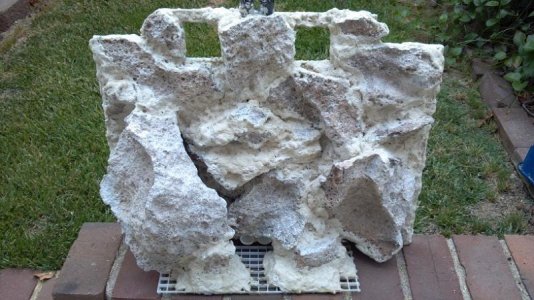
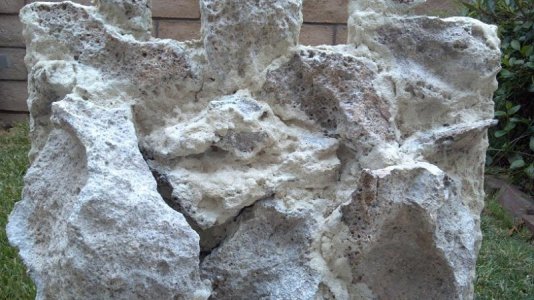
For comparison and an alternative, here is my finished foam rock wall. As you can see in my initial photos, I used more rock and less foam. One advantage is that it won't float. Second, unless you are very creative/artistic like AE above, the dry rock is real and looks real.
Question for AE, do you leave the foam rock black to be covered in Coralline algae or do you cover it with sand?
Question for AE, do you leave the foam rock black to be covered in Coralline algae or do you cover it with sand?
Attachments
atlantiscoral
New member
For all the Foam Rock wall people - here are some after thoughts after building my 230G reef using this technique and having to tear it down completely after 4 years of running.
1. Coraline coverage and general life on the wall was simply amazing - The quality of coverage was unbelievable after 4 years.
2. Did I notice a improvement in the nitrogen cycle due to the vast surface area in comparison to my other systems? ABSOLUTELY! Water quality, and the buffering stability was phenomenal compared to past systems. I had SPS growing out of control, and PE was supurb.
3. The overall visual affect was astonishing...
Now for the bad?!?!
After tearing the wall out of the tank I noticed that the foam had super absorbed the water and after the tank was drained, we couldn't lift it with 4 REALLY BIG GUYS because the foam had water trapped inside of it. The tank weighed about 250 lbs without the wall; with the wall dry, it was around 350lbs and was easily moved back onto the stand after building it. After it was drained? AT LEAST 700 lbs or more. Like I said, 4 guys couldn't move the thing once it was drained; hence the reason we had to tear out the wall (which wasn't very fun BTW, all that silicone I used to affix it to the back really keep it in place).
So my question naturally; How much does this really affect the reef environment in the tank over a period of time?
The tank eventually crashed because of a non-stoppable cyano bacteria growth, on top of a culurpa prolifera invasion, it simply became time to shut it down and start over.
I did battle PO4 issues non-stop... Eventually I was using a 3.5lbs of the highest grade GFO money could buy every 3 months- not a very cheap expense I might add... Not to mention how much of a PITA changing the media is, even with a good reactor like a GEO, it is still a serious chore to change the media on a monthly or bi-weekly basis.
The PO4 problem source could have been a direct result of the base rock I choose to build the wall with. I am actually going to send some of the base-rock samples to a lab and have them analyzed (samples before used, and after torn down being in the environment for 4 years) so hopefully I will have more info on that soon...
Still trying to decide how to approach the new tank... Van Lines just delivered it last week, a brand new 280 Gallon Acrylic which was custom built by a shop in Dublin, OH..
1. Coraline coverage and general life on the wall was simply amazing - The quality of coverage was unbelievable after 4 years.
2. Did I notice a improvement in the nitrogen cycle due to the vast surface area in comparison to my other systems? ABSOLUTELY! Water quality, and the buffering stability was phenomenal compared to past systems. I had SPS growing out of control, and PE was supurb.
3. The overall visual affect was astonishing...
Now for the bad?!?!
After tearing the wall out of the tank I noticed that the foam had super absorbed the water and after the tank was drained, we couldn't lift it with 4 REALLY BIG GUYS because the foam had water trapped inside of it. The tank weighed about 250 lbs without the wall; with the wall dry, it was around 350lbs and was easily moved back onto the stand after building it. After it was drained? AT LEAST 700 lbs or more. Like I said, 4 guys couldn't move the thing once it was drained; hence the reason we had to tear out the wall (which wasn't very fun BTW, all that silicone I used to affix it to the back really keep it in place).
So my question naturally; How much does this really affect the reef environment in the tank over a period of time?
The tank eventually crashed because of a non-stoppable cyano bacteria growth, on top of a culurpa prolifera invasion, it simply became time to shut it down and start over.
I did battle PO4 issues non-stop... Eventually I was using a 3.5lbs of the highest grade GFO money could buy every 3 months- not a very cheap expense I might add... Not to mention how much of a PITA changing the media is, even with a good reactor like a GEO, it is still a serious chore to change the media on a monthly or bi-weekly basis.
The PO4 problem source could have been a direct result of the base rock I choose to build the wall with. I am actually going to send some of the base-rock samples to a lab and have them analyzed (samples before used, and after torn down being in the environment for 4 years) so hopefully I will have more info on that soon...
Still trying to decide how to approach the new tank... Van Lines just delivered it last week, a brand new 280 Gallon Acrylic which was custom built by a shop in Dublin, OH..
atlantiscoral
New member
The baserock was some that I found online, it was rather orangish in color. It covered well with coraline at least.
I used the black UV resistant pond foam.
I used the black UV resistant pond foam.
Thanks for this interesting point.
Would applying a few coats of epoxy to the foam seal it and keep the foam from absorbing the tank water? I would expect the water in the foam would not get any oxygen. Would this cause the foam/water to become toxic? Anyone had any experience with the superabsorbed foam/water?
Wondering if I should apply 3rd and 4th coats of epoxy to the foam. Fortunately, I have more rock than foam.
Would applying a few coats of epoxy to the foam seal it and keep the foam from absorbing the tank water? I would expect the water in the foam would not get any oxygen. Would this cause the foam/water to become toxic? Anyone had any experience with the superabsorbed foam/water?
Wondering if I should apply 3rd and 4th coats of epoxy to the foam. Fortunately, I have more rock than foam.
Similar threads
- Replies
- 15
- Views
- 1K


- Replies
- 592
- Views
- 172K

- Replies
- 404
- Views
- 46K