Randy did in
Post #474 he also provided us with the amount of P released by fish in the solid form. is this wrong? organic material does not just spontaneously decompose. all i am saying is that in order for there to be a lowering of total P in a system, then all of the P released by an organism, must be removed before that organisms produces more waste material which contains P.
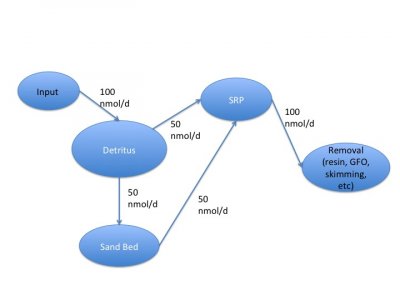
It does not spontaneously decompose, no, but my point is that in a healthy, fully functioning tank at maturity, there is a mass balance such that even if it takes time to decompose, the NET results are independent. Take the example I have in the picture (I made the numbers up for simplicity, but the 50 nmol/d moving from the detritus to the SRP is based on the article Randy linked). Based on a system at steady state, assuming again that sufficient SRP removal is in place so that removal is limited by SRP present (ie. there is excess removal potential), the system is balanced because what is going into each pool is balanced by what is leaving. It does not matter if the matter leaving e.g. the sand bed has been there for five days or twenty, because the fresh input is balanced by removal of old material, and the whole system is balanced in terms of input and output. I think the disconnect here is looking at one organism when I'm looking at the whole community.
Now of course, the system is not strictly speaking at steady state, because our organisms - especially corals - are growing, and so there might be a ~10% or so arrow leading from SRP to corals. You could also add some algae growth and removal via herbivores, which would be another set of bubbles, but again, by definition at steady state, all of these are balanced because what matters is input/output rates, not residence time (how long a particular particle stays in a single pool). Of course, this only applies to mature systems where steady state is a reasonable approximation.
it is still in the system and still able to be utilized. a total increase in P of the system. those same organisms that lead to a faster processing of P are adding more P to the system also. it just doesn't disappear.
Again, this assumes that the population is growing. In my systems, once established, I don't usually see marked growth of the benthic community, because their carrying capacity is usually reached within the first year. If anything, I see a small decline over the next year or so after that as the large stored pools from my uncooked rock are removed.
corals are your must have organisms. yes, they are sequestering P. that P is in a form that makes sense to the system you are keeping. i am saying that all of the benthic organisms in the system are not helping to keep the total P of the system stable. they are increasing the total P of the entire system. every organisms is going to contain P, but it is also going to need P.
Again, at steady state, the pool size does not matter, the input/output rates do. The benthic organisms are only leading to an increase in total system P if that population is growing rather than at steady state. In my experience and in nature, most of the benthos is at steady state because these organisms have a rapid turnover and thus reach equilibrium much more quickly. They also increase the rate of detrital removal. Looking at my picture again, without the benthic infauna, the arrow leading from the sediment could be much smaller than the arrow leading in, in which case there's a very serious problem on your hands, and again one of the things I think leads to crashes.
it is bad in a system that is of a finite size. a container can only handle a certain sized population of any organism. it can only contain enough resources for a certain maximum population. i am pretty sure the ecology knows this.
What this ignores is carrying capacity. You are probably right that these things are spatially limited, but once they reach carrying capacity, the population stabilizes, which is not a bad thing.
how can this be true? this can only be true if all of feces/dead decomposes spontaneously once it leaves the organisms. this can not be true because then the benthic organisms would not have anything to eat. as long as there is P being released through the decomposition of feces/dead while more P is being produced by organisms dying and pooing, then there is going to be an increase in waste organic material if more food is going into the system. the only way this is not going to be true is if the system is 100% efficient and no food is entering the system.
Again, see the mass balance picture. Decomposition does not need to be spontaneous because residence time is not important compared to instantaneous rates.
i get what you were trying to get at, but again you are missing the rate of decomposition of the dead/feces. it will not be balanced if there is an increase in population of the waste organic material feeding organisms. they are showing that there is not a balance.
By strict definition our systems are not balanced, due at the very least to coral growth, so in many ways this point is somewhat academic and not entirely practical. Again, once the community reaches steady state, however, there is a balance, because there is not an increase in population.
the ones listed are all going after the iP that is in the water column. they all must wait for the oP to become iP before they can do their job. i am just suggesting that we should siphon out the waste organic material before it has a chance to decompose. moving the processes closer to the spontaneous decomposition scale. removing the waste organic material when it is in the 37% state or less depending on its rate of decomposition. trying to get this oP out to keep the amount of decomposition down.
This is true, but again it's not the only way to keep SRP down. And it's worth noting that times of highest oP production via fish waste coincides with the fastest rates of associated corals (via the paper Randy linked). You can get exactly the same results as far as SRP with a sand bed WITH fauna (a sand bed without, now that's a different story...)
no, it is showing that resources are not unlimited for all of the organisms in the system. trading O2 for CO2. i for one would rather have more O2 in the system, then CO2.
Carbon is essentially the global limiting element. I was simply explaining the exact effects one would expect if one added too much DOC, and it is indeed a bad thing. But to a limited extent, dosing more is a good thing because it does increase rates of nitrogen removal.
the corals are not growing, and the benthic organisms are not growing. a 100% recycled system with respect to P. again, this is only going to occur if there is spontaneous decomposition of feces/dead where the organisms are not dying/producing more feces by the time the previous feces/dead have decomposed.
Once again, residence time does not matter in a steady-state or near steady-state system.
as long as the food chain is not causing a change in amount of iP available in the water column. for those running system that require very low soluble iNutrients, then yes, the food chain will be detrimental to the health of the system because they are part of the production of iNutrients back into the water column. if one is keeping a system that requires soluble iNutrients, then you are absolutely right and they are not going to harm the system, and in fact will help the system maintain the correct levels of soluble iNutrients.
Couple things. First, corals do require SRP (and SRN, SRC, etc), so we can't really delineate between a system that needs it and a system that doesn't. All life needs it. What you are referring to is more the threshhold SRP (~1 ppm SRP) that determines algal vs coral dominance. And the very point of removal methods is to keep that pool down. The food chain does not necessarily add to SRP when those removal mechanisms are in place, because they tend to be very fast (because they are abiotic) relative to other biogenic rates. Pool size is independent of residence time at steady state, regardless of whether you have one arrow in and out vs. twenty.
it is not being process as fast as the organism is producing more poo. post #474 told us that. it takes 24 hours for all but 37% of the P to become iP. that leaves 37% more needing to get converted to iP. even if it is a half life, that is days before all of that 37% has been converted to iP. unless that fish does not poo by the time all of the 37% has been converted, there is going to be a total increase in P capable of becoming iP.
Steady state...though again of course this limits us to talking about mature systems. I think we have a disconnect because you're considering more an individual organism's or molecule's fate whereas I'm talking about emergent community properties that are the sum of all the processes going on.
what is limiting their carrying capacity? is it space or nutrients? i propose that it is space.

It depends on the amount of energy/nutrients flowing through the system; in a nutrient poor system, the carrying capacity is determined by nutrient rather than space availability. But regardless of what determines the carrying capacity, once it reaches the capacity, the population will stay there unless the total amount of resource is changed. If it is indeed space, then that's good news for us because then a tank has an intrinsic carrying capacity and we don't need to worry as much about sufficient energy flow to maintain the benthic community. In all honesty, given that most tanks have relatively low energy flow compared to natural benthos, I'd be willing to wager that it is nutrient supply to the sand bed that determines carrying capacity, not space except in small tanks.
or they run out of space. space is resource. we must look at all resources needed by an organism.
Basically what I said above; a system at carrying capacity does not have a net change. If the input and outputs were already balanced when that capacity was reached, they will remain balanced unless the aquarist increases the input rate (feeding). If indeed they are space-limited, which is more likely in nano and pico tanks than in "full size" tanks, that's something that gives inherent instability as one feeds more. Keep in mind that the types of organisms we're talking about, though, have natural densities of hundreds to thousands per square meter in nature.
agree. just match the methodology to the must have organism. don't fight nature, work with it. we need to stop thinking that one setup can work for all organisms.
I'd argue very strongly that sand beds are a great way to work with nature, if one understands what's going on in them and takes steps to ensure the benthic community remains healthy.
back to
Post #479 and
Post #497. living space is a resource. a growing population is a healthy population.
A steady population is also healthy. The only unhealthy population is a declining one.
just match the methodology to the must have organism, or to the aquarist available resources. if one has the money for all of this equipment and material, then yes, go for it, but they are not necessary to the extent that they are promoted in this hobby. the waste organic material eventually needs to come out. you can either remove it in small batches regularly, or you can hide it in a substrate and then remove it later when the resources needed to cover up the affects of the iNutrients being released by the waste organic material decomposing in the substrate become to resource dependent to be viable.
A healthy benthic population is key to keeping the waste organic material levels in the sediment low. With a healthy population, they remineralize organics with a higher than 99% efficiency, so a healthy sand bed does not hide nutrients. The tiny component that is not removed accumulates to significant portions over the course of decades.
yep, absolutely. i have not denied there are many different ways to keep a successful reef tank. it is about matching the resources to the must have organisms and the type of maintenance the aquarist is capable of sustaining.
Time is also a resource. Not everyone has the time to actively remove detritus on a daily basis. I can barely find time just to do weekly water changes, and if I were running without a healthy sand bed my tank would be in very dire straits.
if material is accumulating, it really doesn't matter what it is, it needs to be addressed. it is a sign that a system is gaining mass and can not be sustained. it could be in minutes, hours, years, or decades. no system can increase in mass indefinitely and maintain a stable state.
G~
I can go ahead and say that - unless there is something fundamentally different going on in the home aquarium - this material takes decades to accumulate in most cases to the point of affecting permeability. It is much faster in small tanks, of course, because the volume of sediment is smaller, so a semi-fixed rate of refractory material accumulation leads to a larger percent change.