
You are using an out of date browser. It may not display this or other websites correctly.
You should upgrade or use an alternative browser.
You should upgrade or use an alternative browser.
Dinoflagellates.
- Thread starter DNA
- Start date
Day 4, just over 76 hours since first metro dose.
Everything is the same about the two test beakers except the medicine.
Here is my control beaker (no metro)- brown string developed yesterday and bubbles visible today.

Here is the metro beaker (higher than recommended dose) - no strings or bubbles, but there are dinos in brown clumps on bottom

So there is visible macroscopic difference. However, under the microscope, no obvious cell morphology differences between the two beakers.
Looks to me like you'll see it with your eyes before you see it with the scope.
Control

Metro
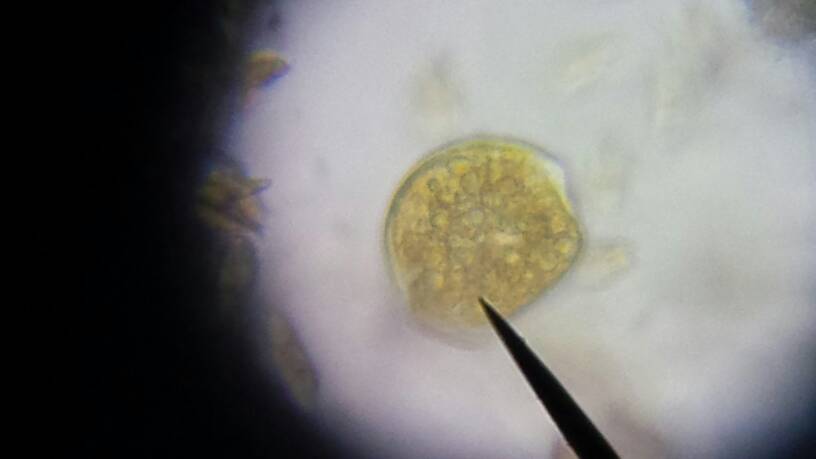
Finally, here's the dinos from my tank wrung out of filter floss into tiny beaker

Under the scope, still evidence of reproduction/splitting

Everything is the same about the two test beakers except the medicine.
Here is my control beaker (no metro)- brown string developed yesterday and bubbles visible today.
Here is the metro beaker (higher than recommended dose) - no strings or bubbles, but there are dinos in brown clumps on bottom
So there is visible macroscopic difference. However, under the microscope, no obvious cell morphology differences between the two beakers.
Looks to me like you'll see it with your eyes before you see it with the scope.
Control
Metro
Finally, here's the dinos from my tank wrung out of filter floss into tiny beaker
Under the scope, still evidence of reproduction/splitting

Kurt03
Active member
8 days in, I'm still seeing osteoporosis strings. Need to put under scope again to confirm.
Tick tock. Playing the waiting game. This tank is empty so I'll do an extended lights out if needed.
My rescue tank so far is doing well and currently the coral look cleaned up so will be moving to display soon.
Tick tock. Playing the waiting game. This tank is empty so I'll do an extended lights out if needed.
My rescue tank so far is doing well and currently the coral look cleaned up so will be moving to display soon.

StrangeDejavu
Member
8 days in, I'm still seeing osteoporosis strings. Need to put under scope again to confirm.
Tick tock. Playing the waiting game. This tank is empty so I'll do an extended lights out if needed.
My rescue tank so far is doing well and currently the coral look cleaned up so will be moving to display soon.
Unfortunately, Twilliard confirmed his Ostreopsis ovata left its cystic state and began multiplying again on week 4. We know Metro leads to the destruction of Ostis currently in the tank, but the question that has to be answered now is: Was this simply an existing cyst coming out as usual, or did Metronidazole force them to encyst? If so, how long should the tank be dosed until you're confident you got them all? And does Metro affect the cyst at higher doses? Those questions haven't been answered yet but will in the future, i'm sure.

jason2459
Well-known member
Run down Update
Prep
Dumped in enough food to cause a massive outbreak of cyano and dinos that would normally last at least 1-2 months
Before Dosing
Day 1 (Night of July 28th)
Day 2 (Night of July 29th)
Day 3 (July 30th)
Day 4 (July 1st)
Day 5 (July 2nd)
Day 6 (July 3rd)
Day 7 (July 4th)
Day 8 (July 5th)
Prep
Dumped in enough food to cause a massive outbreak of cyano and dinos that would normally last at least 1-2 months
Before Dosing
- Turned off Automatic Water Changes
- Took out GAC (would have taken out any GFO too if I had any)
- No ozone (same would apply to UV or dosing H2O2)
- Cut carbon dosing in half
- Tuned down the skimmer but kept it aerating the water
- Kept ATS online
- Kept ATO online
- Kept feeding as normal (a lot)
Day 1 (Night of July 28th)
- 5 grams Metroplex dosed
- (This works out to around 250mg per 10 gallons per day)
Day 2 (Night of July 29th)
- 5 grams Metroplex dosed
Day 3 (July 30th)
- 5 grams (20 pills) Aquazole dosed
- sample under microscope shows active peridinium dinos
Day 4 (July 1st)
- Added filter sock.(100 micron felt. 4" ring by 14" length)
- Blew of all surfaces
- Changed sock
- Brought skimmer back online
- 5 grams Aquazole dosed
Day 5 (July 2nd)
- Changing filter sock 3 times per day
- Blowing off all surfaces in the evening
- Minor grow back of visual dinos
- extremely minor to no growth back of cyano
- 5 grams Aquazole dosed
Day 6 (July 3rd)
- 5 grams Aquazole dosed.
- Very minor growth again.
- Changing out 100 micron felt sock 3x per day still.
- Blowing off all surfaces at night
- Day 6 (night of July 4th)
- Very minor growth again.
- Changing out 100 micron felt sock 3x per day still.
- Blowing off all surfaces at night
- Samples show no recognizable or moving peridinium dinos. A lot more much smaller flagelet phytoplankton of some kind.
- No dosing done
Day 7 (July 4th)
- 5 grams Metroplex dosed
- No blowing off of surfaces done
- Skimmer still online
- Filter sock changed out twice
- Very minor amounts of visual dino growth on rocks
Day 8 (July 5th)
- 5 grams Metroplex dosed
- No blowing off of surfaces done
- Skimmer still online
- Filter sock changed out twice
- Extremly minor amounts of visual dino growth on rocks
- No real change to nitrates or phosphates through out. Possible slight increase in PO4 tonight.
Last edited:

SnowManSnow
Member
keep up the good work on this stuff guys. defeating this scourge will be a HUGE win for the hobby.
Today was day 10 for me. I dosed according to the recommendation for 3 days.
I wring the ostis out from my filter floss hanging in front of my power head into a tiny beaker every day (or two).
Some progress by that metric.

(Day 4 and 8 had two days' growth when wrung out)
I wring the ostis out from my filter floss hanging in front of my power head into a tiny beaker every day (or two).
Some progress by that metric.
(Day 4 and 8 had two days' growth when wrung out)

DNA
New member
Even though day 10 looks promising they have always bounced back from everything else.
I my experiments I'm not trying to get rid of them completely, but reducing them to invisible numbers and keeping them that way.
If we are not figuring out why we are able to keep a bloom going for years I'm pretty sure they will be coming back again soon.
I my experiments I'm not trying to get rid of them completely, but reducing them to invisible numbers and keeping them that way.
If we are not figuring out why we are able to keep a bloom going for years I'm pretty sure they will be coming back again soon.

dustinkimpel
Member
Alright guys update, My dinos are gone. Knock on wood. I'm up to running my lights 6 hours a day and no dinos have returned and my corals a flourishing. Things I've done:
Removed Sand bed kept BB
Removed and soft scrubbed all rock
Dosed H202 for 5 days
Went lights out for 6 days
Added new sump, skimmer and attached Coralife UV sterilizer to return line.
Added 3 new fish
heavy water changes during the lights out period sucking out all visible dino (I know people say wc feed them but it worked for me)
One of the new fish had ich so pulled all fish and put them in hospital tank (maybe the ich had something to do with getting rid of the dino?)
Tank currently just has coral and a cleaner shrimp in it for the next 72 days.
I'll post pics later to show how good my tank is looking, not a dino in sight.
Good luck guys, feel like I've won this battle
For anyone interested this is what worked for me. Haven't had Dino in over a year. If anyone wants pictures of my tank currently running BB just ask and I'll get some.
jason2459
Well-known member
Keep in mind there's a lot of different kinds of dinos. This may not work for all. It may have also just pushed them back from being visible with the naked eye in the tank. 99% of the time my tank is that way but they are still there.For anyone interested this is what worked for me. Haven't had Dino in over a year. If anyone wants pictures of my tank currently running BB just ask and I'll get some.
That said that's awesome you were successful with that treatment and if anyone tries it I hope it works for them as well.

karimwassef
Active member
I'm almost tempted to say that we should stop using the word "Dino" and should instead use "Ostis" or "Amphidinium" or "Zooxanthelle" or even "Oodinium" for velvet disease in fish.
Saying Dinos is like saying "bacteria"
By the way- you can buy dinos for $7.75 from a bio lab... Oops, I mean Amphidinium.
http://www.carolina.com/catalog/det...ppc_products&gclid=CJnF047o5M0CFYOBaQodrK4Ktw
Saying Dinos is like saying "bacteria"
By the way- you can buy dinos for $7.75 from a bio lab... Oops, I mean Amphidinium.
http://www.carolina.com/catalog/det...ppc_products&gclid=CJnF047o5M0CFYOBaQodrK4Ktw
karimwassef
Active member
Hey. Check out section 21.3.3 in this book on fighting "dinos"
https://books.google.com/books?id=-...EIHzAB#v=onepage&q=ost dinoflagellate&f=false
Theme - grow ulva seaweed and the bacteria on it kills dinos...
https://books.google.com/books?id=-...EIHzAB#v=onepage&q=ost dinoflagellate&f=false
Theme - grow ulva seaweed and the bacteria on it kills dinos...
I'm almost tempted to say that we should stop using the word "Dino" and should instead use "Ostis" or "Amphidinium" or "Zooxanthelle" or even "Oodinium" for velvet disease in fish.
Saying Dinos is like saying "bacteria"
Couldn't agree more.
Ostreopsis is basically invulnerable to Peroxide, but amphidinium carterae are done in by around 0.2 ml/liter (according to lit. Haven't tried it)
The most common amphidinium species in our tanks is invulnerable to UV, because it never leaves the sand, but ostreopsis is susceptible because it scatters into water column nightly.
Amphidinium is smaller, unarmoured, less toxic, stays close to rock and sand and is vulnerable to lots of predators. ostreopsis is big, toxic, armored, grows in high-flow strings away from sand and rock so gets eaten by very few predators (mostly just pods). I found some ciliates that would eat ostis, but they didn't grow on it. Bummer :-(
We could all go on, but in terms of most interventions people would try, they just are more different than similar.
The ID down to genera tells you something. "Dinos" tells you very little.
Prorocentrum haven't been played with as much, but they are larger, armored, grow in high flow up on rocks etc, so I'd treat it like ostis until better info shows up.
Symbiodinium / zooxanthellae / similar are small unarmoured, less toxic, and so I'd probably treat them like amphidinium until we know better.
BTW: Did we know that scientific lit has been looking for, but still can't find any evidence of ostreopsis mixotrophy.
Wonder if we could get by just treating it like a photoautotroph.
And that might be the thing they ("dinos") have in common. Light requirements. Which is one reason to be fascinated with the metro treatment. Twilliard says it attacks DNA. And it does in some target organisms. In others it attacks a working photosynthesis system, which is what I think/hope is actually happening.
More on that if it pans out.
karimwassef
Active member
taricha - maybe you should put a matrix table together ... name the dinos on top (left to right), and then the control variables/properties on the left (up down)...
armor
vulnerability to UV
vulnerability to Peroxide
vulnerability to Cilliate predation
Toxicity
benthic vs. night floating
Mixotrophic
.....
then we can add to the table as we learn more
armor
vulnerability to UV
vulnerability to Peroxide
vulnerability to Cilliate predation
Toxicity
benthic vs. night floating
Mixotrophic
.....
then we can add to the table as we learn more
jason2459
Well-known member
Wish we could just call them by name. Most can't see them to identify them and those that can see them is still hard to identify them as many are so very similar and have many variations with in families.I'm almost tempted to say that we should stop using the word "Dino" and should instead use "Ostis" or "Amphidinium" or "Zooxanthelle" or even "Oodinium" for velvet disease in fish.
Saying Dinos is like saying "bacteria"
By the way- you can buy dinos for $7.75 from a bio lab... Oops, I mean Amphidinium.
http://www.carolina.com/catalog/det...ppc_products&gclid=CJnF047o5M0CFYOBaQodrK4Ktw
Like I believe I have Peridinium sp. but what kind I don't know as there's various var. types of Peridinium and its entirely possible its not even peridinium. lol
I wondered about your ID as well. Can't think of anyone else who had them. Pretty unusual to have a weird one like that.those that can see them is still hard to identify them as many are so very similar and have many variations with in families.
Like I believe I have Peridinium sp. but what kind I don't know as there's various var. types of Peridinium and its entirely possible its not even peridinium. lol
I've looked a little bit at your pics and vids, I don't have a better ID.
I wonder if there is something cheap that could be used to stain the cellulose theca to help ID.
karimwassef
Active member
someone should set up a webservice where you send sample of your water and they ID the critters in them.
I think there's a gel that you can add to water that harders into a clear plastic and quickly traps everything like "on glass". Then the service can slice the plastic disc and take images and ID the bugs.
I think there's a gel that you can add to water that harders into a clear plastic and quickly traps everything like "on glass". Then the service can slice the plastic disc and take images and ID the bugs.
Yep. I could do something like that. At least start it as a shared document that can be expanded on.taricha - maybe you should put a matrix table together ... name the dinos on top (left to right), and then the control variables/properties on the left (up down)...
armor
vulnerability to UV
vulnerability to Peroxide
vulnerability to Cilliate predation
Toxicity
benthic vs. night floating
Mixotrophic
.....
then we can add to the table as we learn more
I'll go back and re-read the "stupid dinos" document that was started by ivy and see if there's a way the two can be set up to complement each other.
Similar threads

- Replies
- 65
- Views
- 733


