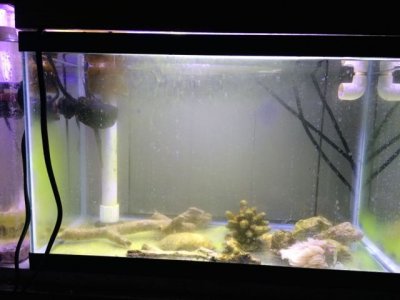
Dinoflagellates.

I wanted to share my current plan for Dinos and how it has been going. I am currently lights out, cover the tank, 10ml of H202 once daily, and only feeding at night in a pitch black room with my blues on for about an hour. I have seen a massive decline in Dinos. Today is day 4.

I also took an infected rock with Dino on it and moved it to me other tank to test the theory of competing algae. This tank has some cyano, diatomes, and green algae all over it. I noticed within 1 day the Dinos spread to a few spots where there wasn't any competing algae. Day 4 into test and the Dinos have stayed secluded to these specific spots. On a powerhead and a few spot on an existing rock. I will continue to monitor and see if it gets out competed. I am not dosing anything in this tank. It is being ran as a normal tank with 6 hours of white and blues and 9 hours of blues.
 
I to am in the midst of a battle with ostreopsis, about six weeks now, I to am convinced that water changes feed it, I have 0 po4 and 0 no3 and lately have noticed very little if any micro algae on the glass just dinos. I have been feeding every other day thinking it's nutrients but now I think the opposite so have started feeding everyday again, I was blowing the rocks and siphoning 20 gallons every other day only to watch it get worse, so how to aggressively siphon the sand bed without doing water changes I asked. So I got a 100 micron sock and siphoned through it only to watch most of it pass through, I tried a 10 micron sock and it looked good till I put a sample of the filtered water under the microscope and saw tons of the buggers, then I tried pumping the siphoned water through a 5 micron sediment filter in a BRS reactor with a maxijet 1200 and BAM, no little buggers got through. So now I am aggressively blowing the rocks and siphoning the sand everyday without changing the water and I am finally seeing results, I have also installed a 5 micron filter in place of my GFO to catch some of the free swimming buggers, I've taken my po4 binder and my sulphur denitrator offline to raise those levels a bit because I now believe the dinos out compete the micro algae in very low nutrient conditions.
 
photos I that did not post properly before
The mess
CoralQtank.jpg

the buggers scale bar 22.5 um
Eudorina.jpg
 
cal stir

Ostreopsis Ovata has a dorsoventral diameter of ~50µm and transdiameter of ~30µm so It can pass through a 100µm sock.
 
I have some 10um socks as well which it got through but who can vouch for the quality of a 10um sock, definitely not getting through the 5um sediment filter.
 
PhQUOTE=LelandF.;23061166]I also turned off my protein skimmer, and haven't turned it back on. After reading Randy's post about his pH climbing when he turned his skimmer off, I decided to unplug mine to hopefully keep the pH higher to help irradicate my dinoflagellates. It's been off for over 2 months now, and things have never looked better. I export nutrients with water changes, gfo, carbon, and by harvesting algae from my refugium. I also decided to keep the 25watt AquaUV sterilizer on the tank permanently.

Leland[/QUOTE]
Are you sure you have this right Leland?
Your protein skimmer removes some carbon dioxide producing organisms and aerates the water. A decrease in carbon dioxide will raise the pH
 
When photosynthesis is occurring, the skimmer might act to bring carbon dioxide back into the water. So cutting back on aeration can raise the pH.
 
I have some 10um socks as well which it got through but who can vouch for the quality of a 10um sock, definitely not getting through the 5um sediment filter.

Sounds like the sediment filter is working for you. I used a Magnum 350 canister filter with the micron cartridge and diatom powder to reduce dino populations periodically without doing water changes. Running it a couple hours a day twice a week helps a lot. Using the diatom powder makes the micron cartridge very easy to clean off and re-use.
 
Sounds like the sediment filter is working for you. I used a Magnum 350 canister filter with the micron cartridge and diatom powder to reduce dino populations periodically without doing water changes. Running it a couple hours a day twice a week helps a lot. Using the diatom powder makes the micron cartridge very easy to clean off and re-use.

I use the magnum also but just with their water polishing filter( 10 microns)

How do you run the diatom powder with that?
 
After getting the filter going, I place the input and output from the filter into about a quart sized plastic container filled with tank water. I usually start this submerged in the tank and then raise the container a couple inches above the water line in the tank. I then add about 1/2 to 2/3 cup of Vortex diatom powder into the container. After a couple minutes the water in the container is crystal clear as the diatom powder coats the micron filter. Submerge the container again and carefully remove the input and output lines. The filter runs the whole time during this process. I then go about blowing debris off the rocks and have even attached a gravel vac to the input line to clean dinos from the sand bed. You just have to be careful with the flow and crimp it as needed to keep from sucking sand into the filter. You never want to completely stop the flow into the filter or the powder will fall off the cartridge and create a mess.
 
Another update.

I still have lot's of dinos, but the odd thing is that for months they have not produced any strings or gas bubbles.
Most of my sand is covered and some of the half lit spots on my rocks as well.
I took a closer look last week and they are the same as before and the change in behavior is a mistery.

My corals are doing much better now, with most thriving, one has died and two are struggling.
The symptoms are usually the same, first a really slow growth is noticed, tissue is lost on the side facing the light while it lingers on the dark side for a long time.
Of course it could be something else, but with such a potent enemy in the tank one has to look there first for explanation.
Slow or no growth and tissue necrosis is something I've seen plenty of for the last few years. I do think dinos are playing a part there.

There is another Cyano phase going on now with the cyano sitting on top of the dinos. A pleasant sight indeed.
Last time it ended with most of the dinos gone and I'm hoping for something similar this round as well.
 
Another update.

I still have lot's of dinos, but the odd thing is that for months they have not produced any strings or gas bubbles.
Most of my sand is covered and some of the half lit spots on my rocks as well.
I took a closer look last week and they are the same as before and the change in behavior is a mistery.

My corals are doing much better now, with most thriving, one has died and two are struggling.
The symptoms are usually the same, first a really slow growth is noticed, tissue is lost on the side facing the light while it lingers on the dark side for a long time.
Of course it could be something else, but with such a potent enemy in the tank one has to look there first for explanation.
Slow or no growth and tissue necrosis is something I've seen plenty of for the last few years. I do think dinos are playing a part there.

There is another Cyano phase going on now with the cyano sitting on top of the dinos. A pleasant sight indeed.
Last time it ended with most of the dinos gone and I'm hoping for something similar this round as well.

Have you tried ethromyacin?
 
update

update

I took my 10 gallon Q tank that looked like (posted above) that was infected with "dinoflagelletes" actually Eudorina based on microscopy.

Only thing in the 10 g tank with a 10 g sump was some pieces of live rock and two small corals. I scrubbed everything I could and cleaned off the walls, and replaced 5 or 6 gallons of water doing that.
Then I added ~ 1 cup of algae- liquid that I had scrapped off of the sidewall of another one of my tanks. ~ 20 x 20 inches of algae junk collected on a razor blade cleaning the glass of my tanks.
I dumped that into the freshly cleaned tank,
I then (~ 10 of 14 days) added 1.5 ml 3 % h202 to the tank in the morning each day (that I did it).
The green algae has taken hold and the eudorina does not seem to be coming back as of yet.
In the three times I did complete changes before I never got growth of green algae (never added a bolus of green algae either)

(still looks pitiful, but much better)

Not sure what did it, H2O2 or the algae, but I think (hope) I am on the right track

ps I have a 20 gallon fish Q tank right next to it with a growing eudorina problem. I did not clean that one but have been adding 2.0 ml of h202 (3%) each day I have been dosing the 10 g and so far, the h202 had done nothing for the other tank.
 

Attachments

  • IMG_0455.jpg
    IMG_0455.jpg
    43.1 KB · Views: 20
Last edited:
Jedimasterben.

That's a good video and a decent microscope.
I'm a bit angry how reefers prefer to practice voodoo in the dark rather than to identify their dinos and contribute to the hobby.
Could you please post some info on that so other reefers can follow in your footsteps.
 
Last edited:
Jedimasterben.

That's a good video and a decent microscope.
I'm a bit angry how reefers prefer to practice voodoo in the dark rather than to identify their dinos and contribute to the hobby.
Could you please post some info on that so other reefers can follow in your footsteps.
Not sure what you mean by follow in my footsteps? You mean just using the microscope or?
 
Back
Top