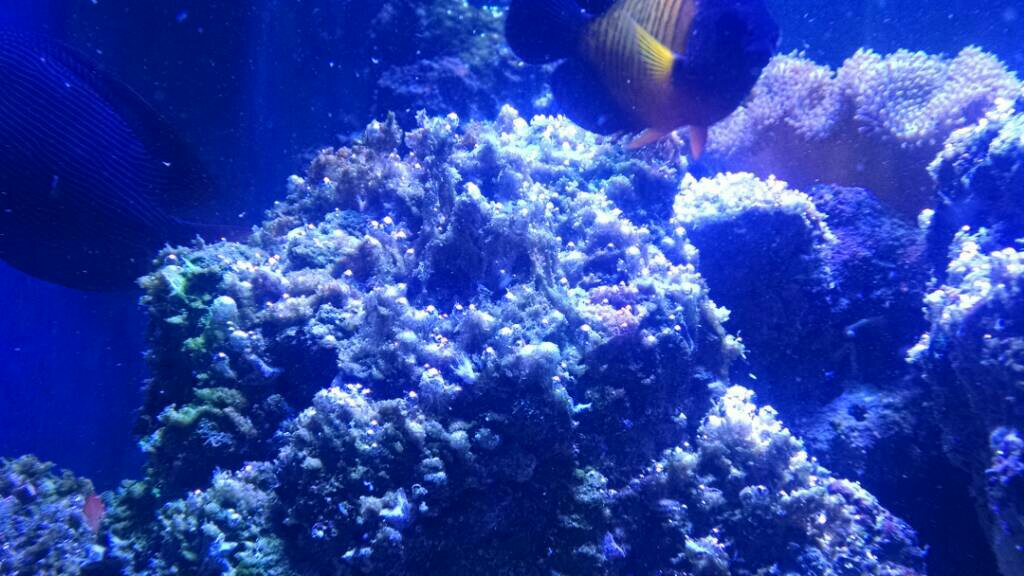
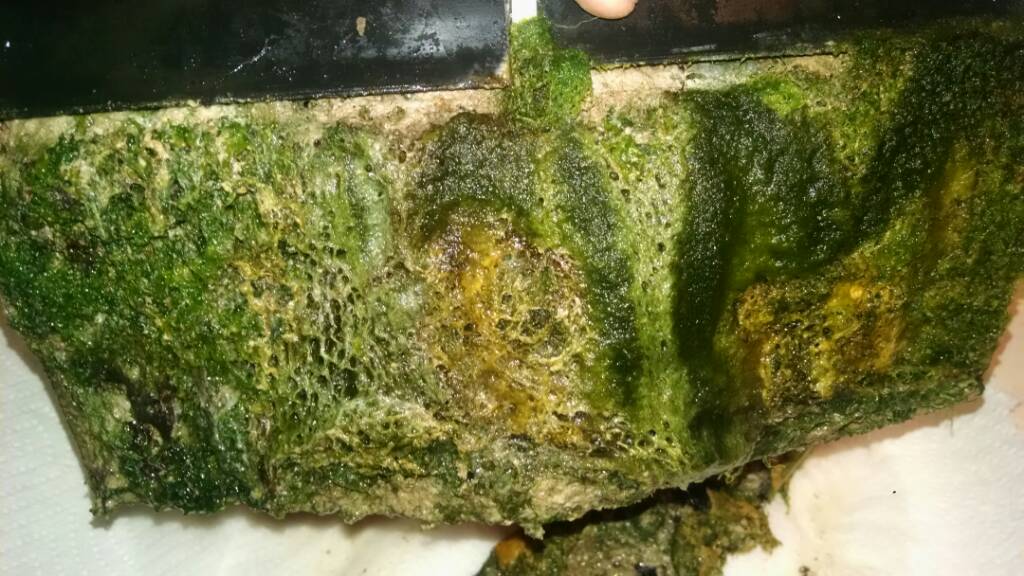
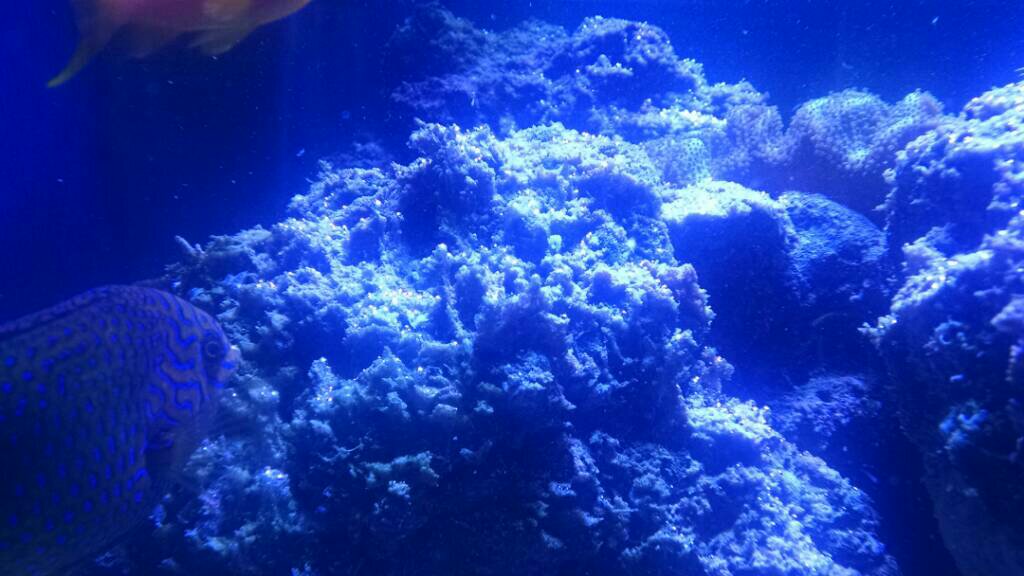
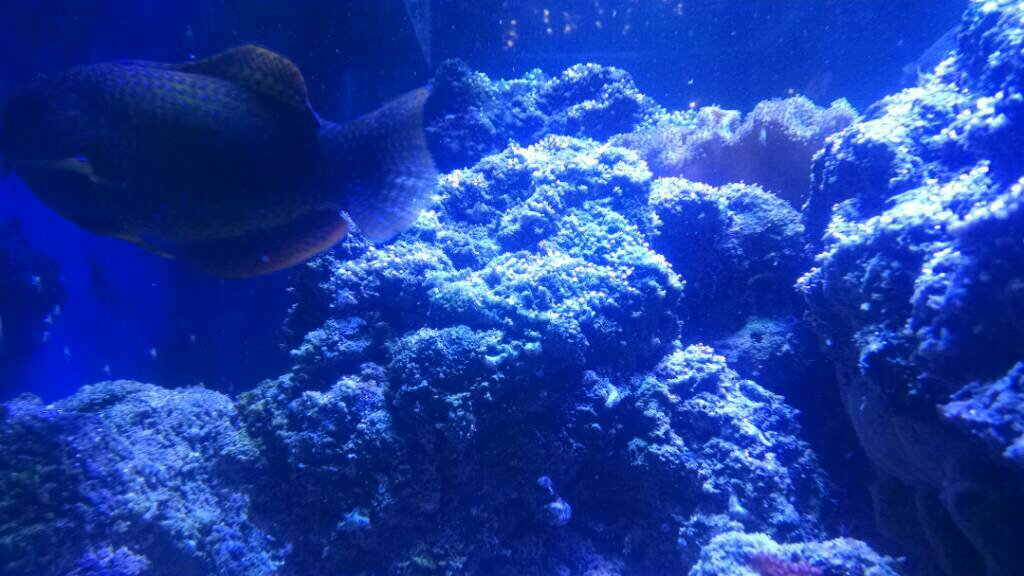
Dinoflagellates.

So while I've not read all 103 pages (at least not that I can remember), I'm not sure I see a need to invoke a lot of special bacteria issues to explain most of the things folks see with dinos.

I certainly don't claim to be any sort of expert on dinos, and they truly are among the worst possible pests we get.

But that said, I'm not sure that all of the successful treatments (or nontreatments) don't simply work because they take away something important to the particular species of dinos that you have.

People should remember that dinos, like algae and most photosynthetic pests need ALL of a source of N, P, Fe, many other trace metals, light, space to grow on, etc.

Take away any ONE of them and the dinos will be gone.

The trick is to find which of those is easiest to reduce while still permitting an adequate amount for other tank inhabitants (since they too need ALL of these).

Keeping a dirty tank and finding the dinos decline may simply mean high levels of bacteria that are present are out competing the dinos for some trace element.

Water changes bring back that trace element.

Keeping a super clean tank may be able to outcompete some dino species for N or P.

Lights out obviously takes away light.

Organic carbon dosing may drive some dinos if they are a species that can take up the organic you are dosing, BUT it does not always happen, obviously. In fact, driving bacterial growth (especially without water changes) can quickly use up trace elements and possibly even help reduce dinos. As noted, lots of folks have been organic carbon dosing for years without any dinos (myself included).

So what I'm wondering is if there are any methods that drive out dinos that CANNOT be explained by a reduction in some unknown trace metal(s) (or direct killing, such as a UV, or possibly hydrogen peroxide, which could be a trace element modifier too). :)
 
Last edited:
That doesn't look like Dinoflagellates to me. Having recently been plagued and (so far) having dealt with them, however I am not an expert and there are many species.

This is what mine looked like (a small sample of what was in the tank):
0C49A3AC-8E8C-466E-B6B7-3011BC63F1D4_zpsafcemolk.jpg


After speaking with some very helpful (and much more experienced reefers than me), I decided to employ a multi-pronged strategy to defeat them (this was performed in a relatively new tank, with only a few SPS frags) This consisted of the following:

1: Remove:
- Siphon to *waste* all the dinoflagellate mass I could with as little as possible water change (replacement water used TMC Pro Reef synthetic salt to ensure no organics) Do NOT try to pass through a filter sock or floss, they will pass through and re-form.

2: Create a hostile environment:

- 8 Day Total blackout (sump and tank wrapped in black plastic) followed by Blue-only lighting for 5 days before introducing whites gradually

- Maintain very low phosphate and Nitrate (Double Rowa amount, changing every 3/4 days)

- Double carbon media, replacing every 4 days

- Raise pH using Air stone to maintain 8.2+

- Wet Skim and clean it constantly - you need the skimmer at peak efficiency to remove dinos in the water column

3: Outcompete:
Create nutrient competition with good profile of microfauna/flora (Initial 10 x dose of FM Ultra-Bio, followed by daily top-ups of normal dose with UltraBak

Remember: Siphon Dead/Dying Dinoflaggelates to waste!
The reason for removal of as much of the dinoflagellate mass as possible prior to blackout and during is two fold: Firstly, they will break down and provide more free nutrients (you are trying to reduce this). Secondly, even if they are not toxic when growing in the tank (as mine were not), they can release toxins when dying off. I ost two conches who started to feed on an area of dying dinoflagellates on the sand.

The good news is that 6 weeks later, and they have not returned and the tank is (as far as I can tell) free of them.

A word on this approach, however - it is not for the faint hearted. Fortunately for me, I did not have a big stock of SPS. (Hammerheads, Acan, soft corals and LPS were fine).

However in my case, it did trigger a massive issue with the fish stock. As they were in the dark, they retreated to the rock and did not feed. This lowered their immune system and allowed a protozoan infection (probably Crytpocaryon) to take hold (I believe this came into the system on some macroalgae from another reefer previously).

So this method is certainly effective, and much more so than miracle in a bottle chemicals, however some care needs to be taken.
 
Last edited:
But that said, I'm not sure that all of the successful treatments (or nontreatments) don't simply work because they take away something important to the particular species of dinos that you have.

People should remember that dinos, like algae and most photosynthetic pests need ALL of a source of N, P, Fe, many other trace metals, light, space to grow on, etc.

Take away any ONE of them and the dinos will be gone.

Keeping a dirty tank and finding the dinos decline may simply mean high levels of bacteria that are present are out competing the dinos for some trace element. Water changes bring back that trace element.

Keeping a super clean tank may be able to outcompete some dino species for N or P. Lights out obviously takes away light.

So what I'm wondering is if there are any methods that drive out dinos that CANNOT be explained by a reduction in some unknown trace metal(s) (or direct killing, such as a UV, or possibly hydrogen peroxide, which could be a trace element modifier too). :)

One of the most frustrating things about dinos is the lack of an obvious cause. We have a list of 'risk factors' that are quite consistent among sufferers, but really there is no obvious difference in husbandry between dino-infested and dino-free tanks we can point to and say 'that's why dinos took over your tank'. As you mention, many people have ULNS tanks with all dry rock, carbon dose, skim heavily and use chemical media without having dinos get out of control.

Dinos are (in my opinion) much more like a multicellular pest organism than an algae. They are mixotrophic so reducing nutrients and light is not terribly effective. Many of us have genuinely undetectable N and P, have not done water changes in months, and do multiple blackouts without permanently killing off dinos. They can form cysts which can persist in the sandbed for years. I believe this is why nobody has had success using a single method of combating dinos, and "ecosystem" methods tend to work. (Possibly excepting DinoX but there have been several failures even with that). I sure wish 'taking away any ONE of them' worked, but this thread is really a testament that it doesn't.

As for methods which don't depend on trace element depletion or direct kill- I think the dirty method should count. We may be changing bacterial communities, growing allelopathic algae, increasing populations of microscopic/macro dino-predators, encouraging coral-mediated control of DOC/DIC and/or increasing direct competetion for nutrients. I'd love to know more about what exactly is going on.

Dosing phytoplankton and adding copepods are also effective for people using both dirty and clean methods. Phyto especially. Your article on raising pH certainly qualifies.:)

ivy
 
Can anyone ID this?

With naked eye it looks like spider web attached to SPS.

I am very confident that that is not dinos! Oh, wait you knew that?

Hum! Does it move under the microscope? Looks a bit like branching cyano eg Scytonema spp. You might allso check out Cladophora (green algae).

hth
ivy (Microscope id is fun, wish I'd taken more microbio)
 
So while I've not read all 103 pages (at least not that I can remember), I'm not sure I see a need to invoke a lot of special bacteria issues to explain most of the things folks see with dinos.

I certainly don't claim to be any sort of expert on dinos, and they truly are among the worst possible pests we get.

But that said, I'm not sure that all of the successful treatments (or nontreatments) don't simply work because they take away something important to the particular species of dinos that you have.

People should remember that dinos, like algae and most photosynthetic pests need ALL of a source of N, P, Fe, many other trace metals, light, space to grow on, etc.

Take away any ONE of them and the dinos will be gone.

The trick is to find which of those is easiest to reduce while still permitting an adequate amount for other tank inhabitants (since they too need ALL of these).

Keeping a dirty tank and finding the dinos decline may simply mean high levels of bacteria that are present are out competing the dinos for some trace element.

Water changes bring back that trace element.

Keeping a super clean tank may be able to outcompete some dino species for N or P.

Lights out obviously takes away light.

Organic carbon dosing may drive some dinos if they are a species that can take up the organic you are dosing, BUT it does not always happen, obviously. In fact, driving bacterial growth (especially without water changes) can quickly use up trace elements and possibly even help reduce dinos. As noted, lots of folks have been organic carbon dosing for years without any dinos (myself included).

So what I'm wondering is if there are any methods that drive out dinos that CANNOT be explained by a reduction in some unknown trace metal(s) (or direct killing, such as a UV, or possibly hydrogen peroxide, which could be a trace element modifier too). :)

RANDY!!! Where have you been? We miss you. :)

Dinos are more like a disease than algae. The fact that they can kill macro like chaeto and micro like a hair algae ATS speaks to their ability to create hostile conditions where the competition cannot survive, regardless of what trace elements are in the water. UV and skimming worked for me. It's the only thing that worked for me.
 
One of the most frustrating things about dinos is the lack of an obvious cause. We have a list of 'risk factors' that are quite consistent among sufferers, but really there is no obvious difference in husbandry between dino-infested and dino-free tanks we can point to and say 'that's why dinos took over your tank'. As you mention, many people have ULNS tanks with all dry rock, carbon dose, skim heavily and use chemical media without having dinos get out of control.

Dinos are (in my opinion) much more like a multicellular pest organism than an algae. They are mixotrophic so reducing nutrients and light is not terribly effective. Many of us have genuinely undetectable N and P, have not done water changes in months, and do multiple blackouts without permanently killing off dinos. They can form cysts which can persist in the sandbed for years. I believe this is why nobody has had success using a single method of combating dinos, and "ecosystem" methods tend to work. (Possibly excepting DinoX but there have been several failures even with that). I sure wish 'taking away any ONE of them' worked, but this thread is really a testament that it doesn't.

As for methods which don't depend on trace element depletion or direct kill- I think the dirty method should count. We may be changing bacterial communities, growing allelopathic algae, increasing populations of microscopic/macro dino-predators, encouraging coral-mediated control of DOC/DIC and/or increasing direct competetion for nutrients. I'd love to know more about what exactly is going on.

Dosing phytoplankton and adding copepods are also effective for people using both dirty and clean methods. Phyto especially. Your article on raising pH certainly qualifies.:)

ivy

FWIW, I'm not talking about the reason to get it, which may be chance just like which people might get a particular infectious disease, but rather, once you have them, what works to get rid of them.

Undetectable N and P from a reefer doesn't mean none, and they definitely are getting them if they are growing. There is no question that without a source of N and P and all the trace elements they need, they will not thrive.
 
RANDY!!! Where have you been? We miss you. :)

Dinos are more like a disease than algae. The fact that they can kill macro like chaeto and micro like a hair algae ATS speaks to their ability to create hostile conditions where the competition cannot survive, regardless of what trace elements are in the water. UV and skimming worked for me. It's the only thing that worked for me.

I do not doubt that they can release toxins and kill organisms nearby. They are well known in the literature for making toxins.

But I'm not sure that says anything about the methods we use to eliminate them that work are not caused by limiting elements that the dinos need.

That's why I was asking you dino experts for evidence that this isn't the case. That means something that rids the tank of them that could not be an element limitation (or direct killing, obviously). :)
 
I am very confident that that is not dinos! Oh, wait you knew that?

Hum! Does it move under the microscope? Looks a bit like branching cyano eg Scytonema spp. You might allso check out Cladophora (green algae).

hth
ivy (Microscope id is fun, wish I'd taken more microbio)


Does not move and it does look very much like Cladophora, but miniature.
 
As for methods which don't depend on trace element depletion or direct kill- I think the dirty method should count. We may be changing bacterial communities, growing allelopathic algae, increasing populations of microscopic/macro dino-predators, encouraging coral-mediated control of DOC/DIC and/or increasing direct competetion for nutrients. I'd love to know more about what exactly is going on.

Dosing phytoplankton and adding copepods are also effective for people using both dirty and clean methods. Phyto especially. Your article on raising pH certainly qualifies.:)

ivy

Not sure that the dirty method counts as opposing evidence if the apparent intent is to drive bacterial and algal growth. These organisms obviously sequester trace elements themselves. I know there are more complex theories, I am just suggesting a simpler and well established alternative to limiting growth of an organism. Lots of other tank creatures likely experience these issues as well, such as possibly Xenia. :)

Of course, increasing dino predators is a fine hypothesis and plan, if it works. :)
 
Well i went ahead and purchased a bottle of dino x...can i siphon out some dinos and perform a test on a cup of them before dosing tank? Will i be able to see death? How do dead dinos look?
 
So, then what can be eliminated that allows other types of growth to out compete Dinos. Problem is there's something like over 2000 forms of dinoflagellates? Could there be one simple element that could be removed or reduced to effect the dino types we're looking at in this thread? But at the same time not harm other life or benificial dinoflagellates like the corals we want to keep and the zooxanthellae in them.


I still propose a strategy of patience and consistency. Do what's needed to keep what you want alive. Manually siphon out or pull out nuisances like dino and Cyano. Allow the things we want to get the upper hand and out compete what we don't want. Life is all about competition so make it favorable for the things we want.

I understand everyone's method is different but stick to it. I see people jumping from one thing to the next and not give one thing a chance. That's more then just a couple weeks of trying something. There are success stories in this thread and they should be looked at. And possible tried but don't think anything works overnight minus some chemical that may do more harm then good. It's also very possible that some of the successes may have been due to something completely unrelated to what was being tried at the time and would have happened anyway.

I'd rather sit and watch for several months something like dino or cyano or bryopsis take over then kill off half the inverts in my tank or 90% of the bacterial in my tank trying to get rid of it and still have the possibility of it not eradicating the pest. Then worse that pest has less competition now and comes back even stronger.

Like in the first time I experienced dino as a pest I was on the way down the path with biopellets and reducing my phosphates from off the charts to well below .09. I was getting Bryopsis under control finally through nutrient control (not reduced feedings) and some manual pulling.

I finalized on the same exact routine/methods I outlined in I think post 2538 above. I haven't really changed my main methods at all in the past 7 years or so. I'm just recently changing a couple things in the way I perform a couple of the methods but the same outcome is expected.

This last infestation with dinos peaked around Nov. 18
9df811d768ddcd5df6a607f9eefef163.jpg


To the 21st
0d39d965c1c37b492027a3db0eddee3c.jpg


I watched it coming on for at least a month before that. It was growing out of the cyano that occupied that same spot, for a good month even before that, the dinoflagellates took over. I decided this time around to do absolutely nothing different then what I had done for the past several years and posted above. I didn't siphon them out or try to disturb them one bit. I was curious what would happen with just being consistent with trying to make life favorable for bacteria, my anemones, and mixed set of corals I was trying to build back up.


On that same day as Nov 18th I took this picture of my ATS screen as it was nice and full.
a86b59d069ac19e73b7c402ad7a83a05.jpg


Here's that same spot Aug 21st with my first wave of cyano leading up to the dino outbreak
8ea9ea207feda94ff7221b2f7ad47ef4.jpg


Doing nothing I watched the cyano and Dinos eventually slough off.

Dec 1st
d1cfa0903d7d2faa1aaaee73b50fb68b.jpg


Dec. 9th
6e40c8eb1b419050aa40eaa254896c86.jpg


Tonight
fcd500519327041e6a643670015240eb.jpg


Through this I've also done the most testing of my water parameters that I've ever done mainly out of curiosity what was happening during these outbreaks.

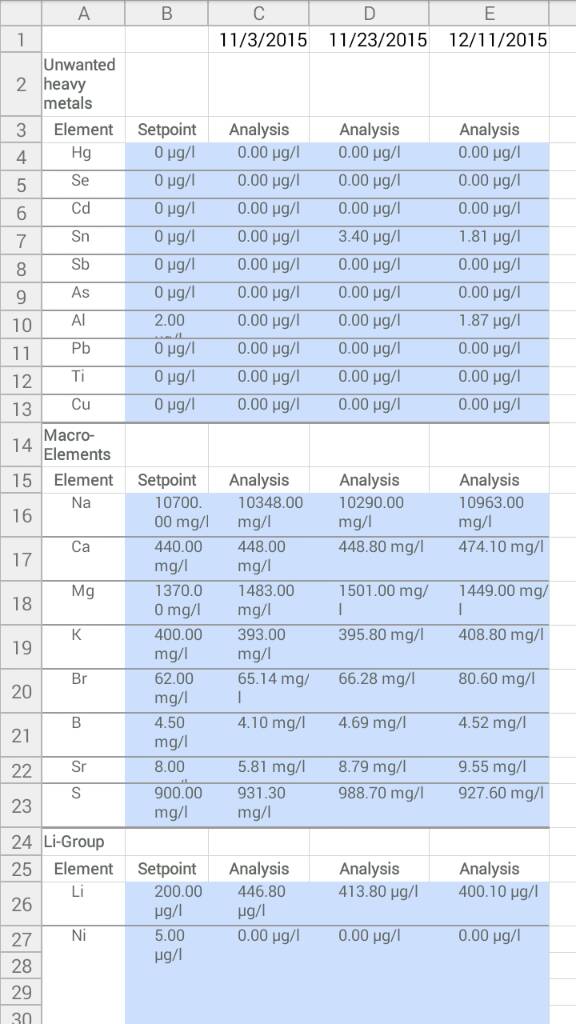
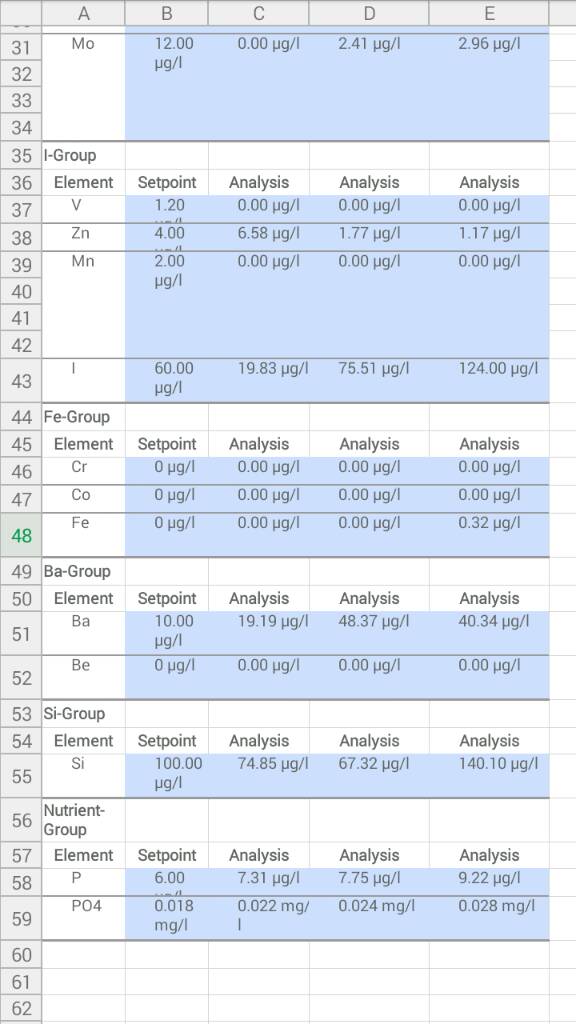
November 3rd I started this thread on testing comparisons and got a Triton test done
http://reefcentral.com/forums/showthread.php?t=2537234

Triton in that test showed no heavy metals that they could detect.

They also matched pretty well with the parameters I took that night.

pH: 8.22 at display 8.29 at sump (Apex)

Salinity:*
34ppt (Veegee refractometer)
34.6 (Apex)
35 (Milwaukee digital)

Calcium: 420 (API) 448 (Triton) week before I tested 440 calcium via API

Alk: 11dkh (API)*

Mg: 1440 (Salifert) 1483 (Triton)


Phosphorus: 16ppb (Hanna ULR Checker) 7.31ug/l (Triton) translates to ppb*

Phosphates: .05ppt (converted) .022 (Triton converted) Interesting enough I tested .03ppt via Hanna a few days later.*

November 10th I start up another testing comparison testing thread based on Nitrates
http://www.reefcentral.com/forums/showthread.php?t=2538789

Nitrates where ~1ppm
Other parameters pretty much the same as above.


November 20th yet another comparison thread this time for PO4
http://www.reefcentral.com/forums/showthread.php?t=2540702

Phosphates were ~.03ppm
Other parameters were about the same as above.

November 24th I start this all out comparison testing thread and by this the Dinos were peaked and on their decline
http://www.reefcentral.com/forums/showthread.php?t=2541190

Compilation of tested Parameters:

Temp:*
77F Display (Apex)
78.8F Sump (Apex)
78.4F Sump Cond probe (Apex)

Salinity:*
34 (Veegee/Vitalsine refractometer)
34.4 (Apex)
36 (Milwaukee Digital)
31.9 (AWT roughly converted from 1.024)
33.96 (Triton calculated with an assumption of F and alk/temp from my readings)

pH:*
8.30 Display (Apex)
8.37 Sump (Apex)

ORP: 386 (Apex)

Phosphates:*
0.018ppm (Hanna 736 ULR Converted from 6 ppb Phosphorous) tested twice
< 0.024ppm (Elos Pro)
0.21ppm (AWT)
0.024ppm (Triton converted from 7.75ppb Phosphorous)

Nitrates:*
0 (Undetectable via Salifert) tested twice
0 (Undetectable via Red Sea Pro) tested twice
0.9 (AWT)

Calcium:*
440 (API)
450 (Salifert)
410 (AWT)
448 (Triton)

Alk:
9dkh (API)
9.6-9.9dkh (Salifert)
8.96dkh (AWT converted from 3.2 meq/L)

Mg:*
1480 (Salifert)
1100 (Red Sea pro)
1500 (AWT)
1501 (Triton)

Other Parameters where they match up AWT vs. Triton:

Potassium
363 (AWT)
395.8 (Triton)

Silicon
0.37352 mg/L (AWT converted from .8mg/L of Silica if I converted right)
0.06732 mg/L (Triton 67.32ug/L)

Molybdenum
0.4mg/L (AWT)
0.00241 (Triton 2.41ug/l)

Strontium
8.4mg/L (AWT)
8.79mg/L (Triton)

Iodine
0.1 mg/L (AWT)
.076 mg/L (Triton 75.51ug/L)

Copper
0.02 mg/L (AWT)
0.00 (Triton)*


December 12 I did another full round with Triton in that thread just previously linked too. Dinos were pretty well gone around December 9th and haven't had any kind of showing since then.

Salinity: 34ppt veegee/vitalsine
pH:8.23 apex

Alk: 10dkh API

Calcium: 440 API

Mg: ~1485-1500 Salifert

Nitrate: under 2ppm

Phosphates:
7ppb phosphorus or 0.021 ppm phosphates converted.*
 
Last edited:
So, why did they leave in the first place. What limited them before and now. I'm doing the same things then and now.

My parameters from what I can test with are pretty much the same as back then as well. Except Mg is higher then normal right now. I could go drudging through my tank journal thread if specific numbers are requested. I've never had issues with nitrates being anywhere near over 5ppm. By the time I had cyano covering everything and Dinos my phosphates were around .03-.08ppm. The first time around with them. The same as now.
 
Last edited:
As I understand it, the red slime is not the actual cyano. It's a biproduct they make when they reach a critical mass.

I can't explain cyano or red slime either except that they can be extremely localized. My suspicion is that there's a local die off that they're feeding on. Not enough to impact overall water parameters to be off, but enough that they can feed and grow in place until all the dead material is consumed. Unfortunately, if their biproduct is toxic, they can create a localized zone that's inhospitable to anything else. As they kill more, the bubble grows... Like a bacterial infection on necrotic tissue spreading to nearby living issue and killing it.

I can't explain it but my dinos and cyano seem to be linked too.
 
Back
Top