Dinoflagellates.

If you have external plumbing, you can plumb one in. In my case, I literally used my back end-to-end weir area:

<a href="http://s1062.photobucket.com/user/karimwassef/media/9ECCCF5B-8265-48D0-9C0F-406190F50BC6_zps1vpsfuym.jpg.html" target="_blank"><img src="http://i1062.photobucket.com/albums/t496/karimwassef/9ECCCF5B-8265-48D0-9C0F-406190F50BC6_zps1vpsfuym.jpg" border="0" alt=" photo 9ECCCF5B-8265-48D0-9C0F-406190F50BC6_zps1vpsfuym.jpg"/></a>

<a href="http://s1062.photobucket.com/user/karimwassef/media/0E03A93D-1937-49DA-8B77-A0FDD9A9F8E0_zps1elfostg.jpg.html" target="_blank"><img src="http://i1062.photobucket.com/albums/t496/karimwassef/0E03A93D-1937-49DA-8B77-A0FDD9A9F8E0_zps1elfostg.jpg" border="0" alt=" photo 0E03A93D-1937-49DA-8B77-A0FDD9A9F8E0_zps1elfostg.jpg"/></a>

<a href="http://s1062.photobucket.com/user/karimwassef/media/FF69B7C4-A269-4105-A178-35F8491AFDD1_zpsjyjpo6wb.jpg.html" target="_blank"><img src="http://i1062.photobucket.com/albums/t496/karimwassef/FF69B7C4-A269-4105-A178-35F8491AFDD1_zpsjyjpo6wb.jpg" border="0" alt=" photo FF69B7C4-A269-4105-A178-35F8491AFDD1_zpsjyjpo6wb.jpg"/></a>
 
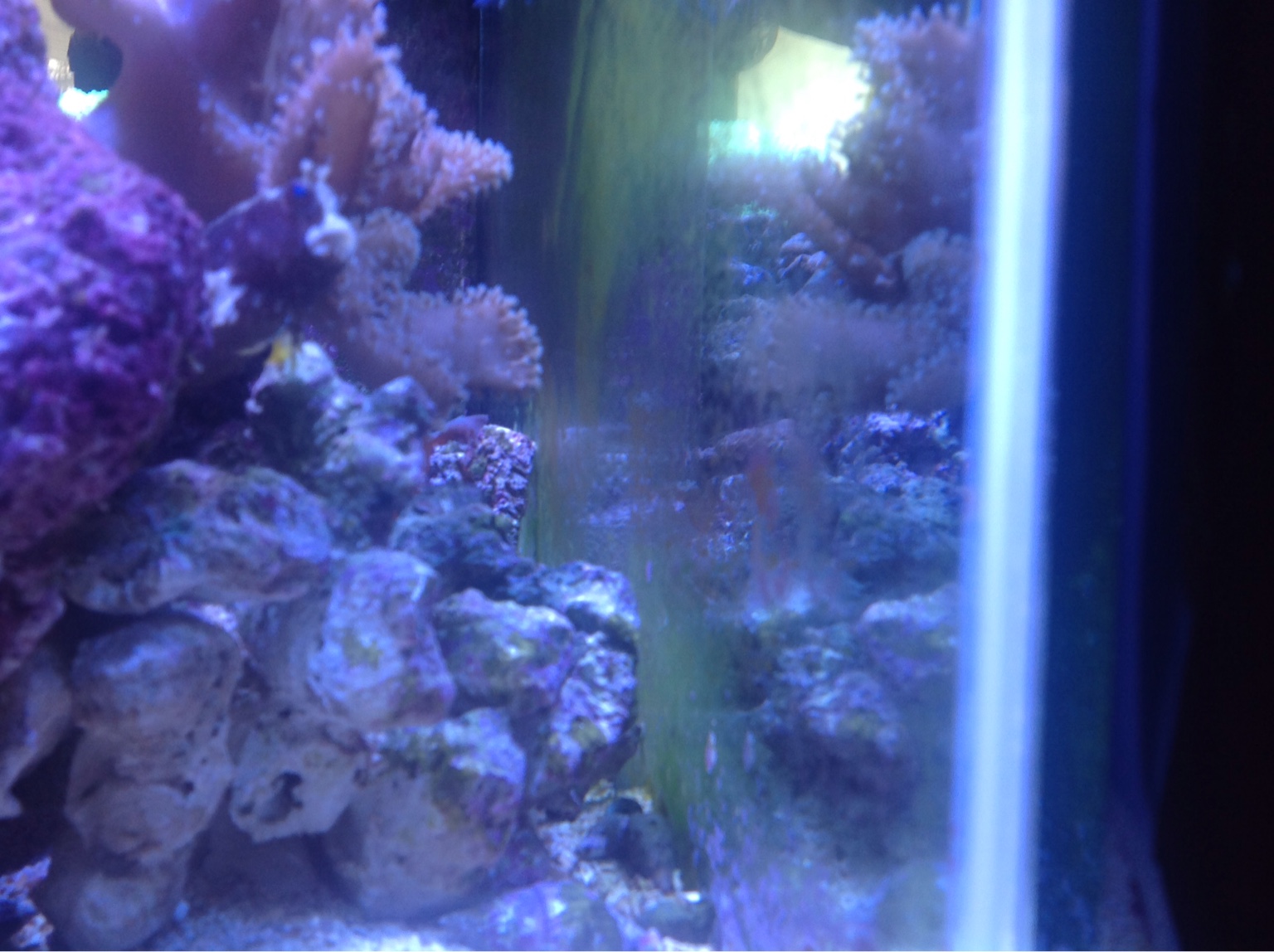
So I have been fighting dinos in my tank for a couple of days now and have noticed something of interest. I have been siphoning into a filter sock into my sump (in place of water change to remove the dinos) and noticed that underneath the dinos in many spots in the tank are hair algae. I was hoping this meant that it was just cyano coating the hair algae since the rock is all new rock (used cycled media) but texture, 0 no3 and po4 with an overflowing skimmer tells me I am most likely dealing with dinos.

I am fortunate to not be dealing with a toxic variety and have had no deaths due to the unbelievable outbreak so I am taking a methodical approach to dealing with it. The only pieces in this tank are frags (or bubble tips) so I daily pull the frags and clean them to avoid death by smothering. Fish are fine and eating well. My plan is to continue daily manual removal via siphoning, plug cleaning and skimming and will begin dosing phyto. My hope is to limp along without water changes (don't need them anyways at the moment) and hope that the dinos will choke themselves out.

I plan to give this a couple of weeks before trying a more aggressive approach.
 
If you have external plumbing, you can plumb one in. In my case, I literally used my back end-to-end weir area:

<a href="http://s1062.photobucket.com/user/karimwassef/media/9ECCCF5B-8265-48D0-9C0F-406190F50BC6_zps1vpsfuym.jpg.html" target="_blank"><img src="http://i1062.photobucket.com/albums/t496/karimwassef/9ECCCF5B-8265-48D0-9C0F-406190F50BC6_zps1vpsfuym.jpg" border="0" alt=" photo 9ECCCF5B-8265-48D0-9C0F-406190F50BC6_zps1vpsfuym.jpg"/></a>

<a href="http://s1062.photobucket.com/user/karimwassef/media/0E03A93D-1937-49DA-8B77-A0FDD9A9F8E0_zps1elfostg.jpg.html" target="_blank"><img src="http://i1062.photobucket.com/albums/t496/karimwassef/0E03A93D-1937-49DA-8B77-A0FDD9A9F8E0_zps1elfostg.jpg" border="0" alt=" photo 0E03A93D-1937-49DA-8B77-A0FDD9A9F8E0_zps1elfostg.jpg"/></a>

<a href="http://s1062.photobucket.com/user/karimwassef/media/FF69B7C4-A269-4105-A178-35F8491AFDD1_zpsjyjpo6wb.jpg.html" target="_blank"><img src="http://i1062.photobucket.com/albums/t496/karimwassef/FF69B7C4-A269-4105-A178-35F8491AFDD1_zpsjyjpo6wb.jpg" border="0" alt=" photo FF69B7C4-A269-4105-A178-35F8491AFDD1_zpsjyjpo6wb.jpg"/></a>
Thats pretty cool...unfortunately, my tank is an aio..but i did manage to install a cpr bak pak fuge..
193dd91dc8e85719d5d3118195bd1cbb.jpg

You can see it in back
 
To be fair to tastyfish...

08/21/2015, 02:40 AM #1570
34cygni

Growth said:
4b. Trophic mode effect
The highest MGR [Maximum Growth Rate] of the HTDs [HeteroTrophic Dinoflagellates] is double the highest MGR of dinoflagellates growing autotrophically. Also, MGRs of small HTDs are much higher than those of similar sized ATDs [AutoTrophic Dinos]. Energy gain of small HTDs through feeding may be higher than that of small ATDs through photosynthesis. Also, enzymes involved in photosynthesis may lower MGRs of dinoflagellates and it is worthwhile exploring this topic. The range of MIRs [Maximum Ingestion Rates] of each HTD was 0.04-24.4 ng C per dinoflagellate per day, while that of each MTD [MixoTrophic Dinoflagellate] species was 0.03-7.0 ng C per dinoflagellate per day. Also, MIRs of HTDs were higher than those of similar sized MTDs (Fig. 5). Heterotrophic activity of HTDs (feeding and digestion) is likely to be higher than that of MTDs.

In other words, among planktonic species heterotrophic dinos eat more and grow faster than mixotrophic dinos. It's likely the same is true of benthic species. Perhaps we can recruit some to help us by providing them with a cryptic environment where they have the home court advantage.


Life cycle stages of the benthic palytoxin-producing dinoflagellate Ostreopsis cf. ovata (Dinophyceae) said:
Several of the cells followed in this study were likely to have been cysts. The various forms included: 1) non-motile vegetative-like cells, also called thecate cysts; 2) ecdysal cells with the same shape as vegetative cells, known as pellicle cysts; and 3) round to elongated thin-walled cysts. All of these forms were detected inside threads of mucous and were viable for more than 6 months after their formation, consistent with the suggestion that those cysts could constitute an overwintering population responsible for bloom recurrence. Interestingly, only the mucilage-covered cysts survived in the samples, suggesting that the mucilaginous matrix acts as a protective coat

Emphasis mine. This suggests that an environment rich in heterotrophic bacteria and microfauna would reduce the reproductive success of ostis depositing cysts there, as the protective mucous layer would be eaten away and the cysts exposed.

Maybe 10 days is long enough to commence the shift to a population of benthic microorganisms typical of a cryptic ecosystem powered by secondary producers, making mixotrophic dinos and their cysts food for hungry heterotrophs.

So while I'm not endorsing the idea, I can see a mechanism that might explain why tastyfish is... If it gets some takers and turns out to work as advertised, it may deserve consideration for a spot in the FAQ as the official Measure of Last Resort.


Growth, Feeding and Ecological Roles of the Mixotrophic and Heterotrophic Dinoflagellates in Marine Planktonic Food Webs
http://hosting03.snu.ac.kr/~hjjeong/Publication/OSJ 45 65.pdf

Life cycle stages of the benthic palytoxin-producing dinoflagellate Ostreopsis cf. ovata (Dinophyceae)
http://digital.csic.es/bitstream/10261/56377/1/HarAlg18_24_34_post_print.pdf

--

taricha said:
I'm starting to wonder if there's something to ciliate predation - at least for less toxic dino species. ...

Ran across this AA article http://www.advancedaquarist.com/2002/10/breeder on culturing ciliates.

Ciliates are called out as predators on prorocentrum dinos in Growth, Feeding and Ecological Roles of the Mixotrophic and Heterotrophic Dinoflagellates in Marine Planktonic Food Webs, and Montireef reported finding ciliates in his skimmate, so it's reasonable to try culturing them.

Note that the AA culturing technique is about producing microorganisms of maximum nutritional value, as they're talking about culturing them for food. In that paper, the food web diagram indicates that ciliates eat bacteria, so you might be able to culture them (or culture a different species) by triggering a bacteria bloom with a few grains of boiled wheat, rice, or barley.
 
Taricha,

How does one ship a sample of Dino? I've never identified mine even though I'm hitting the two year mark with them (I think). I'd scrape some off my glass next time it builds up enough. I'd pay the shipping if you wouldn't mind identifying them for me. And maybe you get lucky and get the species you're looking for.
 
i tried finding a reference to a $100 uv. I'm all in on a UV working, I'm actually about to purchase one of the emperor aquatics 18 or 25w. From everything I've read a cheap uv does nothing? Maybe I missed it? Would be great if that was wrong, I'd rather not spend triple that on one if a cheaper one works??
 
Taricha,

How does one ship a sample of Dino? I've never identified mine even though I'm hitting the two year mark with them (I think). I'd scrape some off my glass next time it builds up enough. I'd pay the shipping if you wouldn't mind identifying them for me. And maybe you get lucky and get the species you're looking for.

This was my answer to my other responder in PM.
I'll post here in case anyone else has a better idea how to ship dinos. Seriously, who ships dinos? And cares about them getting there alive? :-)

"I haven't shipped dinos either.
Dinos are tough enough I hope. I don't expect we'll need to be fancy. I'd suck out a nice amount of them off the rocks or sand or whatever and put in a clean water bottle (like 20oz), filling the rest almost completely with tank water, leave a little air.
Then I'd close it up, and wrap it in towels or old shirts or whatever for cushioning and insulation and shove it in a box."

Yes, I'll gladly put them under the scope and get pics/vids so we can ID them. Thanks a bunch! I'll PM you shipping details.
 
Maybe 10 days is long enough to commence the shift to a population of benthic microorganisms typical of a cryptic ecosystem powered by secondary producers, making mixotrophic dinos and their cysts food for hungry heterotrophs.

So while I'm not endorsing the idea, I can see a mechanism that might explain why tastyfish is...

I've been thinking about what sort of things change between day 4 and day 10 of darkness. I'd expect die off of various things to significantly pick up making lots of nutrients available to bacteria etc.
And maybe it's not the issue that there's a different mechanism that takes effect between days 4 and 10. Maybe it's just the math of exponential growth: 2 to the 3rd is only 8, but 2 to the 10th power is 1024.

Also, you mentioned a hypothetical benthic heterotrophic dino species. Do we know of any such species? I haven't run across one.
 
i tried finding a reference to a $100 uv. I'm all in on a UV working, I'm actually about to purchase one of the emperor aquatics 18 or 25w. From everything I've read a cheap uv does nothing? Maybe I missed it? Would be great if that was wrong, I'd rather not spend triple that on one if a cheaper one works??

As with all equipment, you'll find people who insist that only the most expensive product works and the rest is garbage...

UV is UV. You can argue that the cheaper models less efficient and will consume more power. You can argue that they're harder to keep clean. You can argue that they're large compared to the more compact versions, you can argue that the bulbs burn out sooner and need to be replaced more often, etc... etc...

But a UV bulb is a UV bulb... will it work? if it puts out enough UV AND you run water through it slowly, it will zap dinos (and anything else). It only took a few days for my tank to clear up, and a month to be dino free. I ran it for a few months after that and now only run it at night...
 
Pants reported problems with getting dinos alive at his doorstep and I think he said something about shipping here on RC or his website.
 
My work has a lab so I stole one of these sample jars. I'm going to put it in a box with those hand warmers things and bubble wrap. Can't believe I'm trying to keep these things alive.
b07c407d2b3d7a05f4b122ab9bde526e.jpg


As for my tank, still only getting a slight dusting on the glass, mixed with green algae, every couple of days. The "dustings" get noticeably worse when I force myself to do a water change. I think I'm done getting those long brown bubbly strands on rocks and gravel (knock on wood).

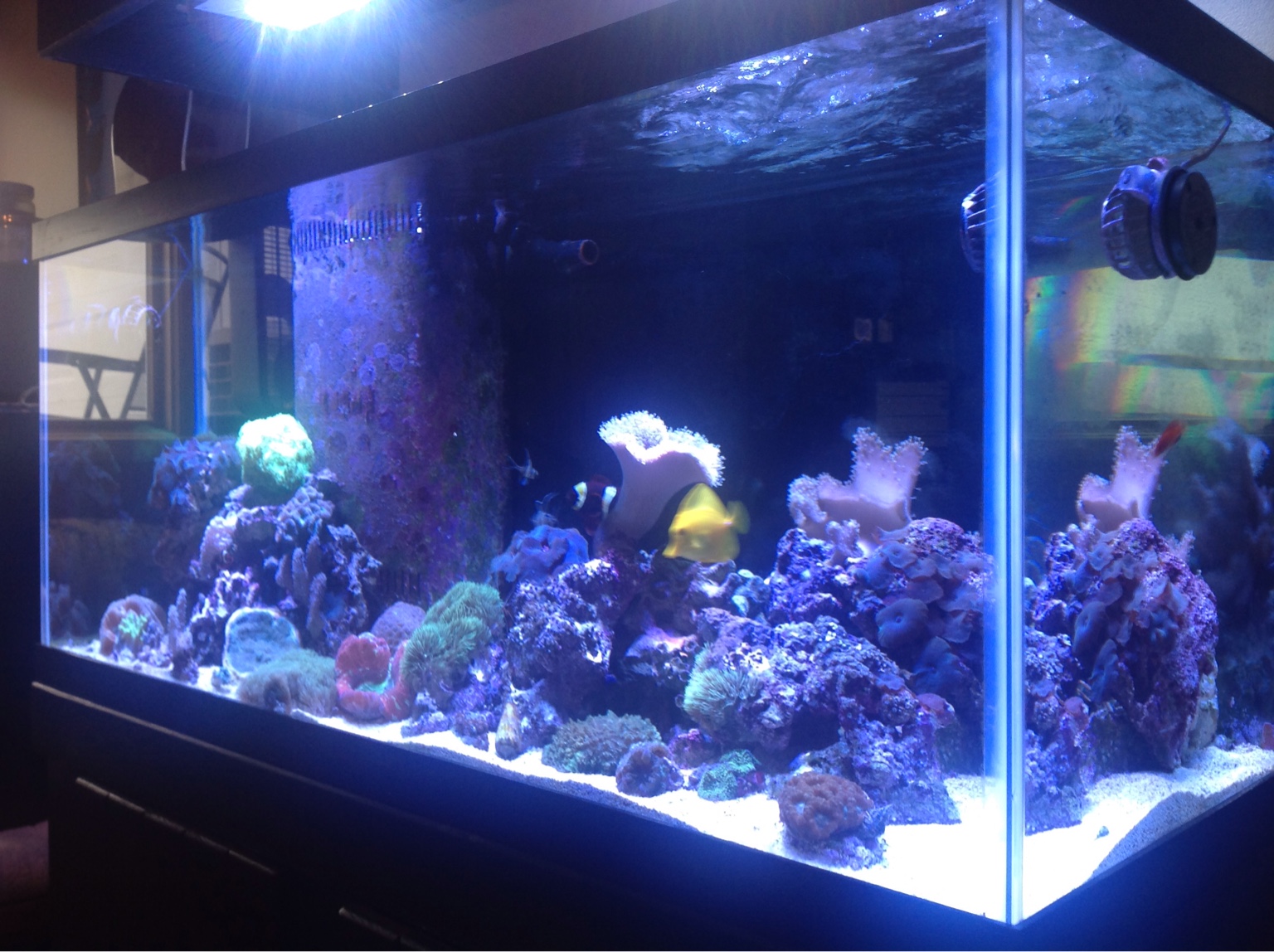
Here's a picture of the back glass that i won't clean so I can send a sample to Taricha. Green mixed with the brown. Picture is bad, it's has more brown spots than it appears. Then full tank shot to show it is beatable!
c299d10b3a7bb2feb2e90d9cb3e27694.jpg

d9c4bf25e80b2a9e81d5042dba438307.jpg

2333b691b1c4c6acab9d015c109945c1.jpg

31a0cbf34b7fc564016e06fcc407b1e5.jpg
 
Back
Top