Dinoflagellates.

When I had this problem a couple years it almost made me quit the hobby. I had to tear down the whole tank and start from scratch. I find it incredible in that short period of time it looks like there is a solution to the problem. Looks like UV and Fluconozole together are quite effective. If I get them again, i'll be sure to try that.

UV, yes. fluco? haven't really seen many reports on beating confirmed dinos with it. Lots of bryopsis success, though.
 
...


Good points and info all about why skimmers don't get enough dinos to make a dent.
Jason, wanted to pick your brain on something I thought I remembered you saying. When most people beat dinos and prevent them from taking over again, it's usually by finding a new more algae-involved equillibrium (some might say "dirtier").
I think in a previous discussion you said you've managed to keep dinos in check, and cause and end blooms at will - while running a pretty clean, low-ish nutrient system. Am I remembering right? and if so would you talk about your clean tank equillibrium that keeps dinos from taking over.
The only other low-nutrient system I can think of that had dinos present but never in bloom was a guy who ran peroxide on auto-doser every hour.


I really don't consider my tank clean as I don't run any kind of major mechanical filtration and never clean my sand or sump out. But my parameters when measuring nitrates and phosphates say differently. But I don't really try hard or at all to hit those numbers. I did at one point switch from vinegar dosing only to a mix of vinegar and vodka (TMZ's ratio of 690ml:310ml). This actually dropped my nitrates to undetectable and phosphates to consistently under .02 and I didn't like it so switch back to just vinegar. Nitrates are back to ranging around 2-5mg/L and phosphates around .02-.09ppm. It was either switch back to vinegar or start dosing nitrates and phosphates which I find a silly practice that many are doing now.

I personally believe it is a balance of consistency but not so much stability. Swings in anything like temp, pH, salinity, etc is fine if it's consistently swinging.

Timfish on here promotes skimmerless systems with lots of water changes. Glennf totally the opposite with promoting heavy skimming, heavy filtration, and practically 0 water changes. Both have had systems running over 10 years and looking beautiful. Then you have PaulB with a tank well over 40 years old now with a tall skimmer, ozone, very periodic water changes, a reversed UGF, Algae trough now scrubber, and periodically adds mud and little critters from the ocean. Then every once in a while blows everything around and filters it out with a diatom filter. I personally like his tank and think it's great looking.

Who's right?

Then look at the ocean and you can find majority is very stable and consistent but you'd find spots of 0 stability yet it's consistently unstable and corals and other inverts grow perfectly well. Look at the thread from down under where the tide consistently goes way out and even exposes corals. Those that are underwater will hit very high temps as the sun beats down on them. Even salinity will increase through the evaporation in the "puddles" left behind. I think the thread is called "How rare is this?" Or near shore reefs where there's consistently run off fluctuating salinity or lagoon reefs. Etc. etc.

Throw off that consistency and you get bleaching. Like the great barrier reef. Has been consistently very stable for decades. Now temps are increasing throwing off that stability which is not the consistency it's ecosystem is used too.

What's right?

I have no idea other then consistency and patience is key. Cyanobacteria has been around from the dawn of life practically. Dinoflagellates around almost as long and is an important part of the holobiont of coral. Heck, cyanobacteria can even produce it's own food. You think we're going to ever totally get rid of it from out tanks? Even if the system is bleached eventually they will return. Can come in from the air, fish, rock, corals, snails, shrimp, etc. They are a part of life. We probably wouldn't be around today if it wasn't for cyanobacteria.

Below is a quoted recap of what I do from earlier in the thread. I don't claim it's the right way to do anything either. Just what I do and have done consistently that seems to work for me. I did try an experiment with Metro and it seemed to help reduce at least the one kind of dino that I think is Alexandrium. Mind is a bit fuzzy right now but could look it up I think I even mentioned it in this thread previously. But that dino is back just as it was before. I don't see it with out looking at a microscope though. My tank will live with it as it has been. My guess is there are things that consume it and or just out compete it.

But it's hard to say exactly what. They have many advantages over other phytoplankton and algae which they are considered. Like they all don't require light like normal Algae and cyano does. They require many of the same trace and major elements that algae does like Iron, Mg, K, etc. So if you limit those you limit Algae. My Algae is not hindered in growth at all. So if it's not limited I doubt my dinoflagellates are hindered by trace elements. Plus, I feed way more then enough along with continuous automatic water changes to keep trace elements plentiful.

Before was on my 55g and I was harvesting calurpa and ulva with a touch of chaeto but chaeto never did very well compared to those two. This was in a custom built hang on back refugium.

I now use an ATS I bought from Turbo's Aquatics and it's fun seeing what I scrape off every couple weeks.

I feel the combination of what I've been doing for import and export which does include the ATS along with not freaking out and changing anything helped.

Post 2538 http://www.reefcentral.com/forums/showpost.php?p=24231040&postcount=2538
Yes, I've been carbon dosing for years and have dino's. None visually right now and probably wont see them again until I screw something up again. My parameters are pretty well posted around now to. With Nitrates under 1ppm and even under .5ppm. Phosphates around .03. Most recently under .03.
...

But I don't strive for clean or dirty and have no idea which I fall into. My parameters for nitrate and phosphates are low. But my sump is full of detritus I never touch. I don't use filter socks or other typical mechanical filtration. The flow in my display tank is setup now to keep detritus suspended until sucked down the overflow to my sump where it becomes food and home to many critters.

For exports:
"¢I don't run mechanical filters besides a skimmer which I use for aerating the water and removing bacteria that has consumed nitrates and phostphates.

"¢I've used vinegar for years and dosed ~100ml/day for 200g total water volume.

"¢I do ~1% automatic water changes daily exporting stuff.

"¢I harvest algae via an ATS.

For imports:
"¢I feed a lot. 4 times per day I have an automatic feeder dump some NLS Marine/AlgaeMax pellets. I hand feed 2-3x per day some meaty food maybe ~2-3 cubes worth. A sheet of nori per day. This brings in a lot of phosphates, trace elements, vitamins, minerals, etc. Plus increases urea dosing nitrates to my tank.

"¢~1% daily automatic water changes importing stuff

"¢I add a small amount of Mg to that water change water. I need to reduce that amount.

"¢I dose limewater which was via ATO and right now experimenting with limewater dosing separate from my ATO.

"¢Carbon dosing via vinegar ~100ml/day. But recently experimenting with a vodka/vinegar mix dosing ~36ml/day.


I didn't touch the dino's this time around and just watched them. Pictures of their peak and eventual decline earlier in this thread.


and to define a few things

Nitrates have always been below 5ppm. Since testing with other nitrate kits that can detect below 5ppm my nitrates are constantly below 1ppm.
Phosphates are consistently around .03ppm and recently lower. My last test was ~ 0.01

Vodka/vinegar mix are in a ratio mixed up to 690ml vinegar and 310ml of vodka based on TMZ's mix from the RedSea NOPOX thread exposing what's in it. No water added.

and my Mg supplement used to be Tech-m but switched a few years ago to a Mg Chloride/Sulfate I mix together myself now for cheaper. Using Randy's ratio for those using Kalk

 
Last edited:
Oh, and yes I most certainly can promote a bloom of both cyano and dinoflagellates. They seem to go hand in hand with my system. First I will visually see the cyano. Then will come the dino b bubbles I call them which is how I know they are blooming. Then the cyano starts to recede and finally the dinos as well. Usually takes a couple month's. I documented at least one phase of doing nothing other then what I usually do but watch in this thread.

I've purposefully and accidentally have done this. And have future plans to do so again. I have a UV and a flow meter to play with now. lol
 
Last edited:
I've gone through my fair share of changes. I believe that the things that work really do work but not because of why we think they work.

For example, I built the biggest baddest skimmer (really) and it was a monster export machine. But I was feeding constantly... to feed my reef but ultimately, feed my skimmer... so I stopped "skimming" but kept the air injection part of it and now I consider it my monster gas exchanger but I don't export any more. Instead, I grow a massive tub of algae and feed that back to my reef fish whose poop is the primary food source...

Basically all the same elements that were keeping my reef healthy before and after are the same... but I call them different things and use them differently. The corals don't care.

That's why I think different methods all work for different people... the corals see what they like ... we think they're really different systems.

By the way, I use UV when my reef catches a bug (like we get the flu), but it doesn't need to run 24/7... just to cure a disease.
 
Thanks, Jason.
Great reply. Would be so much easier if you had a smoking gun to point to. :-)
Much harder telling people the way to keep dinos away in a low nutrient system is....
You must have the patience of a Zen master to defeat the ancient sea monster.
 
Thanks, Jason.
Great reply. Would be so much easier if you had a smoking gun to point to. :-)
Much harder telling people the way to keep dinos away in a low nutrient system is....
You must have the patience of a Zen master to defeat the ancient sea monster.
[emoji1]

Why I don't comment much on much of the chaos of this thread.
 
Hey guys, despite much searching and reading I haven't found decent information about the lifecycle of the typical dinos we get in our tanks (no ich - this is well documented). Any info, insight or pointers on that?
 
You'd need to look through the scientific literature. I'm not sure how varied the dinoflagellates are, but they come in many species. They might have a wide range of behaviors.
 
Hey guys, despite much searching and reading I haven't found decent information about the lifecycle of the typical dinos we get in our tanks (no ich - this is well documented). Any info, insight or pointers on that?

Only significantly documented one is Ostreopsis Ovata. Much less on Prorocentrum Lima, almost nothing on other reef tank Dinos.
There is no fixed cycle. No set rigid phase requirements that can be exploited like with ich. Ostreopsis CAN do sexual reproduction through cysts, but that's not really observed in our tanks - It goes from one annoying cell, grows, splits into 2 annoying cells, and will continue multiplying at up to a division per day until it runs out of something. If it depletes a needed substance like P, it'll remain stagnant and get ready to split when it becomes available again source - different dino, but still. If it hits unhappy conditions (like high ammonia, or as has been reported, possibly metro) it'll make a short-term cyst. If conditions go really bad, it'll make a long term cyst.
good papers I can think of
Best paper I've seen on the topic: New insights on the life cycle stages of the toxic benthic dinoflagellate Ostreopsis cf. ovata
Great pics of cyst forms of Ostis.
Thin-walled cysts, when placed in favorable conditions (fresh replete medium, 21C), produced vegetative cells in a short time interval (3h-2d), confirming that they represent non-dormant cysts. O. cf. ovata cells germinating from the thin pellicle were already provided with a theca
Double-walled cysts isolated from 5-month-old cultures and put in replete medium germinated after 3"“5 days only at [25C], whereas
germination was not observed at [21C].

Moreover, at least two types of cysts were formed,
non-dormant(pellicle) cysts germinating within 2 days and resting
cysts able to germinate after a 5-month-dormancy period only at
25C and not at 21C, with important implications in the
dynamics of blooms in temperate areas.

It also talks about cases of sexual reproduction in Ostreopsis, but it's so inefficient and slow, it's not ever really observed or relevant in a tank...
after five months ...vegetative cells had almost disappeared, while bacteria infected the cultures, and only dark cells and a few thin-walled (only type B) and double-walled cysts were recorded.
Transferring 1 ml of each flask...several pairs of round dark cells covered by a pellicle were observed in the first few days ... In the following days, a few clusters of 3"“4 round, small and motionless cells appeared ... and after a week, a cluster made up of 4 vegetative cells..was observed...Subsequently, 2 h after detection, the vegetative cells started to swim, separating themselves from each other.

another good one: looked at what conditions were required to start and stop blooms in the wild...

A water temperature threshold of 25C plays a key role in the germination of O. cf. ovata cysts and therefore in bloom onset, and an N:P ratio around Redfield value is a necessary condition to allow cell proliferation. The synergy of higher temperatures and optimal N:P ratios resulted in a higher net growth rate of O. cf. ovata cells. After the onset, blooms can be maintained at temperature values even below 20C and at N:P ratios that are in excess of the Redfield ratio. Once the bloom has started it may be maintained not necessarily through high growth rates, but likely through other physiological mechanisms. Bloom decline occurred when temperatures dropped below 18C.
 
another good one: looked at what conditions were required to start and stop blooms in the wild...

Fascinating paper.

paper said:
In conclusion, our data suggest that in the northern Adriatic Sea Ostreopsis cf. ovata blooms are triggered by a combination of calm hydrodynamic conditions, optimal temperature and favorable nutrients (Figs. 8 and 9). Calm conditions are a prerequisite for blooms, and only when this condition exists do temperature and nutrient start to have a decisive effect.

I had a very high N to P ratio as they mention.
 
Well, systems that have had any combination of high and low N or P have had dino blooms so it's only a piece of the puzzle. My P is normally very low. I normally don't have blooms. Iron is another limiting factor for them that algae and other bacteria could out compete them on. There's also many other trace elements they will need.
 
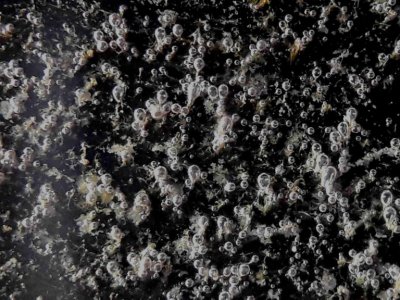
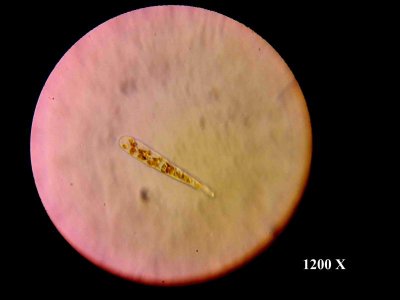
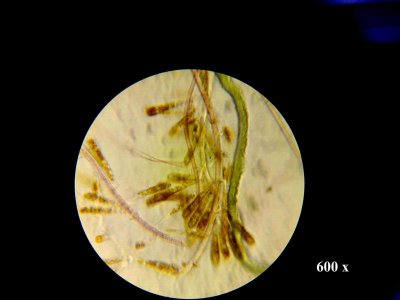
I have asked for help in a different thread to identify a "bacteria" bloom in my 5 month old tank. I was given the impression that I have to different problem locations. The first problem is red stuff - probably cyano (see first image), but I am not sure about the other back wall stuff. It is on most of my back wall, algae like consistency, with lots of bubbles and also diano like strings waving out of it. Please see the remaining images. The size is about 70 um. Is it a diano, and if yes, which one?
 

Attachments

  • Unknown Bacteria BACK WALL.jpg
    Unknown Bacteria BACK WALL.jpg
    104 KB · Views: 12
  • Unknown Bacteria BACK WALL 2.jpg
    Unknown Bacteria BACK WALL 2.jpg
    26.7 KB · Views: 8
  • Cyano 1200 X.jpg
    Cyano 1200 X.jpg
    41.8 KB · Views: 14
  • Unknown Bacteria BACK WALL 3.jpg
    Unknown Bacteria BACK WALL 3.jpg
    32.5 KB · Views: 10
I'd guess that the second picture was cyanobacteria or dinoflagellates, but I'm not good at id'ing microbes. Dinoflagellates should show a flagellum somewhere, if the focus is at the appropriate plane. I didn't see any in your images, but there's the pesky depth of field issue.
 
I'd guess that the second picture was cyanobacteria or dinoflagellates, but I'm not good at id'ing microbes. Dinoflagellates should show a flagellum somewhere, if the focus is at the appropriate plane. I didn't see any in your images, but there's the pesky depth of field issue.

You might be onto something. I don't see a flagellum. You mentioning it also brought up another question/point. If it is dyno, should they be moving? These are static - no visible movement.
 
Back
Top