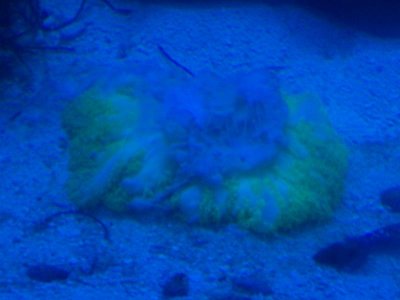
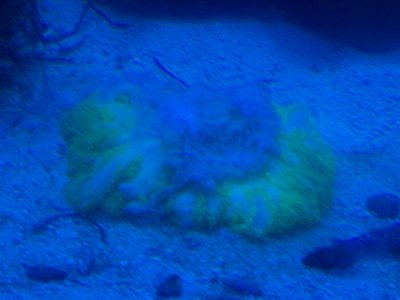
Golden Carpet Anemone Dying?

Why put screen over a gigantea that's bleached to this degree? It's not like the anemone is going to suffer from oxidative stress, brought on by to much photosynthesis. These are very shallow water, bright light, anemones. It probably bleached due to insufficient lighting in the first place. I would blast this anemone with all the light you have, and hope what little zooxanthellae it has, survives.
 
EC, the cause of the bleaching was already described. I have given an example of one anemone that benefited from light acclimation, and there are many more threads on this site. I don't know of any thread where "blasting" a new anemone was a fix-all.
 
Okay..... Let me word the question a little differently.
What benefit is there to shading a gigantea that's bleached to this degree?
Or....
What harm can come from providing it with full strength aquarium lighting?

I'm looking for the mechanism, or cause and effect, that shows this is a good idea. What's the science that supports shading a bleached gigantea?


EC, the cause of the bleaching was already described.

All we know is that the anemone was placed in several stressful situations, and through this time, it lost color. We do not have near enough information to show exactly what caused the anemone to bleach.


I have given an example of one anemone that benefited from light acclimation,

You shaded an anemone and it survived. That does not show that the anemone benefited from being shaded. For all you know, the shading may have interfered with the anemones ability to heal. You may have simply prolonged the time it took for the anemone to recover. The anemone in your link is also a completely different species, that typically inhabits a completely different environment. Witch makes it highly likely to host a completely different clad of zooxanthellae.


and there are many more threads on this site. I don't know of any thread where "blasting" a new anemone was a fix-all.

We shade, or light acclimate, other species of anemone that have their full compliment of zooxanthellae, to reduce the risk of oxidative stress on the animal, or for lower light species. The animal in this thread has virtually zero chance of suffering oxidative stress. No matter how much light you give it. It has very few healthy zooxanthellae within it's tissues. These few zooxanthellae can not produce enough oxidants during photosynthesis to cause this animal stress. They can't even produce enough nutrition to keep the animal from suffering malnutrition. In other words, you can't hurt this anemone by providing it with full strength aquarium lighting. There simply isn't enough zooxanthellae within it to cause problems.

This is a very shallow water species. They are exposed to the full strength tropical sun, pretty much year round. The zooxanthellae that live within this animal have evolved to thrive under these intense lighting conditions. If they do not get enough lighting, they will die, and the anemone will bleach further. Eventually, leading to the death of the anemone as well. This is like trying to grow a Southern pine tree in your living room. It's most likely going to die from insufficient lighting. A piece lilly may thrive in your living room due to it's lower lighting requirements. Zooxanthellae are much like terrestrial plants in this regard. There are different clades of zooxanthellae that prosper under different lighting conditions. Those within S. gigantea thrive under very intense lighting, while those in other species of anemone may prosper under much lower lighting conditions.

 
Last edited:
Here's my bleached and sickly gigantea not long after I got it.
<iframe width="420" height="315" src="http://www.youtube.com/embed/MtctS6G0JUY" frameborder="0" allowfullscreen></iframe>

Here it is after recovery. It made the best improvements, and still resides, just inches under a 250W MH, and four HO T5's.

<iframe width="420" height="315" src="http://www.youtube.com/embed/ugVktUZV-bE" frameborder="0" allowfullscreen></iframe>
 
Parameters looks fine, except for nitrates. I would be working to get that down, if I were you. Best of luck getting the anemone to recover.
 
Sorry EC, didn't mean to ruffle your feathers there.

In my thread, I described, with pictures, what mine did in full lighting. It deflated and gaped it's mouth. When I applied the screens, it stopped. Every time I removed them for more than an hour, it would deflate. When I put them back, it recovered.

According to your science lesson, this should not happen. Also, based on the science above, a new white BTA should be subjected to stronger lighting and not be expected to hide. Yet they often do, even when bleached. Any idea why?

I'm not being rude, I'm honestly asking.
 
anemone

anemone

Hi everyone, well she looks really bad tonight. She has looked like this since yesterday. What confuses me is that she is still putting up and her outside color is still good. It looks like she literally blew up from the center out. Can these guys create new mouths, cause it almost looks like that. Here are pix from earlier. I am trying to keep her alive. Thanks to all.
 

Attachments

  • 100_4451.jpg
    100_4451.jpg
    36.6 KB · Views: 6
  • 100_4453.jpg
    100_4453.jpg
    39.2 KB · Views: 6
  • 100_4460.jpg
    100_4460.jpg
    44.9 KB · Views: 6
That's a dead anemone :( Sorry :(

It is rotting - you need to remove it from your tank. Take it out and CAREFULLY smell it. A healthy anemone has no odor. This dead one will smell like the worst thing you have ever smelt - x 10.
 
anemone

anemone

I took your advice and took it out of the tank. I smelled it, and it smelled fine. There was no odor to it at all. I checked the foot, and the foot was nice and solid. But to not take a chance further, I threw it away.
 
anemone

anemone

Is there a chance this could have recovered? I kept telling myself that I was going to wait until tomorrow morning and see what it looked like. I got panicked when everyone was saying it was dead, and it wouldn't make it and I took it out. I was afraid it would contaminate my tank. But the whole bottom of it was fine and it didn't smell bad at all. Do you think I acted to prematurely?
 
BonsaiNut knows his nems. I would trust him if noone else, and it was probably just too freshly dead to be rotting. My bet is it would've smelled bad tomorrow. When they invert their mouth like that, there's almost no coming back. I am sorry for your loss.
 
anemone

anemone

Thank you. I feel really bad bc I wanted it to make it so much. Do you happen to know where I can get another yellow one, or nice colored one? Thanks to everyone for their help and support. Just for information in the future, I have never had one die in my tank. It it had died in the tank, what would have happened to the other corals, clams and fish in the tank? I have been very luck with my other nems, so far.
 
When it starts to break down like that there's no going back. Perhaps it takes a little longer to smell bad - but you don't want all the bio material in your tank breaking down and giving your water chemistry fits. Sorry about the 'nem :(
 
I would be pi$$ed at the shop that sold that to me claiming it was a "golden carpet" when they should have said it was totaly bleached may not live long animal. No offense but you did not know what you were buying, and the shop pulled the wool over your eyes.


it sucks but it is a super learning experience!

how much did they charge you anyway?


L.R.
 
BonsaiNut, you were correct. This morning, when I got up, there was still some tissue left in the bottom of the tank that I didn't see last night, as the lights were off. Boy, did that sure smell bad. As for the cost, they charged 36.99, said they got a really good deal on it. I guess they did. I am not new to the hobby, and when I first saw it, there was so much yellow on it, as in first pix, that I didn't think it was bleached. I am sad I lost it. Does anyone know where I can get another carpet for a nice price? Thanks again, for all the help and advice.
 
Sorry EC, didn't mean to ruffle your feathers there.

You didn't ruffle my feathers at all. The advice you gave was "text book". It's the advice these types of threads always gets. I was just questioning if it was, or is, the right advice. Nothing personal, and I honestly didn't intend for it to come across as harsh. My sincere apologies if it did.


In my thread, I described, with pictures, what mine did in full lighting. It deflated and gaped it's mouth. When I applied the screens, it stopped. Every time I removed them for more than an hour, it would deflate. When I put them back, it recovered.
According to your science lesson, this should not happen..

I have to be honest. I haven't read your thread.

Anemones don't have light sensing organs, like primitive eyes. How does an anemone without zooxanthellae detect light? If they have healthy zooxanthellae, they may be able to detect substances produced during photosynthesis, which would tell them when the lights are on. If there is an abundance of healthy zooxanthellae within the anemone, during periods of intense illumination, oxidants can be produced at such a high rate, that the anemone reacts negatively. Without this abundance of zooxanthellae, what would cause an anemone to react negatively towards light?


Also, based on the science above, a new white BTA should be subjected to stronger lighting and not be expected to hide. Yet they often do, even when bleached. Any idea why?

If the anemone has no way of detecting light, without zooxanthellae, the anemone may remain in the dark simply because it can't detect that it is in the dark. We may view this as hiding from the light, but that may not be what's happening at all. The anemone may simply be lost, because it has no way of finding the light.


I'm not being rude, I'm honestly asking.

I'm honestly not trying to be rude either. I'm more or less just thinking out loud.
 
Well, it is a fact that anemones don't have eyes. In fact, scientists have tried to figure this problem out for a while now, since anemones DO respond (favorably and unfavorably) to light - whether they have zooxanthellae or not. Even non-photosynthetic anemones can "detect" light in some fashion - scientists just don't know how.

The other thing that we know is that zooxanthellae has a positive impact on clown anemones only under certain conditions. Outside of those conditions (intense light, etc), zooxanthellae will be actively expelled. Additionally clown anemones have the rather sophisticated ability to shuffle zooxanthellae populations based on environmental conditions - swapping out one clade for another if there is brighter light, or warmer water for example.

So I would guess that anemones can't "see" light, but they can detect light via light's impact on their body (in some fashion) similar to the way that plants can't see, but they can detect sunlight and respond to it favorably or unfavorably.

I don't know why, but I have also observed this initial unfavorable response that anemones have when being placed in bright lighting after a period of darkness. Going back to the plant example, plants also respond this way - a plant raised in low light may react very negatively when suddenly moved to bright lighting that will benefit it in the long run. I have had plants that will drop all their leaves when moved into bright lighting - but then will recover and be healthier than ever. It is probably better for us to try to figure out best acclimation practices instead of worrying too much (in this case) about why they behave this way.
 
Just chiming in to the whole lighting thing here.. I'm pretty sure any coral/anemone can suffer from light shock, which is why in fluorescent fixtures you switch out 1 bulb at a time, and not all of them at once. Going from too much to to little light or vice versa is stressful on the animal, and it should be done gradually for best chance of survival. Granted, it is a high light nem, but to pelt it with light when it wasn't getting nearly as much is a surefire way to at least stress it out if not kill it (depending on the amount of stress it has already endured) regardless if it can "see" it or not.

Anyways, sorry for your loss, and perhaps you should tell that LFS that instead of giving you false information on its current condition (i.e. telling you it is gold instead of bleached) and giving you a deal on it they should just flat out say what is going on with their livestock. If they get angry at you, try finding a new LFS. Some have no shame. By the way, what type of lighting was in the LFS tank? And how long was it there? If you decide to get more livestock there you can then guesstimate where to put new corals in your tank so as to not get shocked by light in your tank. For example, whenever I get open brains/trachys/symphillia/lobo I try to shade it for the first week or so or at least if I can turn off half my lights for a few days, and gradually move it towards more light until it is happy. I have noticed many nems are subject to light shock as well, and initial placement is key for survival IME, especially if light parameters in the tanks are very different.
 
I am guessing, but I don't think it was there more than a week. I had been there earlier in the week and it wasn't there. I believe he has t-5 lighting. I am wanting to get another carpet. Can anyone recommend a good place to get one? I was also told by my lfs not to get a blue carpet, as they don't live. Is this true?
 
Back
Top