
You are using an out of date browser. It may not display this or other websites correctly.
You should upgrade or use an alternative browser.
You should upgrade or use an alternative browser.
Haddoni and Gigantea differences???
- Thread starter bimmer88
- Start date

elegance coral
They call me EC
http://www.nhm.ku.edu/inverts/ebooks/intro.html
Quotes from the link.
Gigantea
"Diagnostic field characters Deeply-folded oral disc (more pronounced with size), covered with short (average 10 mm), slightly tapering tentacles that typically all vibrate constantly. Tentacles extremely sticky in life, adhering to collector's hand, and pulling off in clumps; but do not cause stinging sensation. Typically in such shallow water that animals may be exposed at low tide.
Details May be extraordinarily abundant. Oral disc rarely as much as 500 mm diameter, usually lies at surface of sand, often among corals; pedal disc attached to buried object. Non-adhesive verrucae on upper column blue to maroon, contrasting with yellowish, pinkish, tan, greenish-blue, or gray-green column. Basal portion of each tentacle colour of the oral disc (often tan or pink); colour of bluntly pointed distal part -- which is what is generally noted as tentacle colour -- commonly brown or greenish, rarely a striking purple or pink, deep blue, or bright green. Much of central oral disc bare, but deep oral disc folds may hide mouth.
Similar species The shallow, sandy habitat is unusual. Stichodactyla mertensii, which lives on hard substrata, has a flat oral disc and distinctive column. Stichodactyla haddoni typically lives in cleaner sand and deeper water, and its oral disc folds are more regular and more separate than those of S. gigantea; tentacle form and fish symbionts of the two also clearly separate them."
Haddoni
" Diagnostic field characters Slightly to deeply folded oral disc lies on or above sand surface; tentacles either bulbous or with basal "stalk," at the end of which is a blunt or swollen terminal portion that can appear puckered (on close examination). Exocoelic tentacles more robust than the endocoelic ones with which they alternate. Column sturdy.
Details Oral disc diameter commonly 500 mm, rarely 800 mm; yellowish to orange tentacle-free oral area 10-20 mm in diameter. Oral disc, lower portion of tentacles, and column drab -- commonly yellowish or tan. Tentacle ends can be green, yellow, gray, or rarely pink, which can give oral disc a variegated appearance. Exocoelic tentacles usually white, may be up to twice as long as endocoelic, point outward in well expanded animals. Tentacles sticky to touch, may adhere to human skin so strongly that they pull off the anemone; contact with them is painless but can raise welts. Small, non-adhesive verrucae on uppermost column are same colour as column or light rose to purple. Anemone can pull rapidly and completely beneath the sand when disturbed, leaving its fish to hover over the resulting depression.
Similar species Stichodactyla gigantea also lives in sand but typically in shallower water, and folds of its oral disc are less regular and more closely spaced. The oral disc of S. mertensii, which lives on firm substrata, lies fairly flat. The column of S. haddoni is more substantial than that of either, and its tentacles are longer and distinctively shaped. The other species lack robust exocoelic tentacles. Tentacles pull off of S. gigantea as well, but in massive clumps rather than one or several at a time."
Quotes from the link.
Gigantea
"Diagnostic field characters Deeply-folded oral disc (more pronounced with size), covered with short (average 10 mm), slightly tapering tentacles that typically all vibrate constantly. Tentacles extremely sticky in life, adhering to collector's hand, and pulling off in clumps; but do not cause stinging sensation. Typically in such shallow water that animals may be exposed at low tide.
Details May be extraordinarily abundant. Oral disc rarely as much as 500 mm diameter, usually lies at surface of sand, often among corals; pedal disc attached to buried object. Non-adhesive verrucae on upper column blue to maroon, contrasting with yellowish, pinkish, tan, greenish-blue, or gray-green column. Basal portion of each tentacle colour of the oral disc (often tan or pink); colour of bluntly pointed distal part -- which is what is generally noted as tentacle colour -- commonly brown or greenish, rarely a striking purple or pink, deep blue, or bright green. Much of central oral disc bare, but deep oral disc folds may hide mouth.
Similar species The shallow, sandy habitat is unusual. Stichodactyla mertensii, which lives on hard substrata, has a flat oral disc and distinctive column. Stichodactyla haddoni typically lives in cleaner sand and deeper water, and its oral disc folds are more regular and more separate than those of S. gigantea; tentacle form and fish symbionts of the two also clearly separate them."
Haddoni
" Diagnostic field characters Slightly to deeply folded oral disc lies on or above sand surface; tentacles either bulbous or with basal "stalk," at the end of which is a blunt or swollen terminal portion that can appear puckered (on close examination). Exocoelic tentacles more robust than the endocoelic ones with which they alternate. Column sturdy.
Details Oral disc diameter commonly 500 mm, rarely 800 mm; yellowish to orange tentacle-free oral area 10-20 mm in diameter. Oral disc, lower portion of tentacles, and column drab -- commonly yellowish or tan. Tentacle ends can be green, yellow, gray, or rarely pink, which can give oral disc a variegated appearance. Exocoelic tentacles usually white, may be up to twice as long as endocoelic, point outward in well expanded animals. Tentacles sticky to touch, may adhere to human skin so strongly that they pull off the anemone; contact with them is painless but can raise welts. Small, non-adhesive verrucae on uppermost column are same colour as column or light rose to purple. Anemone can pull rapidly and completely beneath the sand when disturbed, leaving its fish to hover over the resulting depression.
Similar species Stichodactyla gigantea also lives in sand but typically in shallower water, and folds of its oral disc are less regular and more closely spaced. The oral disc of S. mertensii, which lives on firm substrata, lies fairly flat. The column of S. haddoni is more substantial than that of either, and its tentacles are longer and distinctively shaped. The other species lack robust exocoelic tentacles. Tentacles pull off of S. gigantea as well, but in massive clumps rather than one or several at a time."
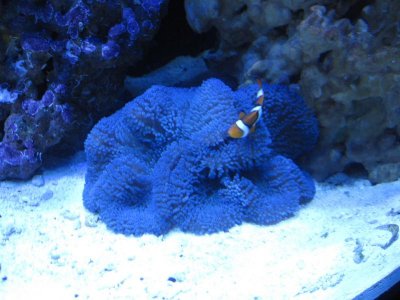
so if my anemone has purple lines and markings on the underside of it's oral disc, it's a Haddoni? kinda had trouble understanding all the other stuff...heheh... Here's a picture of mine... LFS told me it was a Haddoni but i just wanted to make sure i didn't get a gigantea instead...
Attachments
Last edited:

Ron Popeil
Love them clownfish.
well, the folds of the disc and shape of the tentacles do appear to be gigantae, but sometimes stressed haddonis can be visual imposters.
does your anemone have purple spots underneath the disc?
does your anemone have purple spots underneath the disc?
yup... a lot of purple lines and dots underneath the disc... i sure hope its not gigantea... i am aware that these don't fare well in captivity...well, the folds of the disc and shape of the tentacles do appear to be gigantae, but sometimes stressed haddonis can be visual imposters.
does your anemone have purple spots underneath the disc?
Ron Popeil
Love them clownfish.
well then you probably have yourself a gigantae. how long have you had it so far? how long was it at the store you bought it from?
from the initial picture, it looks pretty good. great color, good firmness to the shape. but they can go downhill fast. has it deflated at all yet? or regularly?
if its established, i think youll be able to maintain it just fine with some bright lights and some good strong flow.
from the initial picture, it looks pretty good. great color, good firmness to the shape. but they can go downhill fast. has it deflated at all yet? or regularly?
if its established, i think youll be able to maintain it just fine with some bright lights and some good strong flow.
Ron: Upon a few hours of googling, i came upon this site
http://eddie-coral-adventures.blogspot.com/2008/06/awesome-anemones.html
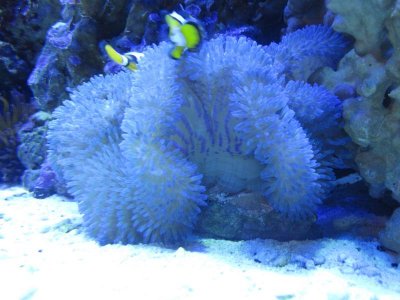
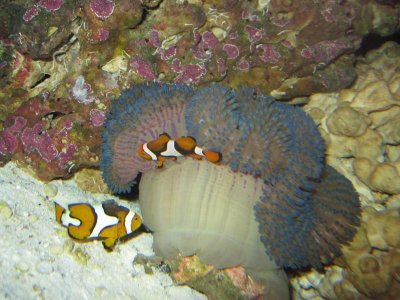
they said identification should be done by looking at the verrucae... according to this site, the verrucae are a bunch of dots or bumps under the oral cavity... for haddonis, it should be barely visible and only at the edges, but for giganteas it should run halfway down. In the pictures from the website, you can clearly see a bunch of dots. What confuses me is that on mine, they are not dots but lines instead... do these count as verrucae??? it appears that there are a few dots along the edges which may qualify as verrucae but i'm really not sure... If you could clear this up or explain this to me, it would be a great help... this way i could know whether or not to add more flow... here are a few pictures of mine..Thanks!!!!
http://eddie-coral-adventures.blogspot.com/2008/06/awesome-anemones.html
they said identification should be done by looking at the verrucae... according to this site, the verrucae are a bunch of dots or bumps under the oral cavity... for haddonis, it should be barely visible and only at the edges, but for giganteas it should run halfway down. In the pictures from the website, you can clearly see a bunch of dots. What confuses me is that on mine, they are not dots but lines instead... do these count as verrucae??? it appears that there are a few dots along the edges which may qualify as verrucae but i'm really not sure... If you could clear this up or explain this to me, it would be a great help... this way i could know whether or not to add more flow... here are a few pictures of mine..Thanks!!!!
Attachments
Last edited:
Fishy_Clown
New member
Hi Mate - just my 10 pennies worth.... You have a gig - pretty sure about that. About the verrucae, some have more than others and depending where then came from, some have evolved slightly differently. Use it as a guide really. Lovely looking one though - please look after it well 
Cheers
Keith
ps: yes, add more flow....gigs love flow and light...
Cheers
Keith
ps: yes, add more flow....gigs love flow and light...
elegance coral
They call me EC
You have a gigantea, so ya, you can kick up the flow a bit.
The verrucae are positioned on those lines you are seeing.
The verrucae are positioned on those lines you are seeing.

Gary Majchrzak
Team RC
imo
imo
it's unfortunate that the RC Anemone FAQ isn't used more often to identify the differences between gigantea and haddoni. The Anemone FAQ is stickied to the top of this forum. It includes husbandry tips, too.
imo
it's unfortunate that the RC Anemone FAQ isn't used more often to identify the differences between gigantea and haddoni. The Anemone FAQ is stickied to the top of this forum. It includes husbandry tips, too.


this is me
Active member
You have a gig. and it's a beautiful one! Man, I wish my LFS(s) would get someone like this.
Good luck with yours.
Good luck with yours.
Just picked it up a few hours ago... kinda disappointed i was given the wrong information by the LFS... the mouth was shut and it was eating so i figured it was a healthy specimen... Hope it doesn't die.. it's one of the nicest blue ones i've seen in the LFS's around here...

You might try getting him off the sand and putting him higher on your rocks.
Mine has its foot stuck on the bottom of my tank. What is the difference(s) of having it on the sand or LR?
this is me
Active member
It is looks happy and hasn't move, I wouldn't touch it.
Mine has its foot stuck on the bottom of my tank. What is the difference(s) of having it on the sand or LR?
hmmm... alrite i need more advice from you gigantea keepers... so i added more flow.. it's not a whole lot... the gigantea is attached to the bottom of a rock in the front of the tank... i put in a korallia 2 in the back of the tank all the way at the top... it's pointing down at the front of the tank's glass and bouncing off at the bottom towards the gigantea... so indirect flow... looks nothing like the flow i see people giving their giganteas on youtube where it's waving all over the place... it appears my gigantea keeps trying to move away from the flow everytime i move it back... i can move it back without detaching it because the rock it's attached to is small and not connected to any other rocks... is it possible my gigantea just doesn't like strong flow?
Similar threads

- Replies
- 20
- Views
- 2K

- Replies
- 5
- Views
- 155

- Replies
- 12
- Views
- 282


- Replies
- 110
- Views
- 1K
