
You are using an out of date browser. It may not display this or other websites correctly.
You should upgrade or use an alternative browser.
You should upgrade or use an alternative browser.
Host anemones allopathic interactions
- Thread starter OrionN
- Start date
Proximity related?
Proximity related?
I recently acquired a purple gig and added it to a 300g containing a RBTA and a Haddoni anemone living in harmony. The original two were approx 3-3.5ft apart in the tank. Both were firmly attached to rock (RBTA) or rock/tank (haddoni) but I wanted to place the gig in the prime real estate between the two. There was around 1ft of spacing between the 3 anemones. All seemed fine but the rock the gig was attached to kept falling over because of the flow on the gig itself. The gig was never in contact with either but as soon as the gig was within about 6 inches of the RBTA it started to move -- something it hasn't done since initially added to the aquarium. There was something about the gig getting too close to the RBTA that caused it to want to move. The Haddoni remains unaffected as is the gig. Monitoring closely as the gig is the centerpiece.
Proximity related?
I recently acquired a purple gig and added it to a 300g containing a RBTA and a Haddoni anemone living in harmony. The original two were approx 3-3.5ft apart in the tank. Both were firmly attached to rock (RBTA) or rock/tank (haddoni) but I wanted to place the gig in the prime real estate between the two. There was around 1ft of spacing between the 3 anemones. All seemed fine but the rock the gig was attached to kept falling over because of the flow on the gig itself. The gig was never in contact with either but as soon as the gig was within about 6 inches of the RBTA it started to move -- something it hasn't done since initially added to the aquarium. There was something about the gig getting too close to the RBTA that caused it to want to move. The Haddoni remains unaffected as is the gig. Monitoring closely as the gig is the centerpiece.
reefkeeper2
Premium Member
Three weeks and no noticeable adverse reactions or behavior from either anemone. The Mag has settled in nicely.
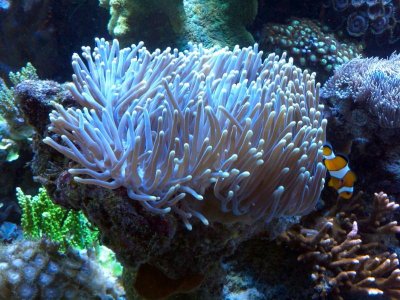
The gig is lookin good the same.
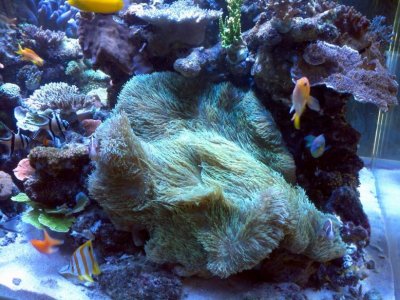
Sent from my Xoom using Tapatalk 2
The gig is lookin good the same.
Sent from my Xoom using Tapatalk 2

Gary Majchrzak
Team RC
I had no problem with mag and haddoni in same the aquarium. Ditto with hundreds of tapetum, Entacmaea and a Macrodactyla in the same aquarium.
At one point I even had a huge Condylactis gigantea in there.
It's all moot. I wasn't "lucky".
There's many reasons filtration is recommended for reef aquaria.
I'm quite surprised at some of the beliefs I've read about in this thread.
At one point I even had a huge Condylactis gigantea in there.
It's all moot. I wasn't "lucky".
There's many reasons filtration is recommended for reef aquaria.
I'm quite surprised at some of the beliefs I've read about in this thread.

elegance coral
They call me EC
I've had an established and settled anemone suddenly get up and march directly down the length of an aquarium to do battle with a newly introduced anemone. (Others have had the same experience.)
I've had this happen more than once. I couldn't detect any "battling" going on though. There may have been IDK. The resident anemone simply moved across the tank and parked itself up next to the new guy. Not sure why.
I added my gigantea and my haddoni moved across the tank. This is the pic I snapped before moving my haddoni.

Another time, I added my gigantea to a tank housing my magnifica and this happened.


OrionN
Moved on
EC,
In either case, were there any damage to the anemones? My Gigantea touch the Maxi-mini for months now without any aggression.
I am particularly interested in Magnifica and Gigantea interaction because this is what I want to put together in a system. Were there any in the two pictures above?
In either case, were there any damage to the anemones? My Gigantea touch the Maxi-mini for months now without any aggression.
I am particularly interested in Magnifica and Gigantea interaction because this is what I want to put together in a system. Were there any in the two pictures above?
OrionN
Moved on
Three weeks and no noticeable adverse reactions or behavior from either anemone. The Mag has settled in nicely.
View attachment 220524
The gig is lookin good the same.
View attachment 220525
Sent from my Xoom using Tapatalk 2
This is really good news for me.
elegance coral
They call me EC
EC,
In either case, were there any damage to the anemones? My Gigantea touch the Maxi-mini for months now without any aggression.
I am particularly interested in Magnifica and Gigantea interaction because this is what I want to put together in a system. Were there any in the two pictures above?
I did not see any damage, or ill effect to any of the anemones above.
I did find it curious for an anemone that had been stationary for a very long period of time to suddenly up and move next to a newly introduced anemone. There must be some cause for this behavior. Unfortunately, I don't know why they did this, how they knew there was a new anemone in the tank, or how they knew where it was.

Here's a video of the gigantea and magnifica. I don't see any signs of stress in either of these anemones, but it's not like I can take their blood pressure or really do any tests to see if they are under stress. A doctor can test my body and tell that I'm under a great deal of stress, even when those around me have no clue. This may have been very stressful on both anemones. I simply do not know.
<iframe width="420" height="315" src="http://www.youtube.com/embed/3kBumSHXgus" frameborder="0" allowfullscreen></iframe>
Last edited:
elegance coral
They call me EC
IMHO, with very minimal research it becomes obvious that allelopathy, and other chemical forms of communication, are common on coral reefs. From anemones, sponges, corals, algae, and others. It would be rare to find one of these sessile organisms that did not use some form of chemical communication.
I'm not aware of any research showing that anemones release chemicals that have allelopathic abilities towards other anemones, and short of that, I don't believe the evidence we have to support this assumption meets the requirements for scientific proof. However, the abundance of anecdotal evidence, both witnessed first hand by myself, and witnessed by countless others, is to much to ignore. I simply would not be able to explain the things I've seen without using allelopathy.
To me, this question is like asking if we're alone in the universe. The evidence to suggest that there is life out there somewhere is overwhelming. We just lack the concrete proof.
I'm not aware of any research showing that anemones release chemicals that have allelopathic abilities towards other anemones, and short of that, I don't believe the evidence we have to support this assumption meets the requirements for scientific proof. However, the abundance of anecdotal evidence, both witnessed first hand by myself, and witnessed by countless others, is to much to ignore. I simply would not be able to explain the things I've seen without using allelopathy.
To me, this question is like asking if we're alone in the universe. The evidence to suggest that there is life out there somewhere is overwhelming. We just lack the concrete proof.
reefkeeper2
Premium Member
That is an amazing video. I wouldn't think they could be in contact like that and not hurt each other. If they seek each other out like so many people report, I wonder what the purpose is? Safety in numbers from predation maybe. A bunch of anemones together would fair better than a lone anemone.
82ndengineer
New member
Why can't I watch the video? I wanna see too!!!!
elegance coral
They call me EC
EC,
That is one great Video. How long did you have them together, or are you still have them together and that is today video?
The anemones weren't together for long. I kept the mag on a pillar in the center of the tank. I came home from work one day and found the mag next to the gig. I snapped a couple of pic's and made the video, then moved the mag back to its pillar. I don't know how long they were next to each other, but it couldn't have been more than a few hours.

stickleback
Member
The anemones weren't together for long. I kept the mag on a pillar in the center of the tank. I came home from work one day and found the mag next to the gig. I snapped a couple of pic's and made the video, then moved the mag back to its pillar. I don't know how long they were next to each other, but it couldn't have been more than a few hours.
Did the mag then stay on the pillar?
Gary Majchrzak
Team RC
if different species, the purpose is warfareThat is an amazing video. I wouldn't think they could be in contact like that and not hurt each other. If they seek each other out like so many people report, I wonder what the purpose is?

We all realize anemone warfare can be like watching paint dry (slow!), right?
The development of enzyme secreting glands, mesenterial filaments, acontia filaments, cnidae (spirocysts, ptychocysts and nematocysts) are a result of evolution- not accident. Survival of the fittest!
Why would sessile animals (corals) develop the ability to sting neighbors and inhibit other species from thriving in close proximity to them and not Actiniarians (sea anemones)?
Get out the popcorn: I've seen video of one anemone species eating (!) another and I wonder if you guys have seen that one?
This warfare isn't limited to anemones.
I have some pix somewhere of a Ricordea eating an Aiptasia and I've seen Plerogyra (bubble coral) repel a H. mag with it's very potent stings.
Anemone (and coral) aggression is real and it's happening everywhere these critters exist: the open ocean, dealer's tanks, well filtered reef aquariums etc. etc.
OrionN
Moved on
I certainly not as sure as Gary regarding the purpose of the move is warfare. If it is they would start sting right away. What is the sense of moving right next to an enemy, exposed to attack and not doing anything about it? If the purpose is to fight, as soon as it reach it's target, it would attack right away.
Also if the purpose is to fight, it would continue to move to the new anemone.
It is possible that on arrival, the new anemone can be located because it "smell" has not saturated the water in the aquarium. But after a day or two, with saturation of the water, it can no longer be locate by the resident anemone. This can be a logical and possible hypothesis that explains possible cause of movement of resident anemone response to a newly introduced anemone. But logical and possible does not always mean correct. I don’t think there is anyway we, as reefer, can confirm or disproof this hypothesis.
In the wild anemone locate, move over and fight each other. I still think that in our aquarium, they cannot locate each other because of saturation of chemical. And that they can do battle but highly unlikely involve in any form or distance chemical warfare. Any allopathic affect we observe in aquarium are purely accidental due to the high concentration of released (for other purpose, or due to illness of the anemone) of chemical in our tank.
Also if the purpose is to fight, it would continue to move to the new anemone.
It is possible that on arrival, the new anemone can be located because it "smell" has not saturated the water in the aquarium. But after a day or two, with saturation of the water, it can no longer be locate by the resident anemone. This can be a logical and possible hypothesis that explains possible cause of movement of resident anemone response to a newly introduced anemone. But logical and possible does not always mean correct. I don’t think there is anyway we, as reefer, can confirm or disproof this hypothesis.
In the wild anemone locate, move over and fight each other. I still think that in our aquarium, they cannot locate each other because of saturation of chemical. And that they can do battle but highly unlikely involve in any form or distance chemical warfare. Any allopathic affect we observe in aquarium are purely accidental due to the high concentration of released (for other purpose, or due to illness of the anemone) of chemical in our tank.
Gary Majchrzak
Team RC
Minh- have you ever witnessed one of your aquarium fishes sniff out an unseen piece of food under a rock?
Why would animals without eyesight (anemones) not develop a KEENER sense of smell than those that can see?
And why do we filter reef aquariums?
I can understand your skepticism of the "proximity effect" in an unfiltered aquarium full of year old chemical soup... but in a well filtered reef aquarium the proximity thing is pretty obvious in MOST critters.
Why would animals without eyesight (anemones) not develop a KEENER sense of smell than those that can see?
And why do we filter reef aquariums?
I can understand your skepticism of the "proximity effect" in an unfiltered aquarium full of year old chemical soup... but in a well filtered reef aquarium the proximity thing is pretty obvious in MOST critters.
OrionN
Moved on
Gary,
When something is decaying, it gives off more and more of the decaying product as it decays. The ammonia and other decaying product are clear off every quickly in our aquarium by our biological filter. It is not the same as something that give off a constant amount as scent, pheromone or whatever marker that it give off. Substances that use as marker or communication tend to be very potent, stable and not degrade very quickly in natural condition. This is why I feel that then tend to be saturated in aquarium. If you have Ozone or other oxidizing agent as part of your filtration system, then obviously it is different. Most of us use skimmer and rock and sand as filtration. I think skimmer likely to remove some of these, but rock and sand, IMO, is not effective in removing communication chemicals.
You know how I feel about chemical that use for fighting and release into open water.
This discussion is very stimulating. I enjoy trying to convince you very much.
When something is decaying, it gives off more and more of the decaying product as it decays. The ammonia and other decaying product are clear off every quickly in our aquarium by our biological filter. It is not the same as something that give off a constant amount as scent, pheromone or whatever marker that it give off. Substances that use as marker or communication tend to be very potent, stable and not degrade very quickly in natural condition. This is why I feel that then tend to be saturated in aquarium. If you have Ozone or other oxidizing agent as part of your filtration system, then obviously it is different. Most of us use skimmer and rock and sand as filtration. I think skimmer likely to remove some of these, but rock and sand, IMO, is not effective in removing communication chemicals.
You know how I feel about chemical that use for fighting and release into open water.
This discussion is very stimulating. I enjoy trying to convince you very much.
Gary Majchrzak
Team RC
how did you jump to decaying matter?
My fishes generally don't eat decaying matter.
Have you ever seen a fish sniff out a fresh (not decayed) UNSEEN piece of pellet food?
(Gee- they can even smell FRESH food when I add it to my sump!)
Have you ever seen an anemone grab flesh and reject plant matter for that matter? Ever wonder why?
It's quite obvious that anemones have heightened physical awareness!
Google the ciliary cone complex. This is the structure in anemones which is sensitive to mechanical and chemical stimulii.
Mastigiphores are used to capture prey and for defense.
This stuff may or may not be online.
Greg (bonsainut) has the Shick book I need LOL!
My fishes generally don't eat decaying matter.
Have you ever seen a fish sniff out a fresh (not decayed) UNSEEN piece of pellet food?
(Gee- they can even smell FRESH food when I add it to my sump!)
Have you ever seen an anemone grab flesh and reject plant matter for that matter? Ever wonder why?
It's quite obvious that anemones have heightened physical awareness!
Google the ciliary cone complex. This is the structure in anemones which is sensitive to mechanical and chemical stimulii.
Mastigiphores are used to capture prey and for defense.
This stuff may or may not be online.
Greg (bonsainut) has the Shick book I need LOL!
reefkeeper2
Premium Member
if different species, the purpose is warfare
We all realize anemone warfare can be like watching paint dry (slow!), right?
The development of enzyme secreting glands, mesenterial filaments, acontia filaments, cnidae (spirocysts, ptychocysts and nematocysts) are a result of evolution- not accident. Survival of the fittest!
Why would sessile animals (corals) develop the ability to sting neighbors and inhibit other species from thriving in close proximity to them and not Actiniarians (sea anemones)?
Get out the popcorn: I've seen video of one anemone species eating (!) another and I wonder if you guys have seen that one?
This warfare isn't limited to anemones.
I have some pix somewhere of a Ricordea eating an Aiptasia and I've seen Plerogyra (bubble coral) repel a H. mag with it's very potent stings.
Anemone (and coral) aggression is real and it's happening everywhere these critters exist: the open ocean, dealer's tanks, well filtered reef aquariums etc. etc.
There is no question about warfare between animals on the reef. Especially between different species competing for space. But those anemones in that video are not stinging each other. It would be immediately evident if they where. I think in this instance and with these two species there is some other advantage to this behavior. Has anyone observed anemones of the same species moving together in aquariums or is it just different species?
Similar threads


- Replies
- 14
- Views
- 280
