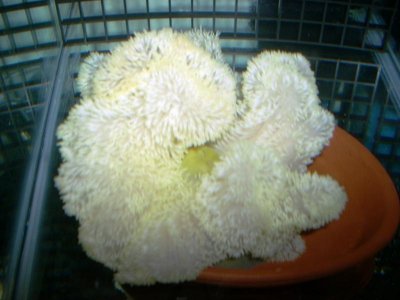
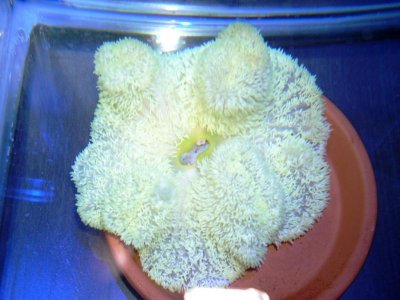
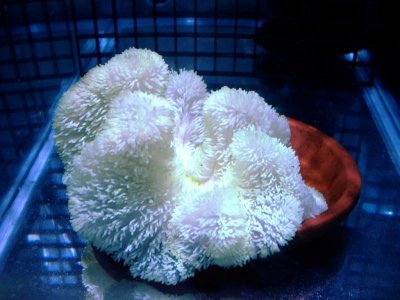
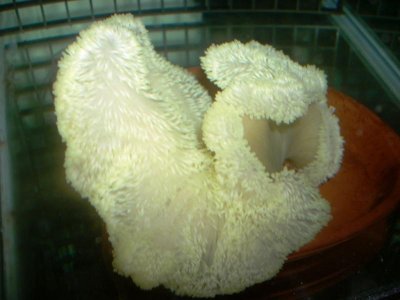
New gigantea from LA

It looks promising. of course a tight mouth is what we thrive for but the way it looks does not present a major problem. Is it sticky?

 
Stickiness is not indicative of health. It just means that the nem can fire its nematocysts. On the opposite end of the spectrum, dying gigantea have the ability to fire their nematocysts. The first gigantea I had shot its nematocysts all over the tank.

IME stringy zoox is actually a good sign. It means that the nem is not holding onto dead zoox. Most of the infected nems expel zoox in the form of pellets.

Even if the nem bleaches, if you manage to iradicate the pathogen, you can quickly bring back the zoox population. I am more than willing to give you a few tentacles from my healthy gigs if it comes to that.
 
The anemone hasn't deflated but still has a slightly open mouth.

attachment.php


It is also still expelling Zooxanthellae in the form of black stringy goo.
I extracted it and under the microscope you can see it crawling with little organisms that obviously feed on the Zooxanthellae.

At this point I start worrying it may bleach completely.

I changed the light to a Kessil A360W in the hope it may help in the recovery.


That's what I'm doing. The filter is to keep the water clean.


My liveaquaria Gigantea bleached completely during treatment. One month later it still hasn't regained any color back.
 
My liveaquaria Gigantea bleached completely during treatment. One month later it still hasn't regained any color back.

I found so far that fully bleached is a death sentence for an anemone (or coral) unless it can reacquire some from a neighboring anemone or coral.

The anemone may live for a few months but will shrink and get weaker and weaker.

That was pretty much what happened to my crispa.

I guess you have enough other gigs that con donate some zoox, but if mine completely bleaches it will likely perish.

Has anybody tried Maxi Minis as zoox donors for gigs? That would be one I have.
 
I found so far that fully bleached is a death sentence for an anemone (or coral) unless it can reacquire some from a neighboring anemone or coral.

The anemone may live for a few months but will shrink and get weaker and weaker.

That was pretty much what happened to my crispa.

I guess you have enough other gigs that con donate some zoox, but if mine completely bleaches it will likely perish.

Has anybody tried Maxi Minis as zoox donors for gigs? That would be one I have.


I've had the opposite experience. In the past I have had bleached anemones fully recover on their own if given proper conditions.

Best of luck with yours, looks like it is responding well.
 
A bleached anemone with no zooxanthellae looks identical to the one with a few (even 1) zooxanthellae still in his tissue. Over 1 month, then we can see the different. One will recover and the other will not unless it get zooxanthellae from some where.

Zooxanthellae are specialized dinoflagellate in the genus Symbiodinium that are essentially obligate endosymbiotic, and does not live out side of the host animal in any significant degree.

It is unlikely that our anemone can get zooxanthellae from the environment if there is absolutely no zooxanthellae in his tissue.

I have had Bleached BTA that did not recover after at least 1 year. I eventually sold him for cheap when I moved from Seattle to Texas. He lived with continue feeding but I am sure without feeding he will not do well. I was new at reef keeping at the tie in 1997 (although I keep marine aquarium with macro algae in it for many years). He certainly did not become unbleached from the environment although I have a lot of corals and clams in a thriving reeftank that time.
 
Last edited:
I gave the fourth dose of cipro last night and it looks like the bleaching has stopped - I really hope so. It still has a quite a few tentacles with some brown in them so as of now there are still zoox left for recovery.

It hasn't deflated since I started treatment and the mouth is only slightly open.

At this point I'm hopeful the anemone will make it.
 
5. dose last night and seems to be stable.

It expelled another poop tightly packed with zoox. I put it under the microscope and it has quite a few critters on it. Since the poop was hanging out in the mouth for a while they may have come from the outside.

This is how it looks usually during the day:
attachment.php


Mornings and evenings
attachment.php


Last picture today
attachment.php


Its mouth is still sometimes open and it is barely sticky.

Getting ready to administer the 6. dose.
 

Attachments

  • 20150425-133800.jpg
    20150425-133800.jpg
    56.9 KB · Views: 2
  • 20150426-010801.jpg
    20150426-010801.jpg
    46.5 KB · Views: 2
  • 20150426-231200.jpg
    20150426-231200.jpg
    60.6 KB · Views: 2
There is a good chance that it will regain strength after the pathogen is removed and the anemone is placed in a stable environment with sufficient flow and light. It's definitely not a goner and is showing promising signs.
 
Looking pretty good today:

attachment.php


Gonna do a partial water change later and then give the 7th dose of cipro
 

Attachments

  • 20150427-200600.jpg
    20150427-200600.jpg
    60 KB · Views: 2
Treatment is done :bounce1:

This was it before the treatment and before it started to expel Zooxanthellae and deflated:

attachment.php


and this is the current state:

attachment.php


It still has some slightly brown tentacle tips so some Zooxanthellae are still remaining to start over.

Now the question is what to do with it. My new tank should have been here by now but got delayed again and will likely not be here before the end of the of May.
My current tank is full with all the frags I collected over the last months and has to be taken down to set up the new tank anyway. And any transfer brings always some risk of injury. Plus the percula would with high probability get into it and start bugging it.
So for now I would prefer to leave it alone in the hospital/quarantine tank and just continue daily large water exchanges with the main tank and let it recover some strength and color before letting some anemone starved clowns loose on it.

Also at which point would it be advised to start feeding it?
 

Attachments

  • 20150429-013800.jpg
    20150429-013800.jpg
    43.1 KB · Views: 1
He cannot stay in the HT and get feed. since he is on a piece of ceramic, moving him would not cause injury. He need to eat as bleached as he is. I would just clear an area for him and put him in the frag/DT tank and start feeding him. You don't need to feed him a lot, just enough to keep him from shrinking.
 
Well, my current main tank is only 25 gallon (including rock volume), at best twice the volume of the HT.
Also my HT has a skimmer and bio filter, so with water change I'm confident that I can keep a pretty good water quality. The light is also the same as in the DT.

But since I need to tear down my current DT anyway, I may do it rather sooner than later and transfer everything into a 40 gallon breeder.
 
Now it's mouth is closed and it's also pretty sticky.
I fed it 2 or 3 Mysis and it took them.

BTW, are gigs as dangerous for fish and shrimp as haddonis?
 
Now it's mouth is closed and it's also pretty sticky.
I fed it 2 or 3 Mysis and it took them.

BTW, are gigs as dangerous for fish and shrimp as haddonis?
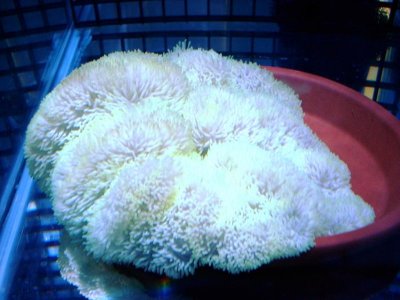
I've noticed a healthy gig can be almost as dangerous whith shrimps but I would still say Haddoni is more aggressive.
 
Last edited:
Back
Top