New LED DIY Build

I will be planning on hooking up all of the strings and setting the voltage and current to the minimum values. Then raising the voltage until the LEDs just light, then raising the current until I get to the desired level.

NO !!!!! .... Let me try and break this down:

Problem: a single driver to power multiple unbalanced strings by the use of load resistors in order to achieve current balance.

I highlighted the words "driver" and "load resistors" because they are at the core of your current (and "current") problems. A power supply deemed driver is basically a very very smart power supply. Load resistor are typically needed in "dumb" or voltage driven power supplies, so I fear by mixing of the two your are asking for issues. In your case this Mean Well is double smart in that it can drive to a specified current or a specified voltage - do not try to drive both! I know.... many who are, although it works for them, are theoretically operating these devices inappropriately - that said, yes, I can successfully hammer a nail in with a pipe wrench.

Now for some context. Best-case scenario: if you had one string or several balanced strings (ie same type & # of LEDs), then you would opt to run your Mean Well in "current regulation mode" ONLY. Hookup your DVM in series with the LED string, turn down the voltage POT all the way, then turn up the current POT until you measure the ideal operating LED current desired. Notice, no load resistors required - because the driver will self-vary voltages to maintain the set current (even if an LED shorts/dies)! This is the "ideal" way to drive LEDs. So note to self - consider independent drivers for different LED types (voltages), & do not mix on the same string (yes, seen it done - don't recommend it)!

However, let's leave our "ideal" world, your situation is unbalanced strings. Therefore, we can't use the current POT on your driver because it tries to regulate the sum of the current (all strings as one) attached. You are on the right track however - run the Mean Well in Voltage regulation mode - but ONLY in voltage regulation mode! That means turn the current POT all the way down, then turn the voltage POT up until you reach a desired voltage. Do this without any strings attached and connect your DVM measuring across the (+) & (-) terminals. Note: you "may" however need a small load attached, because the driver may detect an "open" circuit thus shutting itself off.

Now that the driver is in voltage-mode, we can now employ load resistors to isolate each string from affecting the others. We need some simple ohms law calculations for your load resistors to achieve "current balancing". Tip: in order to minimize stress on these load resistors we'll want to max out the total number of LEDs in each string to just under the max set voltage output of the driver. Here's how "I" would configure each string said our driver was set to constant 47V :

String 1 (2.9v LEDs):
(+)-->|-->|-->|-->|-->|-->|-->|-->|-->|-->|-->|-->|-->|-->|-->|-->|---/\/\/\/---(-)
(16) LEDs & (1) 1 ohm resistor {5-10 watts}

String 2 (3.1v LEDs):
(+)-->|-->|-->|-->|-->|-->|-->|-->|-->|-->|-->|-->|-->|-->|-->|-------/\/\/\/---(-)
(15) LEDs & (1) 1 ohm resistor {5-10 watts}

Now, the above two string calculations are good "on paper". The reality is that you won't hit the current specs exactly (but close). DO NOT try and muck with the current POT on the driver in order to tweak it in! Remember, you are in "voltage regulation" mode now, so the ONLY correct way to tweak current in each individual string is to alter the load resistors.

One caveat, I have not personally worked with that model Mean Well driver, BUT the datasheet clearly show it has the features I've described above.

Internet loses context, so please don't take my typing style as condescending. I see that you are a bit frustrated, and if you adhere to what I've written, you'll get out of this jam you are in (albeit your LEDs are not irreversibly damaged). I'd be happy to clarify any of this if you need - best of luck!
 
Last edited:
turn down the voltage POT all the way, then turn up the current POT until you measure the ideal operating LED current desired
This won't work if the voltage pot is too low. There will not be enough voltage to drive the current.
 
This won't work if the voltage pot is too low. There will not be enough voltage to drive the current.

Thank you FishMan "“ yes a nominal POT setting may be required to "boot" the opposing sensing circuitry - again, "I" have not worked with this driver per se. But the concepts I've outlined above in regards to fundamentally operating that driver in what we would refer to as "current regulation" vices "voltage regulation" mode still stands true and I stand behind it. It is the culmination of the scenario that he wants to power multiple strings having different current/voltage specs using the same single driver that he'll need to run that driver in constant voltage mode ONLY, and thus rely on individual load resistors to tweak in the required current specs in each of the strings. I read this thread up to now with all the different ways he should take, and Yes, some of those ways will indeed work (inadertantly I may add), Yes, his watts on those resistors are way too low too, BUT can we at least get sound fundamentals on how he should be "correctly" implementing this driver to best match the given scenario of mixed strings specs on one driver.
Just trying to provide help - not win an argument.
 
Sorry maybe I worded that poorly not trying to start an argument. Just trying to prevent a problem later when they may not be able to get the current up.
 
No worries FishMan - Yes I did read your comment correctly which is why I agreed with you that a nominal POT setting may be warranted. My point was more driven at the entire thread participation, so I don't mean to come off as confrontational either.

More on the Driver Datasheet: (page 5)
There are two major kinds of LED drive method "direct drive" and "with LED driver". A typical LED power supply may either work in "constant voltage mode (CV) or constant current mode (CC)" to drive the LEDs.
Mean Well's LED power supply with CV+ CC characteristic can be operated at both CV mode (with LED driver, at area (A) and CC mode (direct drive, at area (B).

Direct driving : Under direct driving, the power supply will work in "constant current mode (CC)" and output voltage of the power supply will be clamped by sum of forward voltage (VF) of the LED strip. The total forward voltage of series connecting LEDs is suggested for 75%~95% of power supply rated output voltage due to concern of the best PF
value and efficiency.

With LED driver :
Using additional driver, the power supply will work in "constant voltage mode (CV)" and output voltage of the power supply will be kept in rated value.
In this drive mode, several design issues need to be considered:
1.Output voltage of PSU must be higher than total forward voltage of series connecting LEDs by 3V minimum.
2.Input capacitor (Cin) of LED driver circuit should use 2.2uF ~ 22uF(typ.) of rating depends on the operating frequency of the LED driver.
The higher the operating frequency is used, the smaller value of Cin should be chosen, and vice versa.


Note: Mean Well is simply saying if you run their driver in Voltage-mode, you will want "with LED driver" circuit (not included). Most likely refering to a Buck circuit driver. BUT don't get side-tracked, this is still however the same point I was making - only difference in that we are proposing pre-calculated load resistors in lue of a Buck circuit. The reason they don't mention load resistors is becuase driving LEDs via current requlation is always the "proper" way. So to be more proper, set the Driver to voltage mode, then use Buck drivers (or load resistors) for each LED string. Call it a day and get back to reefing!
:)
 
Smith: you are the man! Thanks for clarifying a bit, a few additional questions to help me.

1. I have calculated the load of the resistors to be balanced, in theory the XR-E LEDs will operate at the 3.6v at 833ma and the XM-Ls at 3.0v. so by swapping a few of the XR-E's with the XM-Ls I can be ~mostly~ balanced in terms of load on the string. It is likely that each string is going to be a bit off due to variances in the LEDs, I was planning on measuring and swapping these LEDs to achieve better load balance in the string.

2. The power resistors were put in-line to simply get a reading of the current that is flowing across each of the strings, but I can't seem to get that working. When I read the voltage across the resistors they are wildly different (I think I'm doing something wrong here). Don't you simply read the voltage across the resistor with the circuit powered and divide by the ohm rating? If I wanted to use resistors to only read the current and not add any significant load would I want high or low ohm values? I will get some different resistors once I figure this out.

3. If I set the voltage to the target circuit voltage (46.2) then if all of the LED strings are correctly balanced it should be running at around 833ma, but if the LED strings are not balanced then half of the strings are going to be getting lots more current, how can I figure this out ahead of powering the circuit to avoid burning through a bunch more fuses?

Thanks again!
 
Smith: you are the man! Thanks for clarifying a bit, a few additional questions to help me.

(1) "so by swapping a few of the XR-E's with the XM-Ls I can be ~mostly~ balanced in terms of load on the string" <-- you are loosing me here... I'm not a fan of putting different LED characteristics on the same string. This goes back to one of the original posts I've placed in this thread. I know the rational of what you're trying to do (wink wink), but that is totally asking for problems and fried LEDs!! I won't go into theory but simply pushing a fixed current through a mixed-LED string does not guarantee each neighboring LED will auto-absorb it's proportional amount of energy dissipation (watts). Again, those that have (or are) doing this - good for you - but it's NOT best practice.

(2) Does your meter have an actual amperage measurement mode to allow in-line amperage readings directly (i.e. put your meter in-series with the entire string)? But if it's just a volt/ohm meter - than you're stuck with doing the voltage-drop math - sorry.

(3) Again - DO NOT mix/match LED types in the same string. So I've mocked-up several variations, and came up with this:

Setup driver for constant-voltage @ 45V solid

XR-E String:
45 Source voltage
3.6 diode forward voltage
833 diode forward current (mA)
12 number of LEDs in your array
2.2 ohm ~5 watts Load Resistor
total power dissipated by the array is 37,512 mW

XM-L String:
45 Source voltage
3.0 diode forward voltage
1,100 diode forward current (mA)
15 number of LEDs in your array
1 ohm ~5 watts Load Resistor
total power dissipated by the array is 50,710 mW

With the above parameters, you won't blow any LED's or fuses. Yes, in light of this information I understand you might need to adjust your LED quantity and/or layout, but these are the "electrical reality" of your situation. You could drop the driver voltage more and run lesser quantities through the LED wizard - just try to keep those load resistor very low in ohms ( shoot for < 3 ohms).
 
2) Low ohms. A large resistor will not represent the string when the resistor is removed. Case in point an infinite resistor (open circuit) will allow no current to flow. Remove the resistor (complete circuit) and current will flow)

3) You can't start with a lower voltage and see how far off you are.
 
Ok, I hear you on the mixing of LEDs on the string. When I first did my research I mistakenly thought that it was just balancing the total forward voltage on the string that mattered and then the current would split evenly across each of the voltage equal strings <-- my oversight.

Now to get myself out of this mess.

I originally thought that I would run the HLG at 833ma across each of the 6 strings, and then eventually if I needed it purchase a separate driver for the XR-E's and drive them separately, which would free up current that the XM-L's can use, split into three the current would be around 1600ma which would just about double the amount of light output.

I could accelerate these plans and order a new driver for the XR-E strings, if I used the LED calculator that you linked - thanks, here's what I come up with.

39 XR-E
3 strings of 13 LEDs
3.7v LED vf
1000ma per string
1ohm 1watt resistors

Then I would use the HLG-250 to drive the 3 strings of 13 XM-L:

39 XM-L
3 strings of 13 LEDs
3.1v LED vf
1666ma per string
40.3 source voltage

The thing I don't understand is why the calculator always adds a resistor to the circuit, even if the total source voltage matches the total forward voltage exactly. Why even have a resistor in these circuits? Man I am normally pretty good with this stuff, but these designs are throwing me for a loop.
 
Yup, that the thread that I got my idea for my build from, however there are a couple of key differences;

a) I'm using a voltage/current limiting driver so I can nail the voltage setting exactly to match with the hope to eliminate the need for the power resistor

b) I'm trying to mix two different types of LED across the strings.

I'm now also considering mixing the LED types evenly across the strings, 14 LEDs, 7 XM-L, 7 XR-E. This way there should only be minor differences in voltage drop and current. Any reasons this won't work or potential issues I'm not taking into consideration with this approach - other than the concept of not mixing LED types on the same driver?

Thanks!
 
Success!

Learning lessons the hardway is my MO for this month. I finally got the setup working properly, all 84 LEDs mixed XR-E and XM-L across 6 strings all balanced to within a quarter of a volt. What I did was to spread the LED's evenly across the 6 strings, so each string has 7 XR-Es and 7 XM-Ls. Turn the voltage up to the target voltage (in my case this was 45.5) and then slowly start raising the current and measuring, and voila, I am now running all of the LED strings at about 830ma of current and at 45.5v.

It is very very bright, even at 830ma the XM-L's are blinding, I can't imagine what they'd look like at 3a.

The only thing left now is to do some clean-up on the wiring, mount the rails and install in the hood.

Here are a couple of lessons learned along the way:

Buy your aluminum from a local metal supplier - it cost a quarter of what Rona was charging.

A wire brush on a drill can clean the aluminum channel quickly and does a great job.

When drilling 168 holes in aluminum a little bit of 3-in-1 oil makes it go a lot faster.

Make sure that you are using the right sized drill-bit for the tap, one size smaller works, but you will break the taps off in the hole.

You can use a cordless drill for tapping the holes, just make sure that you use it on the low speed setting, and have a drill that gives you a tork option. Tapping with the drill took hours off the build.

Use a tiny amount of heat transfer compound, it will get really squished when you tighten down the LED.

Nylon washers and 4-40 bolts are hard to find locally - I got mine cheap on ebay.

Make sure you have a good wire-stripper, I don't have one and my hands are now sore from stripping a ton of wire.

Soldering the LEDs is easiest if you pre-tin them before attaching them to the heatsink.

Skin burns when you repeatedly touch the iron.

It's nearly impossible to take a good picture of a fully lit LED array.
 
Try this for taking the pictire...

set up your camera on a tripod.

take one photo exposed on the illuminated bulb. (which will leave everything else black and the optics or led in correct exposure.

Then take another properly exposed on the heatsink.

down load Photomatix and merge the two together... Congrats, you just did an HDR photo and will love how it works perfect for photogtaphong items with bright spots and shaddows...
 
MHG: thanks for the tips, I'm going to try to get some nice shots once I have everything setup, I got a nice tripod just for this purpose.

Here is a FTS with the new lights installed...

picture.php


Looks so nice, lucky that I got a great color mix. I didn't get any optics for the LEDs, I'm considering getting some now just to get the light a little more directed.
 
If the picture approximatly resembles the same color when see it in person ... that looks really good :thumbsup:

If I've read your posts correctly it seems you're not gonna be able to adjust the RBs and CWs seperately - you're not afraid you're gonna regret that?
Or do you still have a way to make the CWs popup a little more than the RBs - or the other way round?
 
moliken, cutlass: re damsels - there are three of them in the tank, they were not a problem when I first added them, but they are getting more agressive, especially with the small regal tang that was added. I think cause he's blue with yellow they think he's a threat. I would love to trap them somehow, just not sure how to do it - I fear having to tear down the tank to get them out.

kcress: the sand is a really fine powder aragonite that I got from the LFS, when I put it in it really clouded up for about a week then settled down, but I wish I would have got a slightly more course sand as a diamond goby clouds it up with all his sifting.

Jimmy: I have no way to adjust the color, as they're all being run off of one driver, if I did the build again, I would go with two drivers. But more for being able to maximize the output of the CW which are running at about 1/2 their potential output. Still the color and intensity look nice, and I might try to put some optics on there to get more focused light.
 
if I did the build again, I would go with two drivers. But more for being able to maximize the output of the CW which are running at about 1/2 their potential output.

How much are you running the XMLs at now?
Would you say I could run them @ 1000mA when equipped with 80° optics?
Theoretically they should put out more light than an XPE CW @ 1000mA

I have 2 HLG-150-36Bs (4.2A) for the XMLs, and running them at 1000mA would save me an HLG-150
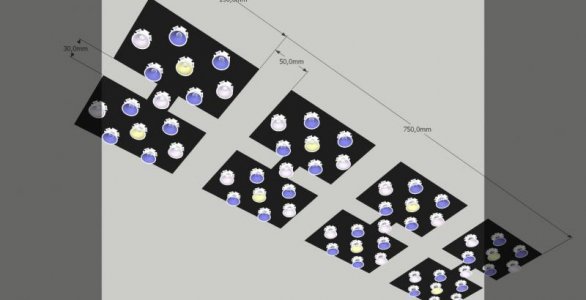
Instead of two drivers I could run 40 CW's from one driver and use the other one for 16 XML NW's, of which I put one between every two CW's. (thumbnail shows what I mean, I'm building two of those fixtures)
It would be nice to adjust the 16 NW's seperate from the CW's and still have some upgrade possibilities.
 

Attachments

  • LED setup.jpg
    LED setup.jpg
    31.3 KB · Views: 24
Last edited:
Back
Top