overskimming ha!!

<a href=showthread.php?s=&postid=7887115#post7887115 target=_blank>Originally posted</a> by RichConley
Right, but for every pocket that swirls down with increased contact time, one gets swirled up, and has decreased contact time.


Rich... you continue to ignore (or confuse) "dwell time" and "contact time".

You are trying to use a mean average. One type of contact removes only the short contact stuff. The other type of contact removes the LONG and SHORT contact stuff.

So lets say the same NET amount of stuff is removed in both types of skimmer. Do you want the skimmer that gets all the types of stuff, or the one that just gets some types? Think about that hard before you answer!
 
People need to just ignore me and read Beans posts.

Generally we're thinking exactly the same thing, hes just WAY more articulate than me in most cases.

Thanks bean...carry on everyone.
 
LOL... are you hitting on me?

I just like a good conversation once in a while.. we can certainly take this to a new thread if need be :)
 
Also... no need to ignore your posts rich, you have brought up some very good points. None of us have all of the answers, and a lot of us seem to be looking at one or two key things and leaving others out. I have tried to put it all together, and certainly don't think I did it in an articulate way!

Sleepy sleepy and time go beg the dogs, cat and wicked witch for some room on the edge of the bed.
 
<a href=showthread.php?s=&postid=7887144#post7887144 target=_blank>Originally posted</a> by BeanAnimal
You are trying to use a mean average. One type of contact removes only the short contact stuff. The other type of contact removes the LONG and SHORT contact stuff.

So lets say the same NET amount of stuff is removed in both types of skimmer. Do you want the skimmer that gets all the types of stuff, or the one that just gets some types? Think about that hard before you answer!

Right, I get that.

I agree, that conceptually, getting some of everything is the best situation, but we're into a very grey area here, as, like you said, theres some turbulence in all skimmers.

The question is, how much efficiency (at grabbing short contact protiens) do we lose, trying to grab the long ones? And generally, how much of each do we have? IE are we optimizing to grab these longer protiens, when its not needed? I dont really know.

I agree with you though, just build bigger and taller. More contact time, more dwell time. Bigger skimmers are better.
 
Yup... and you know i am not fully sold on venturi intakes and like to force air either into stones or RC loops anyway.... so taller is something I shoot for no matter what. I base this on the work of Escobal and some other foam fractition papers. However not all of us have room to go up, so in that case fat recircs are really the only choice.

I honestly think that the swirling can be of great benefit if it is well designed.
 
<a href=showthread.php?s=&postid=7887173#post7887173 target=_blank>Originally posted</a> by RichConley
Right, I get that.

I agree, that conceptually, getting some of everything is the best situation, but we're into a very grey area here, as, like you said, theres some turbulence in all skimmers.

The question is, how much efficiency (at grabbing short contact protiens) do we lose, trying to grab the long ones? And generally, how much of each do we have? IE are we optimizing to grab these longer protiens, when its not needed? I dont really know.

I agree with you though, just build bigger and taller. More contact time, more dwell time. Bigger skimmers are better.

Where do you get this notion of long and short proteins in relation bubble to contact time? As a chemistry major, proteins fall into to major categories, hydrophobic (water-fearing) and hydrophilic (water loving). Of course proteins have different masses but I don't understand how that would affect it's ability to bond to the oxygen molecules. Are you implying that by swirling, (therefore giving more dwell and contact time...they are the same) that skimmers are attempting to remove "long" rather than "short" proteins? I don't agree, the point of swirling is simply to extend the time that proteins have to bond with oxygen molecules.
 
a quote from Randy Holmes-Farley's article on skimming in Reefkeeping Online Magazine:

http://reefkeeping.com/issues/2006-08/rhf/index.php#10

"Likewise, the way the bubbles move relative to the water is important. If the bubbles are moving against the water's flow, or are in a turbulent environment, the required absorption time will be lower (because the flow helps bring organics to the interface) than if the bubbles are moving with the flow".

If we could all just agree that swirling can increase the distance the air/water mixture must travel inside a skimmer this debate is all over. Molecules not only adhere as bubbles rise- they also adhere as bubbles travel horizontally. Exposure is increased with swirling. The bubbles must travel a greater distance if swirled (albeit in the same amount of time if they were not swirled because X in =X out).
 
Last edited:
Gary, If you read my lengthy post, that is exactly what I describe :0

LBCBJ, I think your statement begs to differ with itself... either that or you have confused LONG and SHORT with physical attributes and I was using the terms to differentiate contact times. One of Escobals main points was that different protiens take different amounts of time to bond. I simply attempted to describe these as "long" and "short" even though it would be logical to assume they vary at all points in between :)

Keeping a single protien in contact with a single bubble appears to be the key here. The longer the contact, the more apt the protien is to "stick". So therefore the longer the bubbles path the better chance the stubborn protiens have to stick. The "easy" protiens will stick in any skimmer.
 
<a href=showthread.php?s=&postid=7885042#post7885042 target=_blank>Originally posted</a> by Gary Majchrzak
Why are skimmers of the same height yet different diameter rated differently at the same GPH?
Contact time is the answer.
This is the truth. We must move on. This debate has sidetracked the original thread.
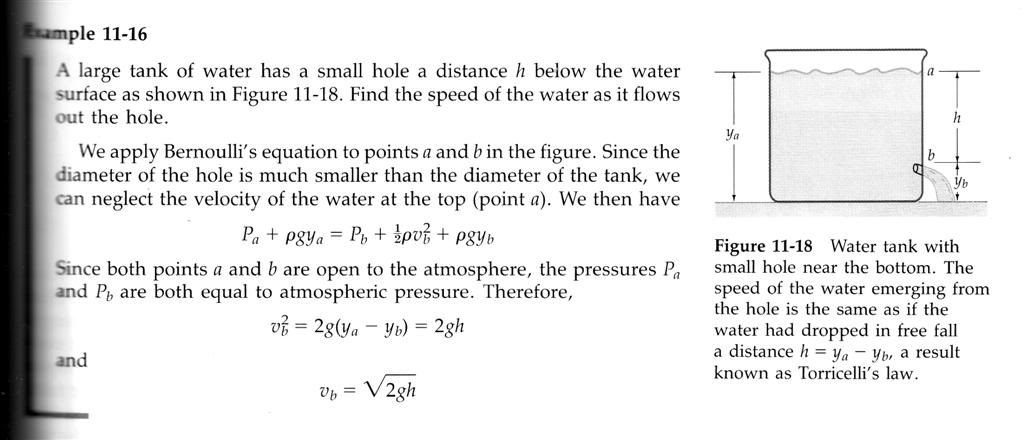
I've tried to explain this the best I can but you continue to mention the diameter. Here's is the simpliest example I could quickly find. Its on pg 349 of a popular basic text called "physics" by Paul Tipler.


click to enlarge

Our situations are different because we are adding water also and other things going on, making it more complicated. But as far as the water rising goes, it shows that because the diameter of the cylinder is set (not changing), the outgoing water velocity (which contact time depends upon) is only dependant on the height (or the rate of the incoming water). If the water was spinning Torricelli's law still wouldn't change. I imagine that in the contact time formulation that the dx and dy would be zero and their integral would go to one.
<a href=showthread.php?s=&postid=7885172#post7885172 target=_blank>Originally posted</a> by LBCBJ
This discussion is way to damn complicated. A simple mind should understand that a given volume of water that is forced up, back down, and then back up (hence "swirling") will have greater contact time than a stream of water that flows only upward.
Making a good skimmer can be quite complicated and these are some of the same calculations skimmer manufactures will do. The swirling referred to here isn't "forcing up, back down and then back up".
<a href=showthread.php?s=&postid=7885172#post7885172 target=_blank>Originally posted</a> by LBCBJ
All of the water in my Deltec does not move vertically at the same rate, some pockets of water are "swirled" and therefore held in the reaction chamber for a slightly longer amount of time.
The average vertical velocity will stay the same. For those that move up quickly, there will be those that move up slowly.
<a href=showthread.php?s=&postid=7885722#post7885722 target=_blank>Originally posted</a> by manderx
like i said before, it's easy to test with a bucket. knock yourself out.
I will get two buckets, put air stones in both coming from an air pump, put a powerhead in one so it swirls. When the air pump is shut off I doubt that the swirling bucket will keep the air bubbles longer but I will test it because of your suggestion. But if it does, I agree that this will increase/decrease dwell time.
 
Last edited:
Bean,

Thanks for your post and joining the discussion. I have to go out but will reply tonight.

<a href=showthread.php?s=&postid=7887765#post7887765 target=_blank>Originally posted</a> by Gary Majchrzak
a quote from Randy Holmes-Farley's article on skimming in Reefkeeping Online Magazine:

http://reefkeeping.com/issues/2006-08/rhf/index.php#10

"Likewise, the way the bubbles move relative to the water is important. If the bubbles are moving against the water's flow, or are in a turbulent environment, the required absorption time will be lower (because the flow helps bring organics to the interface) than if the bubbles are moving with the flow".

If we could all just agree that swirling can increase the distance the air/water mixture must travel inside a skimmer this debate is all over. Molecules not only adhere as bubbles rise- they also adhere as bubbles travel horizontally. Exposure is increased with swirling. The bubbles must travel a greater distance if swirled (albeit in the same amount of time if they were not swirled because X in =X out).

Gary,

I quoted that passage a while back in this thread. That article isn't very different from the article he wrote a few years ago, nothing really new with respect to this discussion. We also have to look at the air and water seperately, not link them together and come to simple conclusions based on the 'air/water' mixture.

Firstly, without the swirling, the environment is turbulent. The air/water mixture is not just rising calmly. It has motion left and right so I don't agree that the swirling automatically increases distance traveled.

Secondly, the key to what Randy said is that water and air moving in opposite directions would decrease contact time, not the same (which I said several times earlier in this thread) direction. Looking at the video's provided, it would seem that the swirling actually hampers this because if anything it helps to move the air and water in the same direction together.
 
Last edited:
<a href=showthread.php?s=&postid=7887765#post7887765 target=_blank>Originally posted</a> by Gary Majchrzak
a quote from Randy Holmes-Farley's article on skimming in Reefkeeping Online Magazine:

http://reefkeeping.com/issues/2006-08/rhf/index.php#10

"Likewise, the way the bubbles move relative to the water is important. If the bubbles are moving against the water's flow, or are in a turbulent environment, the required absorption time will be lower (because the flow helps bring organics to the interface) than if the bubbles are moving with the flow".

If we could all just agree that swirling can increase the distance the air/water mixture must travel inside a skimmer this debate is all over. Molecules not only adhere as bubbles rise- they also adhere as bubbles travel horizontally. Exposure is increased with swirling. The bubbles must travel a greater distance if swirled (albeit in the same amount of time if they were not swirled because X in =X out).

Nicely put Gary...I don't understand why others are having difficulty understanding this. It's a basic concept. But, I don't agree with the last sentence of your statement. If certain pockets of water travel different distances then at least some of them remain in the reaction chamber for longer amounts of time. The water in the reaction is a mixture of new and old water (I'm talking about the water entering the skimmer second by second), meaning it is possible for a volume of water that entered 1 second later to leave the skimmer before the water that was there 1 second before.
 
To reiterate,

What Randy said is that contact time is decreased when water and air move in opposite directions, not in the same direction together. It doesn't matter how much distance is traveled, if they are moving together in the same direction uniformly, the process goes back to depending upon diffusion, which can take hours as Randy also pointed out.
 
Kimoyo, with all due respect I think you are missing some very important mechanics here. You are focusing on one aspect from one standpoint. That is the Volume in over time T and the volume out over that Time T.

Look at it this way. I feed one end of a lake with garden house and at the other end I poke a hole in the dam to allow exactly that amount out. Some of the introduced water will undoubtably make it's way directly to the hole in the dam while other portions of the introduced water will find a much slower route to the output of the dam.

You guys (some of you) seem to be missing the bigger picture here.
Air entrained in the water will follow the path of the water. Like I said the air will try to escape as it is buoyant. This effect will slow the water down more than it would otherwise slow down without the air. However, the air is still entrained and following the path of the water. This will substantially increase the contact time between some water molecules and their host or comingled bubbles. This is exactly what we want.

You guys are confusing "counter current" water flow and what goes on there. In a counter current flow the contact time IS INCREASED for some of the molecules and not others. Of course of a water molecule and bubble pass like two trains on opposite tracks, the contact time is reduced. However don't forget that the ovarall downward flow of water in a CC skimmer body has the effect of reducing the upwards velocity of the bubbles. AGAIN those water molecules with stuck protiens that are attached to the surface tension of a bubble will have a MUCH greater contact time than of the water column was neutral or upflowing.

This is some very simple mechanics, but it seems to be overlooked by most of the conversation here.

Please once again note that most (all?) of the reputable foam fractition studies show that contact time between a protien and an air/water interface is the key component to removal.

CC skimmers and swirling skimmers simply increase the contact time of SOME of the protiens to a host bubble. That is exactly what we want.

LBCBJ you are partly on the right track, but you are thinking of a FIFO (first in first out) model... and this is simply not the case. Please take not of the lake example above.

If you still don't believe the concept, then some food coloring in your skimmer should give you an indication what is going on.

Lets say your skimmer holds 1 gallon and the feed pump does 2 gallons a minutes. Simply pouring 1 gallon of colored water directly into the feed line while the skimmer is running clean water should take exactly 30 seconds to suck in turn the reaction chamber color, then clear. I think you will find that the residual color lasts a lot longer than 30 seconds :)
 
<a href=showthread.php?s=&postid=7888117#post7888117 target=_blank>Originally posted</a> by BeanAnimal
Kimoyo, with all due respect I think you are missing some very important mechanics here. You are focusing on one aspect from one standpoint. That is the Volume in over time T and the volume out over that Time T.

Look at it this way. I feed one end of a lake with garden house and at the other end I poke a hole in the dam to allow exactly that amount out. Some of the introduced water will undoubtably make it's way directly to the hole in the dam while other portions of the introduced water will find a much slower route to the output of the dam.

You guys (some of you) seem to be missing the bigger picture here.
Air entrained in the water will follow the path of the water. Like I said the air will try to escape as it is buoyant. This effect will slow the water down more than it would otherwise slow down without the air. However, the air is still entrained and following the path of the water. This will substantially increase the contact time between some water molecules and their host or comingled bubbles. This is exactly what we want.

You guys are confusing "counter current" water flow and what goes on there. In a counter current flow the contact time IS INCREASED for some of the molecules and not others. Of course of a water molecule and bubble pass like two trains on opposite tracks, the contact time is reduced. However don't forget that the ovarall downward flow of water in a CC skimmer body has the effect of reducing the upwards velocity of the bubbles. AGAIN those water molecules with stuck protiens that are attached to the surface tension of a bubble will have a MUCH greater contact time than of the water column was neutral or upflowing.

This is some very simple mechanics, but it seems to be overlooked by most of the conversation here.

Please once again note that most (all?) of the reputable foam fractition studies show that contact time between a protien and an air/water interface is the key component to removal.

CC skimmers and swirling skimmers simply increase the contact time of SOME of the protiens to a host bubble. That is exactly what we want.

LBCBJ you are partly on the right track, but you are thinking of a FIFO (first in first out) model... and this is simply not the case. Please take not of the lake example above.

If you still don't believe the concept, then some food coloring in your skimmer should give you an indication what is going on.

Lets say your skimmer holds 1 gallon and the feed pump does 2 gallons a minutes. Simply pouring 1 gallon of colored water directly into the feed line while the skimmer is running clean water should take exactly 30 seconds to suck in turn the reaction chamber color, then clear. I think you will find that the residual color lasts a lot longer than 30 seconds :)

Bean, can I place my signature at the bottom of this quote? This is exactly what I've been trying to say in a brief manner. I tried to explain the exact opposite of the FIFO method but apparently you misunderstood me.
"The water in the reaction is a mixture of new and old water (I'm talking about the water entering the skimmer second by second), meaning it is possible for a volume of water that entered 1 second later to leave the skimmer before the water that was there 1 second before."
Do you not agree with this statement? The lake and food coloring are good examples, being I was having trouble thinking of one myself. I agree 100% with the your above statements.

"However don't forget that the ovarall downward flow of water in a CC skimmer body has the effect of reducing the upwards velocity of the bubbles."

Exactly, and by slowing the upwards velocity of the bubbles this helps to increase contact time.
 
just came up on 2 gallons of skimmate and all appears to be doing well.. xenia seem to be pulsing very very rapidly.. I wonder if this is a sign that they are hungry.

All corals seem to be doing exceptionally well no real problems to speak of.

I understand this is only an observation and that results are swayed due to too many variables but Im starting to wonder if this over skimming thing is a joke. I never thought that It was true, but I had to see for myself.

Brian
 
<a href=showthread.php?s=&postid=7893218#post7893218 target=_blank>Originally posted</a> by LFS_worker
just came up on 2 gallons of skimmate and all appears to be doing well.. xenia seem to be pulsing very very rapidly.. I wonder if this is a sign that they are hungry.

All corals seem to be doing exceptionally well no real problems to speak of.

I understand this is only an observation and that results are swayed due to too many variables but Im starting to wonder if this over skimming thing is a joke. I never thought that It was true, but I had to see for myself.

Brian

wait another month, and see what happens.

I know in my tank (58 gallon, with Reef Octopus NW200), if I dont feed for 2 or 3 days, the SPS lighten up considerably.
 
There are several different ideas being put forth as to why swirling makes skimmers are more effective.

Gary started by saying that because the distance traveled is greater there would be a greater contact time. I understand how that can be confusing because students have trouble understanding the difference between speed and velocity all the time. I've tried my best to explain why this wouldn't be true and its detailed above.

Bean has pointed out,
<a href=showthread.php?s=&postid=7888117#post7888117 target=_blank>Originally posted</a> by BeanAnimal
Look at it this way. I feed one end of a lake with garden house and at the other end I poke a hole in the dam to allow exactly that amount out. Some of the introduced water will undoubtably make it's way directly to the hole in the dam while other portions of the introduced water will find a much slower route to the output of the dam.
Okay, great, :thumbsup:. Just like with all skimmers, some molecules will stay longer while other molecules go faster, I've even said that in this thread before. But we are talking about a net effect, whether swirling will improve the contact or dwell time of not one molecule but the average of all the molecules vs. not swirling. The colored water example was beautiful but lets move back to the real question.
<a href=showthread.php?s=&postid=7883702#post7883702 target=_blank>Originally posted</a> by manderx
yes, air out = air in, after it takes some time to hit equalibrium. there is this lag between the time the first bubble is injected till the first bubble exits. when you swirl the water, you extend this lag. forget about vector components, they don't apply here since the bubbles are so heavily influenced by the water around them. for example, if you have 2 skimmers with the same airflow going into it. in one skimmer the bubbles linger 20 seconds. in the other, they linger 30 seconds.
<a href=showthread.php?s=&postid=7888117#post7888117 target=_blank>Originally posted</a> by BeanAnimal
Air entrained in the water will follow the path of the water. Like I said the air will try to escape as it is buoyant. This effect will slow the water down more than it would otherwise slow down without the air. However, the air is still entrained and following the path of the water. This will substantially increase the contact time between some water molecules and their host or comingled bubbles. This is exactly what we want.
Bean and manderx have proposed that by swirling you increase the dwell time of the water (bean) and air (manderx) without increase the height or diameter of the skimmer. Lets make this very simple, supposed I have a sealed 5g container with two holes in it. One hole is the inlet and the second hole is the outlet with a constant input/output of 5g/min. The container has a finite volume and is filled full with water. I hope we can agree that water and air take up a finite amount of space in these conditions and now let's put some air bubbles in the container. There was 5g of water, now there will be less because the air has to physically take up room in the container and the water input rate can change. Bean and Manderx say that by swirling you increase the net (collective average) dwell time of the water or air by slowing it down. So we swirl the water/air mixture while we continue to add water/air (at different rates) in this enclosed container with a finite volume. If what Bean and manderx suggests happens, that a net amount of water/air slows and stays in the container longer (increasing dwell time) while we continue to add water at a constant rate, then the volume of water and air inside the container would have to increase. Swirling cannot have a net slowing of air and water inside the container with a constant input because the container has a finite volume. Increase the volume of the container (increase the height, width), yes, that will increase the dwell time, but not just by swirling. Unless you can show that this average increase in dwell time can happen without increasing the volume or changing the input/output rate, which is the theory prosposed (please don't change theories again), it doesn't work because as Bean said,
<a href=showthread.php?s=&postid=7887087#post7887087 target=_blank>Originally posted</a> by BeanAnimal
yes the qty of water in = the qty water out. The qty air in= the qty air out.
By all means, If swirling increased dwell time I would be all for it, swirl that baby up! I wouldn't need a 5ft skimmer standing next to my tank, I could put the skimmer under my stand, man that would be perfect and I would be extremely happy! But, unfortunately, you guys have not said one thing in this thread that physically supports what looks like only marketing claims. You can not shrink a 5' skimmer to 3' skimmer (same diameter) with dwell time just by swirling the water in it.


Bean, it would not be constructive for me to address your previous post. But eddy currents have nothing to do with this, and talking about shear, a second rank tensor (not sure if you knew), without talking about vector components in this conversation isn't productive.

 
Kimoyo, your still missing they key component... LETS ASSUME the NET volume of air does not change (as you aleady noted). It is realesed, and the throughput of the skimmer does not change with regards to water either. Those are fixed inputs with dictated outputs.

However some coheared water/air molecules stay longer than others. It's that simple. For any given timeslice T there should be about the same amount of air and water in the skimmer. Some of that air could have been there for minutes, while some of it could have just entered and be on it's way out. The key is that not all of the air/bubble units will act this way. Some are independent of each other and follow shorter paths.

With a direct ascent, all of the air goes straight up and out. In a turbulant skimmer body this would not be the case, muc of the air would be sent on long journeys up and down before escaping.

The swirling is similar to the turbulance, but it is more ordered and less stressful for the tiny bubbles.

Enjoy.
 
Last edited:
Back
Top