Pete's 110 build

Hey Pete, do you run your CaRx in-sump or outside the sump? Is there any risk in running them in-sump that you can think of?

Speaking of controlling the flow-through the reactor from the "feed" side... I'm considering using one of these 1/4" push-type (John-Guest) needle valves after the ball valve on my manifold. I think I would be able to get a better low flow rate by using it. Thoughts?

http://www.usplastic.com/catalog/item.aspx?itemid=32220&catid=662

Vertex also makes one but is 2x the price - and I think they are exactly the same thing. ;)
 
Last edited:
Hey Pete, do you run your CaRx in-sump or outside the sump? Is there any risk in running them in-sump that you can think of?

Speaking of controlling the flow-through the reactor from the "feed" side... I'm considering using one of these 1/4" push-type (John-Guest) needle valves after the ball valve on my manifold. I think I would be able to get a better low flow rate by using it. Thoughts?

http://www.usplastic.com/catalog/item.aspx?itemid=32220&catid=662

Vertex also makes one but is 2x the price - and I think they are exactly the same thing. ;)

Keeping the CaRx inside the sump is preferred, so if you have any slight leaks they are contained. The only concern would be heat or voltage leakage from a recirc pump. I know a couple people that keep them submerged in the winter and then elevate them in the summer to use the pump heat as needed.

Your link is to the same plastic needle valve I used in the past on the 300g and they work fine. They can clog so keep that in mind as I found it didn't take much sediment or build up to cause the flow to slow down or even stop. But as long as you have a visual on the flow and check it as part of your routine it shouldn't be an issue.

I think I still have at least one of those valves somewhere so I may have to do the same on my 110 as your describing. It's how I had my larger CaRx set up on my old 300g for the same reasons discussed. In retrospec I should have done the same setup for my 110g but probably just went with what it came with and didn't give it a second thought at the time. So thanks for reminding me.:thumbsup:
 
Keeping the CaRx inside the sump is preferred, so if you have any slight leaks they are contained. The only concern would be heat or voltage leakage from a recirc pump. I know a couple people that keep them submerged in the winter and then elevate them in the summer to use the pump heat as needed.

Your link is to the same plastic needle valve I used in the past on the 300g and they work fine. They can clog so keep that in mind as I found it didn't take much sediment or build up to cause the flow to slow down or even stop. But as long as you have a visual on the flow and check it as part of your routine it shouldn't be an issue.

I think I still have at least one of those valves somewhere so I may have to do the same on my 110 as your describing. It's how I had my larger CaRx set up on my old 300g for the same reasons discussed. In retrospec I should have done the same setup for my 110g but probably just went with what it came with and didn't give it a second thought at the time. So thanks for reminding me.:thumbsup:

Perfect! I think I've decided to run in-sump then - per your recommendation. That gets me out of having to build a shelf and a bunch of extra work to make this happen. :D YES, those are the exact valves I was linking to - sorry the link didn't work. Do you remember if you bought the ones from US Plastic or the Vertex branded valves from BRS?
 
Perfect! I think I've decided to run in-sump then - per your recommendation. That gets me out of having to build a shelf and a bunch of extra work to make this happen. :D YES, those are the exact valves I was linking to - sorry the link didn't work. Do you remember if you bought the ones from US Plastic or the Vertex branded valves from BRS?


I did get mine from US Plastics the only difference was the ones I got were threaded not John Guest. When I get home tonight I'm going to dig around in my parts boxes and see if I can find one.
 
hehe - I tried the link a seocnd time and it worked. I then edited my comment accordingly but you must have been responding already.

I did get mine from US Plastics the only difference was the ones I got were threaded not John Guest. When I get home tonight I'm going to dig around in my parts boxes and see if I can find one.

Awesome! I'll probably order 2 of the US Plastic ones then - one for backup. I need to double check the inlet plumbing size on the Geo Reactor (still waiting for it to ship) but it sounds like the ticket! :)
 
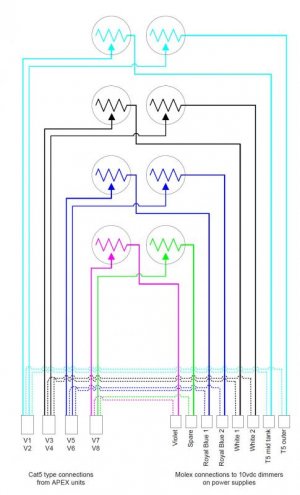
The APEX parts didn't come in last week but I at least built the dimmer box. I will hard wire the APEX dimmer cat5 style wires to the box so the manual dimmer controls work in series with the APEX. This will allow me to turn down the normal APEX settings manually for acclimating corals etc. The switch will send a signal to the APEX that will over ride the normal program to turn all dimmable ballast to 100% and from there I can manually make adjustments to each ballast to test alternate lighting configurations, set the tones for pictures, etc, etc.

file.php


file.php
 
That's freakin' awesome Pete. That seems to really make up for what the Apex VDM lacks in real-time controllability. And you've made it fully customizable for your lighting setup. Nicely done! :thumbsup:

What does the 2nd label from the top say - the dimmers below T5? What does V1 control?
 
That's freakin' awesome Pete. That seems to really make up for what the Apex VDM lacks in real-time controllability. And you've made it fully customizable for your lighting setup. Nicely done! :thumbsup:

What does the 2nd label from the top say - the dimmers below T5? What does V1 control?

thanks Brett and sorry about the picture glare
I'll probably change the labels, I put some on there more for this post then myself. But from top to botom they were intended to represent the T5's, Royal Blues (RB), Whites (WH) and Violets (VI). I noticed after I made the Vi tag that it wasn't going to stay long term but left it for now.

I may end up tagging all 8 dimmer knobs with a V1 - V8 (consistant with the APEX program) and add a color location code to each, if it will all fit on one or two lines of the label tape.

So
V1-T5's-loc# (location# could be; in/out or light position 1&8, 2&7, etc)
V2-T5's
V3-RB
V4-RB
V5-WH
V6-WH
V7-Violet
V8-spare

was also considering using the spectrum or spectrum range but it gets more complex
 
I see it now. Thanks for the explanation. It's going to give you so much more control over the system now that I see exactly what's going on. Love it! :)
 
I see it now. Thanks for the explanation. It's going to give you so much more control over the system now that I see exactly what's going on. Love it! :)

I just hope it works as planned :hmm2:
-----------------------------------------

pods at play behind my frag rack


<object width="853" height="480"><param name="movie" value="http://www.youtube.com/v/3xPVNiCPfIc?hl=en_US&version=3&rel=0"></param><param name="allowFullScreen" value="true"></param><param name="allowscriptaccess" value="always"></param><embed src="http://www.youtube.com/v/3xPVNiCPfIc?hl=en_US&version=3&rel=0" type="application/x-shockwave-flash" width="853" height="480" allowscriptaccess="always" allowfullscreen="true"></embed></object>
 
One of your great videos is being featured in Coral Magazine. Unfortunately, they are crediting the chap who put his name on your video.... That's just wrong :(
 
What??
Please elaborate. I know someone copied one of mine but said he copied it in his write up, wondering if it's another one

-------------

Update

I checked and they give referenced to me on a couple of them (by username) so I'm okay. I didn't know they were using them but I saw two of my vids featured there, kind of cool actually. Let me know if there are others without my user name referenced and I'll contact them accordingly.

thanks
 
Last edited:
Hey Pete, got a CaRx question for you... Got my reactor plumbed but haven't started CO2 yet as I'm trying to work out a couple kinks. As we discussed prior, I plumbed the GEO 618 reactor to my manifold and put a needle valve inline before the reactor (effluent is wide open). For some reason every time I turn the needle valve down to a normal operating drip rate I get TONS of bubbles in the reactor - which is causing the effluent rate to be very inconsistent. I don't see any leaks, however, I plumbed the "feed" side of the reactor with John Guest quick connect fittings. Do you think it could be sucking air from those fittings?? I haven't a clue why there's so much bubbling inside the reactor - almost skimmer-like. lol

I just looked at Reef Octopus Ca reactor pics and they have quick connect fittings standard. Weird... :confused:
 
Hey Pete, got a CaRx question for you... Got my reactor plumbed but haven't started CO2 yet as I'm trying to work out a couple kinks. As we discussed prior, I plumbed the GEO 618 reactor to my manifold and put a needle valve inline before the reactor (effluent is wide open). For some reason every time I turn the needle valve down to a normal operating drip rate I get TONS of bubbles in the reactor - which is causing the effluent rate to be very inconsistent. I don't see any leaks, however, I plumbed the "feed" side of the reactor with John Guest quick connect fittings. Do you think it could be sucking air from those fittings?? I haven't a clue why there's so much bubbling inside the reactor - almost skimmer-like. lol

I just looked at Reef Octopus Ca reactor pics and they have quick connect fittings standard. Weird... :confused:

Not likely at the fittings but you could at the valve itself. A vacuum leak can be created at the point where you decrease the internal size, thus creating a higher velocity and lower pressure to the point of a vacuum. Or, specifically where the needle valve restricts flow can act as a venturi and pull air in from someplace very near the point of acceleration/pressure drop (likely the stem). If you have other sections of tubing that significantly reduce and cause an accelerated flow the air leak could be there but I doubt you have any other areas that would fit the criteria.

Throttle back on the main valve some to see if that helps or create some back pressure on the needle valve by restricting it downstream (of the valve or reactor).

I love using those quick disconnects, especially the one that has a built in shut off for use up stream of the reactor.
 
Brett, on second thought if it is a john guest fitting on the downstream side they are designed to seal with internal pressure and may not work well under a vacuum. That said the vacuum zone isn’t very far from the point of restriction. I don’t know of any specific calculation to determine the vacuum zone but I would think it would only be at max a half inch or so.

Another consideration is those needle valves often have a flow direction on them. Check to see if the direction is correct and it doesn’t have an arrow on it try to flip it around to see if that helps.

The valve may also have a threaded bonnet (cover) that the stem goes through, if it does you could try to tighten it up a bit or even pull it off and use some plumbers silicon grease on it to help seal the potential vacuum leak source.

---------------------------------------------

The APEX items are on back order so not much progress on the manual dimmer box. For those that follow and want to check it out below is the wiring diagram, not shown is the on off switch that will toggle the APEX from controlled dimming to manual mode.
 

Attachments

  • dim box.jpg
    dim box.jpg
    50.4 KB · Views: 17
Hey Pete, thank you so much for the information!! Sorry I've been out of pocket for the last couple days but I'm back now. So it's obvious now that these reactors are to be run with some level of internal pressure to avoid excess bubbling inside the chamber. I still have the reactor plumbed to my manifold but have removed the needle valve to pinpoint where the vacuum is coming from.

With that said, if you remember my manifold design, I have a recirc/bleed valve at the end of my manifold - that dumps back into the sump. I typically keep it half open. Would this be enough of a bleed as to avoid over pressurizing the reactor? That and I'm using 1/4" tubing as the feed-size tubing anyway - with the valve to the manifold half open at this point. Thoughts? Just don't want to over pressurize the thing, but I have a feeling considering the internal bubbling I'm not even close...
 
Back
Top