
You are using an out of date browser. It may not display this or other websites correctly.
You should upgrade or use an alternative browser.
You should upgrade or use an alternative browser.
Regenerating GFO
- Thread starter tatuvaaj
- Start date
Just read the MSDS above.
O.K. Randy....
with the variable of 38-50-% NAOH - how will one be able know that you have a 1m solution? And - is there a dandger of the solution being stronger?
If no, then could James79 just err on the side of a stronger solution? That is - use the 38% as the amount of NAOH....
O.K. Randy....
with the variable of 38-50-% NAOH - how will one be able know that you have a 1m solution? And - is there a dandger of the solution being stronger?
If no, then could James79 just err on the side of a stronger solution? That is - use the 38% as the amount of NAOH....
Just read the MSDS above.
O.K. Randy....
with the variable of 38-50-% NAOH - how will one be able know that you have a 1m solution? And - is there a dandger of the solution being stronger?
If no, then could James79 just err on the side of a stronger solution? That is - use the 38% as the amount of NAOH....
I've been using much more than 1M NAOH. Tried to figure it out by weight and didn't get a closer estimate than a lot more, but I'm sure of that.:lol2: Seems to work fine. Does disolve some of the GFO but not too much.
Well.. that is what I don't want to do....dissolve the GFO.
But I also don't want to NOT re-charge the GFO to it's full capacity.......
Maybe Randy can enlighten us on this...?
T
It's not much, quite a bit less than what I rinse off fresh BRS HC GFO. Similar consistency though.

I don't think vinegar has been given an "equal" status for re-charging GFO. ....Really seems from my read of the entire thread - that is may be o.k. for a "pre-rinse" or a 1st step, but then the use of NAOH is what Randy has recommended...if I read all of this correctly.
NAOH and Vinegar are at the opposite ends of the ph scale. So....one of them will better release the adsorbed phosphate better than the other. There may be reason to use both, with vinegar as a pre-cleaner, but I would like clarification on all of this.
T
NAOH and Vinegar are at the opposite ends of the ph scale. So....one of them will better release the adsorbed phosphate better than the other. There may be reason to use both, with vinegar as a pre-cleaner, but I would like clarification on all of this.
T
ScooterTDI
New member
The concentration of the NaOH is not particularly critical. I posted info earlier in the thread that examined the concentration and quantity of NaOH solution required for regeneration. That can be used as a rough guideline.
Using vinegar alone should work just fine. In fact, I'd argue that it will work better than NaOH alone depending on the degree of CaCO3 precipitation on the surface of the GFO. Vinegar will likely dissovle away slightly more of the GFO surface, but the quantity dissolved away is not noticable. The concentration and quantity of vinegar is not particularly critical either. I'd say a good general guideline is >2X the volume of GFO you are trying to regenerate with 0-50% dilution of the vinegar.
I was planning on running some experiments this weekend, but I forgot to get supplies before I got snowed in this weekend. I'll try to get to the store tommorow and run some experiments.
redfishsc, I wouldn't want to risk anything with a kiln. Those things get really really hot and if something goes wrong, you can't just open it up until it spends many hours cooling down. A standard hobby pottery kiln usually doesn't have any fume hood. I wouldn't personally wouldn't want a big handful of carbon combusting and releasing smoke/fumes, which it certainly would.
Scott
Using vinegar alone should work just fine. In fact, I'd argue that it will work better than NaOH alone depending on the degree of CaCO3 precipitation on the surface of the GFO. Vinegar will likely dissovle away slightly more of the GFO surface, but the quantity dissolved away is not noticable. The concentration and quantity of vinegar is not particularly critical either. I'd say a good general guideline is >2X the volume of GFO you are trying to regenerate with 0-50% dilution of the vinegar.
I was planning on running some experiments this weekend, but I forgot to get supplies before I got snowed in this weekend. I'll try to get to the store tommorow and run some experiments.
redfishsc, I wouldn't want to risk anything with a kiln. Those things get really really hot and if something goes wrong, you can't just open it up until it spends many hours cooling down. A standard hobby pottery kiln usually doesn't have any fume hood. I wouldn't personally wouldn't want a big handful of carbon combusting and releasing smoke/fumes, which it certainly would.
Scott


ScooterTDI
New member
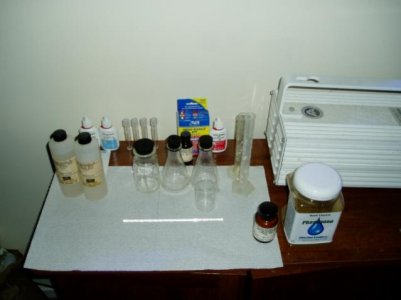
I got a bunch of reagents today. I wish I hadn't gotten rid of the triple beam balance I used to have, but a digital kitchen scale will have to suffice. I'll let you guys know when I get some results.
Scott
Scott

redfishsc
New member
This is a great thread, thanks to all you guys who have been contributing. I've avoided the use of GFO b/c of the cost. Now it's well within reach.
How many times have you guys regenerated the GFO so far (and expect that it's still working)?
Scooter, agreed about the pottery kiln and the carbon. Fumes from the carbon would probably be not very pleasant and electricity costs would probably be more than the carbon itself.
How many times have you guys regenerated the GFO so far (and expect that it's still working)?
Scooter, agreed about the pottery kiln and the carbon. Fumes from the carbon would probably be not very pleasant and electricity costs would probably be more than the carbon itself.
ScooterTDI
New member
Methods:
Phosphate Solution:
- 1 mL of 75% H3PO4 was added to a 50 mL beaker containing 50mL of water (sol'n A)
- solid NaOH was added to sol'n A until pH was 7.8
- ~10 mL of sol'n A was added to ~90 mL of artificial saltwater in a small reagent bottle
- A white precipitate formed immediately upon the addition of sol'n A (likely Ca3(PO4)2)
- The precipitate settled and the supernatent was decanted (sol'n B). The precipitate was discarded
- The solution was diluted 1111 times and tested for PO4 using an API test kit. The determined PO4 concentration of sol'n B was 2222 mg/L
Saturation of GFO w/ PO4
- 6 g (10mL) of PhosBGone pelletized GFO (by Fine FilterAquatics) was placed into two 125 mL Erlenmeyer flasks.
- 25 mL of solution sol'n B was added to each Erlenmeyer flask containing GFO and lightly swirled periodically
- After 30 min., the liquid was decanted from each flask and discarded
- The GFO was rinsed with 125 mL of water followed by three 25 mL rinses
Acid Regeneration:
- 5 mL of glacial acetic acid was added to 95 mL of water (sol'n C)
- 25 mL of sol'n C was added to one of the flasks containing the GFO and lightly swirled periodically
- After 1 hr., the solution was decanted from the flask
- The decanted solution was diluted 11x with tap water
- A 5 mL sample of the decanted sol'n was taken and 5 drops of API High Range Test Kit was added. The pH was adjusted upwards with a NaOH sol'n (5g/100mL) until the last drop increased the pH to >8.8. The number of drops was counted and recorded.
- A new 5 mL sample of the decanted solution was taken and the pH was adjusted upwards with the same number of drops of the NaOH sol'n as previously determined.
- This sample was then tested for PO4 with an API test kit.
- Another 25 mL of sol'n C was added to the flask containing the GFO for an overnight soak to determine if additional PO4 can be extracted from the GFO
Base Regeneration:
- 5 g of NaOH was added to 100 mL of water (sol'n D)
- 25 mL of sol'n D was added to one of the flasks containing the GFO and lightly swirled periodically
- After 1 hr., the solution was decanted from the flask
- The decanted solution was diluted 101x with tap water
- A 5 mL sample of the decanted sol'n was taken and 5 drops of API High Range Test Kit was added. The pH was adjusted downwards with an Acetic Acid sol'n (5% v/v) until the last drop decreased the pH to <7.4. The number of drops was counted and recorded.
- A new 5 mL sample of the decanted solution was taken and the pH was adjusted downwards with (n-1) drops of the NaOH sol'n
- This sample was then tested for PO4 with an API test kit.
- Another 25 mL of sol'n D was added to the flask containing the GFO for an overnight soak to determine if additional PO4 can be extracted from the GFO
Preliminary Results
- The PO4 concentration of the acid regeneration solution was not noticable different from that of the blank sample
- The PO4 concentration of the base regeneration solution was ~400 mg/L
Preliminary conclusions:
Acid regeneration using vinegar does not appear that it will work adequately. The PO4 concentration of the 11x diluted sample was not noticably different from the blank. I used tap water to dilute the sample which in retrospect was a mistake because the tap water had a PO4 concentration of about 1 ppm. I used tap water because I didn't think the prescence of PO4 in the dilution tap water would matter much because I expected the PO4 concentration of the sample to far exceed that of the tap water. My previous finding of PO4 was probably the result of PO4 in the vinegar as I foolishly did not test a blank on the vinegar solution. Also, I previously did not dilute the vinegar solution, so very minor desorption of PO4 could easily yield an "off the charts" result. I guess at an acidic pH the surface charge of the GFO is positive and keeps the PO4 bound (?), despite the dissolution of the GFO surface. I had thought that under acidic conditions the dissolution would be great enough to prevent PO4 from remaining bound. Sorry for the incorrect information guys. I was a little too hasty and not nearly thorough enough in my original evaluation of acid as a regeneration solution. I'll see if the prolonged overnight soak will make a difference, but at this point I am doubtful
The good news is that the NaOH regeneration process seemed to work well with only a 1 hr soak and a ~1 M concentration. I'll test the second round of regeneration solutions tommorow to verify that the GFO had been effectively stripped from the GFO and then I'll investigate if the GFO's ability to bind phosphate after being regenerated.
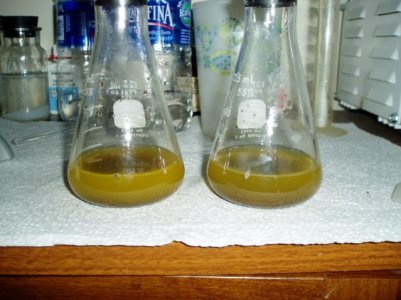
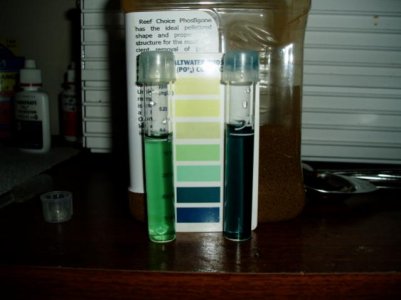
In the "Regeneration" and "Results" picture I attached, the acetic acid regeneration solition is on the left and the NaOH regeneration solution is on the right.
Scott
Phosphate Solution:
- 1 mL of 75% H3PO4 was added to a 50 mL beaker containing 50mL of water (sol'n A)
- solid NaOH was added to sol'n A until pH was 7.8
- ~10 mL of sol'n A was added to ~90 mL of artificial saltwater in a small reagent bottle
- A white precipitate formed immediately upon the addition of sol'n A (likely Ca3(PO4)2)
- The precipitate settled and the supernatent was decanted (sol'n B). The precipitate was discarded
- The solution was diluted 1111 times and tested for PO4 using an API test kit. The determined PO4 concentration of sol'n B was 2222 mg/L
Saturation of GFO w/ PO4
- 6 g (10mL) of PhosBGone pelletized GFO (by Fine FilterAquatics) was placed into two 125 mL Erlenmeyer flasks.
- 25 mL of solution sol'n B was added to each Erlenmeyer flask containing GFO and lightly swirled periodically
- After 30 min., the liquid was decanted from each flask and discarded
- The GFO was rinsed with 125 mL of water followed by three 25 mL rinses
Acid Regeneration:
- 5 mL of glacial acetic acid was added to 95 mL of water (sol'n C)
- 25 mL of sol'n C was added to one of the flasks containing the GFO and lightly swirled periodically
- After 1 hr., the solution was decanted from the flask
- The decanted solution was diluted 11x with tap water
- A 5 mL sample of the decanted sol'n was taken and 5 drops of API High Range Test Kit was added. The pH was adjusted upwards with a NaOH sol'n (5g/100mL) until the last drop increased the pH to >8.8. The number of drops was counted and recorded.
- A new 5 mL sample of the decanted solution was taken and the pH was adjusted upwards with the same number of drops of the NaOH sol'n as previously determined.
- This sample was then tested for PO4 with an API test kit.
- Another 25 mL of sol'n C was added to the flask containing the GFO for an overnight soak to determine if additional PO4 can be extracted from the GFO
Base Regeneration:
- 5 g of NaOH was added to 100 mL of water (sol'n D)
- 25 mL of sol'n D was added to one of the flasks containing the GFO and lightly swirled periodically
- After 1 hr., the solution was decanted from the flask
- The decanted solution was diluted 101x with tap water
- A 5 mL sample of the decanted sol'n was taken and 5 drops of API High Range Test Kit was added. The pH was adjusted downwards with an Acetic Acid sol'n (5% v/v) until the last drop decreased the pH to <7.4. The number of drops
was counted and recorded.- A new 5 mL sample of the decanted solution was taken and the pH was adjusted downwards with (n-1) drops of the NaOH sol'n
- This sample was then tested for PO4 with an API test kit.
- Another 25 mL of sol'n D was added to the flask containing the GFO for an overnight soak to determine if additional PO4 can be extracted from the GFO
Preliminary Results
- The PO4 concentration of the acid regeneration solution was not noticable different from that of the blank sample
- The PO4 concentration of the base regeneration solution was ~400 mg/L
Preliminary conclusions:
Acid regeneration using vinegar does not appear that it will work adequately. The PO4 concentration of the 11x diluted sample was not noticably different from the blank. I used tap water to dilute the sample which in retrospect was a mistake because the tap water had a PO4 concentration of about 1 ppm. I used tap water because I didn't think the prescence of PO4 in the dilution tap water would matter much because I expected the PO4 concentration of the sample to far exceed that of the tap water. My previous finding of PO4 was probably the result of PO4 in the vinegar as I foolishly did not test a blank on the vinegar solution. Also, I previously did not dilute the vinegar solution, so very minor desorption of PO4 could easily yield an "off the charts" result. I guess at an acidic pH the surface charge of the GFO is positive and keeps the PO4 bound (?), despite the dissolution of the GFO surface. I had thought that under acidic conditions the dissolution would be great enough to prevent PO4 from remaining bound. Sorry for the incorrect information guys. I was a little too hasty and not nearly thorough enough in my original evaluation of acid as a regeneration solution. I'll see if the prolonged overnight soak will make a difference, but at this point I am doubtful
The good news is that the NaOH regeneration process seemed to work well with only a 1 hr soak and a ~1 M concentration. I'll test the second round of regeneration solutions tommorow to verify that the GFO had been effectively stripped from the GFO and then I'll investigate if the GFO's ability to bind phosphate after being regenerated.
In the "Regeneration" and "Results" picture I attached, the acetic acid regeneration solition is on the left and the NaOH regeneration solution is on the right.
Scott
Attachments
excellent methods.
the only thing i would also have done (maybe you did and i missed it) is tested solution b before/after the GFO soak and solution b before/after the GFO soak to quantify a)how efficient the GFO was at removing PO4 and b) how efficient the NAOH was at reversing this.
the only thing i would also have done (maybe you did and i missed it) is tested solution b before/after the GFO soak and solution b before/after the GFO soak to quantify a)how efficient the GFO was at removing PO4 and b) how efficient the NAOH was at reversing this.
Methods:
Phosphate Solution:
- 1 mL of 75% H3PO4 was added to a 50 mL beaker containing 50mL of water (sol'n A)
- solid NaOH was added to sol'n A until pH was 7.8
- ~10 mL of sol'n A was added to ~90 mL of artificial saltwater in a small reagent bottle
- A white precipitate formed immediately upon the addition of sol'n A (likely Ca3(PO4)2)
- The precipitate settled and the supernatent was decanted (sol'n B). The precipitate was discarded
- The solution was diluted 1111 times and tested for PO4 using an API test kit. The determined PO4 concentration of sol'n B was 2222 mg/L
Saturation of GFO w/ PO4
- 6 g (10mL) of PhosBGone pelletized GFO (by Fine FilterAquatics) was placed into two 125 mL Erlenmeyer flasks.
- 25 mL of solution sol'n B was added to each Erlenmeyer flask containing GFO and lightly swirled periodically
- After 30 min., the liquid was decanted from each flask and discarded
- The GFO was rinsed with 125 mL of water followed by three 25 mL rinses
Acid Regeneration:
- 5 mL of glacial acetic acid was added to 95 mL of water (sol'n C)
- 25 mL of sol'n C was added to one of the flasks containing the GFO and lightly swirled periodically
- After 1 hr., the solution was decanted from the flask
- The decanted solution was diluted 11x with tap water
- A 5 mL sample of the decanted sol'n was taken and 5 drops of API High Range Test Kit was added. The pH was adjusted upwards with a NaOH sol'n (5g/100mL) until the last drop increased the pH to >8.8. The number of drops was counted and recorded.
- A new 5 mL sample of the decanted solution was taken and the pH was adjusted upwards with the same number of drops of the NaOH sol'n as previously determined.
- This sample was then tested for PO4 with an API test kit.
- Another 25 mL of sol'n C was added to the flask containing the GFO for an overnight soak to determine if additional PO4 can be extracted from the GFO
Base Regeneration:
- 5 g of NaOH was added to 100 mL of water (sol'n D)
- 25 mL of sol'n D was added to one of the flasks containing the GFO and lightly swirled periodically
- After 1 hr., the solution was decanted from the flask
- The decanted solution was diluted 101x with tap water
- A 5 mL sample of the decanted sol'n was taken and 5 drops of API High Range Test Kit was added. The pH was adjusted downwards with an Acetic Acid sol'n (5% v/v) until the last drop decreased the pH to <7.4. The number of drops
- A new 5 mL sample of the decanted solution was taken and the pH was adjusted downwards with (n-1) drops of the NaOH sol'n
- This sample was then tested for PO4 with an API test kit.
- Another 25 mL of sol'n D was added to the flask containing the GFO for an overnight soak to determine if additional PO4 can be extracted from the GFO
Preliminary Results
- The PO4 concentration of the acid regeneration solution was not noticable different from that of the blank sample
- The PO4 concentration of the base regeneration solution was ~400 mg/L
Preliminary conclusions:
Acid regeneration using vinegar does not appear that it will work adequately. The PO4 concentration of the 11x diluted sample was not noticably different from the blank. I used tap water to dilute the sample which in retrospect was a mistake because the tap water had a PO4 concentration of about 1 ppm. I used tap water because I didn't think the prescence of PO4 in the dilution tap water would matter much because I expected the PO4 concentration of the sample to far exceed that of the tap water. My previous finding of PO4 was probably the result of PO4 in the vinegar as I foolishly did not test a blank on the vinegar solution. Also, I previously did not dilute the vinegar solution, so very minor desorption of PO4 could easily yield an "off the charts" result. I guess at an acidic pH the surface charge of the GFO is positive and keeps the PO4 bound (?), despite the dissolution of the GFO surface. I had thought that under acidic conditions the dissolution would be great enough to prevent PO4 from remaining bound. Sorry for the incorrect information guys. I was a little too hasty and not nearly thorough enough in my original evaluation of acid as a regeneration solution. I'll see if the prolonged overnight soak will make a difference, but at this point I am doubtful
The good news is that the NaOH regeneration process seemed to work well with only a 1 hr soak and a ~1 M concentration. I'll test the second round of regeneration solutions tommorow to verify that the GFO had been effectively stripped from the GFO and then I'll investigate if the GFO's ability to bind phosphate after being regenerated.
In the "Regeneration" and "Results" picture I attached, the acetic acid regeneration solition is on the left and the NaOH regeneration solution is on the right.
Scott
ScooterTDI
New member
Scott,
Thank you very much for your work! :thumbsup:
I think using vinegar as a first step in the regeneration is still beneficial as it frees surface occupied by carbonates. At least in my case there seems to be a lot of CaCO3 precipitated on the media.
No problem. I should be thanking because you guys really got me interested in this. I wish I still worked in a lab. :sad1:
Yea, I am thinking that my original anecdotal "regeneration" with acid, was probably just the result of removal of CaCO3. I do drip Kalk for all my topoff even though my coral load is pretty light right now. I'm sure much of the kalk just precipitates out.
Scott
ScooterTDI
New member
excellent methods.
the only thing i would also have done (maybe you did and i missed it) is tested solution b before/after the GFO soak and solution b before/after the GFO soak to quantify a)how efficient the GFO was at removing PO4 and b) how efficient the NAOH was at reversing this.
I did not test the sol'n B after exposure to the GFO. The idea behind sol'n B was that it would quickly saturate the GFO with PO4. I didn't bother testing sol'n B after the soak because it was likely that I wouldn't be able to detect much of a change in the 1111x diluted sample. Assuming I don't get much more PO4 out of the GFO when I test the overnight NaOH soak tonight, the GFO only removed ~1/4 of the PO4 in sol'n B. This would be difficult/impossible to detect with the API kit (1.5 mg/L vs. 2.0 mg/L in the 1111x dilution)
Scott
Similar threads


- Replies
- 31
- Views
- 3K
- Replies
- 6
- Views
- 2K
- Replies
- 11
- Views
- 2K
