Regenerating GFO

Why rinse the lye out with RO and not tap water? Is it just to keep the PO4 from the tap water out?

And silicate, which can be very high in some tap water and will take up binding sites on GFO.

I rinse my new GFO with tap water to remove fines, but the wash volumes are fairly low. If I were using large volumes to wash out specific chemicals, I'd be concerned about silicate and phosphate.
 
Update.
I did 1000 grams of GFO with 640 grams of Crystal Drain Opener and 16Ltrs of RODI water. Now I am mixing it My reactor till Friday and I will start to do RODI flush. Wish me Luck!

By the way I have read that dry or wet will not make any difference.
 
This is a great thread that has helped me immensely. Figured I'd share how I used it...

So I had a real tough time figuring out exactly how much of everything to use (water, acid, and sodium hydroxide) in each step. It took me a long time to convert all of the different measurements mentioned. So...being a spreadsheet nerd, I took the steps outlined in the Advanced Aquarist article and put everything into a spreadsheet that calculates how much to use.

This is what it looks like:

GFORegenSnip1.jpg


Basically you just have to simply figure out how much GFO (in cups) you want to regen, enter that into the spreadsheet, and the rest will calculate.

GFORegenSnip2.jpg


I tried attaching it to this post, but never attempted this so lets see if it works!


Disclaimer: I'm not a chemistry expert at all, not even a novice, so if anything is off (numbers, etc) let me know.
Disclaimer: I am an excel expert :wave: and am sure there's better ways to do this.

 

Attachments

This is a great thread that has helped me immensely. Figured I'd share how I used it...

So I had a real tough time figuring out exactly how much of everything to use (water, acid, and sodium hydroxide) in each step. It took me a long time to convert all of the different measurements mentioned. So...being a spreadsheet nerd, I took the steps outlined in the Advanced Aquarist article and put everything into a spreadsheet that calculates how much to use.

This is what it looks like:

GFORegenSnip1.jpg


Basically you just have to simply figure out how much GFO (in cups) you want to regen, enter that into the spreadsheet, and the rest will calculate.

GFORegenSnip2.jpg


I tried attaching it to this post, but never attempted this so lets see if it works!


Disclaimer: I'm not a chemistry expert at all, not even a novice, so if anything is off (numbers, etc) let me know.
Disclaimer: I am an excel expert :wave: and am sure there's better ways to do this.

Now that is helpful info.
 
Bheron, Thanks for the spreadsheet, very helpful too. The only thing that I might suggest to change is to use RODI water in step 3 for rinse.
 
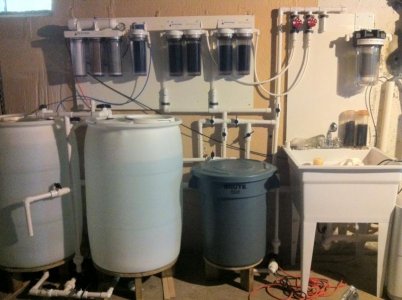
Here's my regeneration station, with a bonus of my RODI/saltwater mixing station.

The gray Brute is the regen reservoir and I use a small Pan World pump to circulate solution through the two dual reactors via the gate valve manifold.

The plumbing looks a little complicated, but it allows me to do several things with ease. I can pump RODI water into the Brute directly from my storage bin, I can mix the bin without circulating through the reactors, drain the bin without circulating the reactors and put the reactor output straight to the drain for rinsing.

I typically do eight cups of HC GFO at once (four BRS cartridges). I fill the Brute to a mark with tap water, add a couple shots of muriatic acid and circulate the reactors overnight. Then I drain the Brute, rinse the reactors with a few gallons of freshwater, then fill the bin back to the mark and mix the NaOH and circulate for four days. After the regen is complete I shut off flow to the reactors and slowly neutralize the solution with muriatic acid, dilute with freshwater before pumping it into my drain. I'll rinse out the Brute with tapwater spray and towel up any dust, then I'll fill the Brute with RODI and rinse through the reactors to the drain. While rinsing I frequently cycle the bypass valve to "burp" the GFO and draw fines/solution out. I find a steady rinse doesn't clean it as much as I'd like.

In the picture there's a six cup jumbo reactor that I just got but haven't hooked up yet. I don't think my Brute is big enough to comfortably do 14 cups, but I can probably do the jumbo plus one or two normal cartridges.
 

Attachments

  • regen station.jpg
    regen station.jpg
    63.6 KB · Views: 17
Great idea. This one is book marked. Guess I better find another BRS reactor or two.

How do you store the reactors when they are not in use? Or are all 4 in use 24/7? What if I put a valve between the 2 BRS reactors and shut off one half of the setup?
 
Last edited:
Mine are just empty when not in use. My dual reactors are plumbed in parallel, so if needed I just turn off the valve for one of them.
 
Oh, you mean the individual cartridges, Chris? I just let them drip on a wire shelf until needed. I haven't had any problems (yet) with secret microbes growing in the wet media and killing livestock, if that's what you're worried about.
 
is the "bucket-o-lye" expended upon regeneration of the GFO or can it be re-used?

e.g. can I add a supplemental amout to keep the PH high and use again?
 
That's an interesting question. I don't know what the solubility limits might be. I'd probably just pitch the lye solution, but it might work twice. You could make a reference solution of lye to check with your pH meter, and compare that to a used batch, I suppose, but pH is not the only issue.
 
Back
Top