Silent and Failsafe Overflow System

Left hole - emergency. Use an upturns elbow and vertical,pipe to get it to the desired height.

Middle hole - open channel. Set the height as needed with vertical pipe and 2 elbows to form a u tube.

Right hole - siphon. Down turned elbow. This should allow you to adjust the water level in the box.

Worst case you could upturn the siphon elbow and add a vertical pipe and the another u suction.

That or simply rebuild the box, now that you know where the problem is.
 
Left hole - emergency. Use an upturns elbow and vertical,pipe to get it to the desired height.

Middle hole - open channel. Set the height as needed with vertical pipe and 2 elbows to form a u tube.

Right hole - siphon. Down turned elbow. This should allow you to adjust the water level in the box.

Worst case you could upturn the siphon elbow and add a vertical pipe and the another u suction.

That or simply rebuild the box, now that you know where the problem is.
Thanks for the reply.

Ok so I'm trying to follow the references as to which is which, meaning orientation.

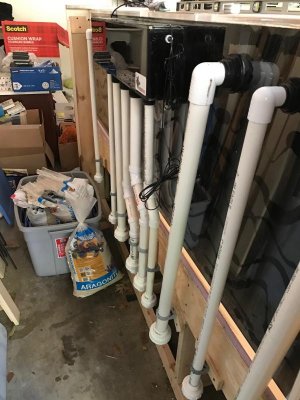
In my post #949, first picture the top are you calling that left or right? I suppose it doesn't matter much since it would be repurposing the lines. In the current config, the bottom most elbow in the photo is my full siphon (sits at about 3/8in gap between its inlet and bottom of box), the center sticking up with holes my emergency and the topmost downturn elbow my open channel ( sits at about 5/8 in gap between its inlet and bottom of box).

Back to your suggestion, I think I follow but I have a question. If I raise the open channel via a vertical + dbl elbow in a u fashion does that dictate the water level or will my lower siphon's down turn elbow still have some factor on it? Im guessing not and that it is the open channels top of u, correct?

Second thing, any thought regarding my three DT holes pictured? Meaning, do you think I need to do anything to them or is your thinking its all a matter of the overflow box water level?

Sent from my SM-G930P using Tapatalk
 
Most of your noise is likely due to the waterfall from the three holes. Raising the water in the overflow box will help. For the most part, the height of the open channel will dictate the water level.
 
! Update ....

I did a rather simple test this morning after having thought more on tbe mechanics. First I dialed my siphons gate valve fully open. Next I fully closed my open channels ball valve. As presumed after thinking about the dynamics at play the water in my overflow began to rise. I then dialed the gate on the siphon clised a little causing rhe wateer to rise even faster until emergency started to kick in. Then i slightly openend the open channels ball valve to lower the water insise the box again but only enough such that the level was at the bottom of my DT holes. I played with it for a few turns not getting it perfect but enough to let it run tbat way foe a few minutes ro observe and listen or shpuld I say lack there of - silence atlast. This confirmed my holes at the DT are fine as is, its all just a mater of water level in my overflowbox. Meaning, that if I raise the water level within then the problem should be resolved. Based on closing my open channel and allowing my emergency to serve as the open, temporarily confirmed that I dont need to change my siphon plumbing. I believe based on this, that raising my open channels topmost portion is the way to go/ dictates the water level....

So if that assumption is correct I can provide the elevated U as proposed but still keep my inlet near the bottom of the box to keep livestock from entering.

Sent from my SM-G930P using Tapatalk
 
why dont you just screen in your internal box? Avoid cerith snails and the below works like a charm.

2016_04_10_Internal_2.jpg
 
Last edited:
How critical is it to have the U bends? In my overflow box I can only fit a single 90 degree elbow on the full siphon and secondary drain.
 
How critical is it to have the U bends? In my overflow box I can only fit a single 90 degree elbow on the full siphon and secondary drain.
If the 90 is downfacing, like bulkhead on the side, no problem, if horz facing like bulkhead underneath, your probably going to such air not attain a full siphon and gave lots of noise. So it depends on your configuration.

Sent from my SM-G930P using Tapatalk
 
Clowning around, I have a setup very similar to yours. I find that the pass through holes need to be about half way submerged to be silent. The amount of flow will somewhat dictate this & I do have close to 1000 gph going through my pass through holes. I have all my holes drilled in the bottom of the box , so my open channel has a sanitary tee with a street 90 installed into the tee. The bottom of the inlet on the tee where the 90 slips into the tee is set just below halfway on the pass through bulkheads. That way only a small amount of water drains through the open channel & the water level in the box is halfway up on the pass through holes.

How bean said to have your drains setup with the open channel in the middle hole really does make the most sense. By doing it that way the holes in the side of the box only need to have a 90. The syphon would have a 90 facing down & the emergency facing up with a short piece of pvc in the 90 to set the height. So the open channel would be the only drain that would need to have a u tube.
 
Last edited:
Thanks all. When I find another window of time I will give it a work over but the mrs says I need to catch up on some other projects first. So for the interim, I just have to live with it until I can get to it. Unfortunately everything is glued, so this should be a fun little challenge...

Sent from my SM-G930P using Tapatalk
 
Hello all, i'm in the process of plumbing my tank with the synergy reef overflow. Is there a limit to the amount of 90's or 45's i should be using on the drain lines? Thanks!!!
 
dual siphon

dual siphon

Question: I'm trying to feed a waterfall scrubber off my drain lines, currently I have a standard bean animal on 1.5" pipe. I would like to lower the open channel and create a second siphon line also controlled by a gate valve feeding the ATS (it will have an overflow elbow so if the slot gets clogged, water will still flow at the rate set by the gate valve).

Essentially, will this system work with two gate valve controlled siphon lines and one emergency dry pipe? or should I convert the dry pipe to the open channel to accept fluctuations? Open to any advice, thanks.
 
Well, it wouldn't be a bean animal drain if u did this & there is to many variables to say if it will work or not. I think u would have issues trying to tune 2 seperate syphons in the same overflow box. If u do decide to give it a try I would definitely keep the emergency dry. If u run a trickle through it it has a chance to get clogged & the chances of a flood go up dramatically. Personally, I would feed it from my return pump. That way u still have a beananimal drain so u have all the redundancies that come along with it. U wouldn't have to be constantly messing with your valves eighther. I just think it will be hard to keep everything stable with two syphons in the same overflow, especially with no open channel. U will also have more control of the amount of flow feeding the scrubber if u feed it from the return or a small individual pump if your return pump isn't big enough.

If u are set on feeding it with a drain then I would keep the drains setup with a beananimal & feed it from the syphon. U won't have much control of the flow through the scrubber this way but u would still have the best drain setup as possible.
 
Last edited:
Question: I'm trying to feed a waterfall scrubber off my drain lines, currently I have a standard bean animal on 1.5" pipe. I would like to lower the open channel and create a second siphon line also controlled by a gate valve feeding the ATS (it will have an overflow elbow so if the slot gets clogged, water will still flow at the rate set by the gate valve).

Essentially, will this system work with two gate valve controlled siphon lines and one emergency dry pipe? or should I convert the dry pipe to the open channel to accept fluctuations? Open to any advice, thanks.

Im doing a variation of this here:
http://www.reefcentral.com/forums/showpost.php?p=25060297&postcount=9365

Your going to still need Open Channel and emergency channel. The 2nd gate valve is to handle whatever can't be handled by the first overflow.

LSU is right - it's technically no longer a beananimal.
 
A thank you to BeanAnimal for this great design. My plumbing which is as close a copy of his design as possible, has worked flawlessly since January 2017... the only issue was my own dumb fault by not having a return pump as strong as I needed for my system.

It would take a long time, sometimes over an hour to equalize after feeding and I thought I must have created some flaw in the plumbing setup, but after increasing return pump flow rate 500 more GPH - It equalizes in less than a single MINUTE...and then whisper quiet.

It's a beautiful design!
 
Question: I'm trying to feed a waterfall scrubber off my drain lines, currently I have a standard bean animal on 1.5" pipe. I would like to lower the open channel and create a second siphon line also controlled by a gate valve feeding the ATS (it will have an overflow elbow so if the slot gets clogged, water will still flow at the rate set by the gate valve).

Essentially, will this system work with two gate valve controlled siphon lines and one emergency dry pipe? or should I convert the dry pipe to the open channel to accept fluctuations? Open to any advice, thanks.

That would basically mean turning it into a herbie. The main advantage of the bean is that you have an open channel that can also function as a siphon. Many of the herbie setups I have seen do not have an adequate emergency, that will not handle the full flow in the event the siphon becomes completely blocked. Bean solves this problem. You'd be better off T-ing the single siphon drain. If possible, one thing you might consider is adding a fourth drain as your second siphon. That is what I am doing for my new build - actually I am having three siphons (one to ATS, one to refugium and one to sump), one open channel and one emergency.
 

Attachments

  • IMG_0700.jpg
    IMG_0700.jpg
    71.2 KB · Views: 15
Last edited:
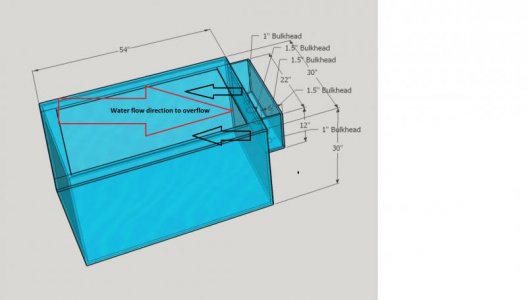
Quick question I hope. I have a 240 that I am starting to plumb this week. It is a peninsula style tank with the overflow on the side rather than the back. So not a traditional coast to coast. It has two 1" return lines on the outside of the overflow with 3 1 1/2" bulkhead/overflow drains in the middle.

My question is if I use the two 1" returns will the overflow natural direction cause problems? Or will it be counter productive? Not sure if I'm asking the question right. I apologize. I'm just thinking that the water direction entering the overflow will be greater than the return pump and 1" lines.

I have a XF230 Gyre that will be the primary water circulation and a Jebao DC 12000 pump for return. At least that was my plan but could change if need be. This is for a 240 gallon tank that is 54" L x 30" H x 30" D.
 

Attachments

  • retrn.jpg
    retrn.jpg
    26.6 KB · Views: 18
If I am understanding what u are saying then u will be fine. Most people's returns are on the same end as the overflow. On most setups they are both on the back glass, u will just be switching it around to where it is on the side pane of glass. They have quite a few peninsula tanks with it setup that way.

U will have to extend your returns from the bulkheads in the overflow box to where the water exits inside of the tank & not inside the overflow box. How u do this will depend if the tank is notched or u have pass through holes to get water from the tank to the overflow box. If u have pass through holes then u probably would have a bulkhead in the back of the tank for the returns. So u would connect the bulkhead in the overflow box to the bulkhead on the tank. If the tank is notched or u don't have a bulkhead on the tank itself for the return, then u would probably have to connect to the bulkhead in the overflow & go over the side of the tank to get the returns into the tank.
 
Back
Top