Threaded joints leaking. Should I start over?

DobieMom

New member
I've had basic freshwater/saltwater aquariums much of my life, but my husband recently surprised me with a 120 gallon reef ready aquarium with 2 corner overflows for our anniversary.

He tried his hardest to plumb the overflows to the wet/dry filter correctly. We bought PVC pipes to run from the overflow boxes to the filter. He roughed up/sanded the joints and glued them.

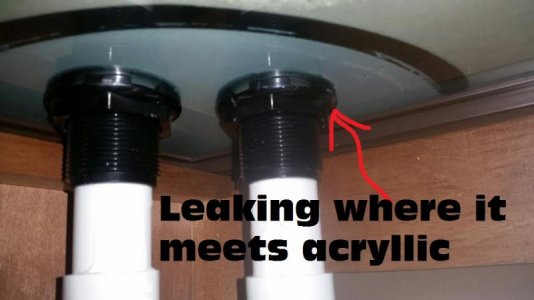
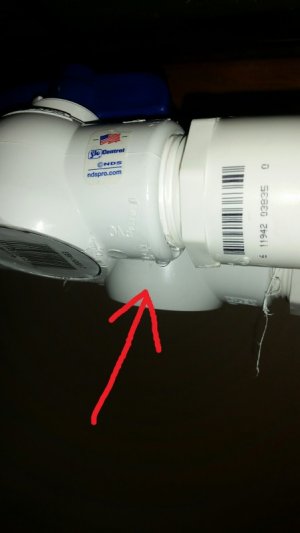
We filled the tank. 20 minutes later, the seal around one of the intake pipes at the bottom of the aquarium is leaking (slowly). 2 of the Threaded ball joints are also leaking even though he used thread tape. (slow drip).

Do we need to start over? Drain the tank. Rip everything out? Not sure how to properly fix these tiny leaks now that everything is glued together. When we started the filter everything else seemed to be functioning great. He's so disappointed.
 
Leak1.jpg
<BR>
Leak1.jpg
<BR>
Leak%203.jpg
 
Photos...

Photos...

I'm trying to share photos but having a hard time figuring out how. Here is one (attached I think.) I spelled Acrylic wrong in the pic..lol..Not my day.
 

Attachments

  • Leak1.jpg
    Leak1.jpg
    35.5 KB · Views: 4
Ball joint photo...

Ball joint photo...

Here is another pic (attached)
 

Attachments

  • Leak 2.jpg
    Leak 2.jpg
    51.6 KB · Views: 4
Tell him he's in good company! :D I've had repeat problems using pipe tape and now just use cheap silicone I (not silicone II that has fungicide added) on my threaded joints.
 
Non-hardening PVC paste is, IMHO, a far superior product to the tape. I did some research on why it's a better product and found that the tape is static while the paste is actually forced into the areas it's needed most by the water pressure. Image below from Lasco Fittings.


threadsealant.jpg


Just pull your threaded joints apart and use a non-hardening pic paste. Also double check your bulkheads aren't too tight. Finger tight is plenty. Check for gasket deflection, there shouldn't be any. Good luck!
 
If glued joints are leaking they need to be replaced.
I also gave up on tape and use only paste now.
I sleep better and don't see salt creep.
 
Non-hardening PVC paste is, IMHO, a far superior product to the tape. I did some research on why it's a better product.
Just pull your threaded joints apart and use a non-hardening pvc paste. Also double check your bulkheads aren't too tight. Finger tight is plenty. Check for gasket deflection, there shouldn't be any. Good luck!

Ding.. ding..ding.. Give this man a gold star.. :thumbsup:

Rectorseal at Home Depot.. Make sure its says for thread sealant/paste for PVC
 
One more question...

One more question...

Non-hardening PVC paste is, IMHO, a far superior product to the tape. I did some research on why it's a better product and found that the tape is static while the paste is actually forced into the areas it's needed most by the water pressure.
Just pull your threaded joints apart and use a non-hardening pic paste. Also double check your bulkheads aren't too tight. Finger tight is plenty. Check for gasket deflection, there shouldn't be any. Good luck!

Thank you everyone! We are going to take apart the joints and try one of the non hardening sealants you suggested later today. Fingers crossed! I think you are right bulk head is too tight, messing up the gasket.

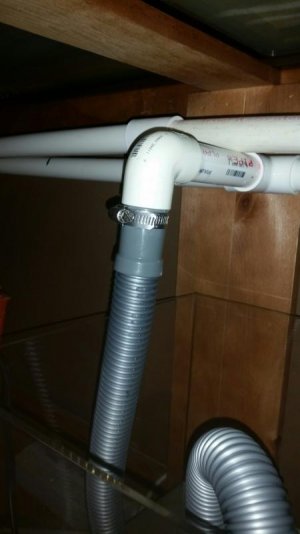
Once more quick question... We used a flexible hose (photo attached) connecting the pump tot he PVC system. This also has a small drip, but it's dripping back into the glass the pump is in so not a big deal, yet. Is there a better way? I wanted something flexible in case the pump ever needs cleaning/replacing.
 

Attachments

  • Leak 4.jpg
    Leak 4.jpg
    30.8 KB · Views: 3
I use the Teflon tape but put it on really thick,5-6 layers, if not liquid Teflon works well and the PCV paste. All different options. It's really your choice but if using the tape 1-2 layers is really not enough.


Sent from my iPhone using Tapatalk
 
Teflon tape is meant for iron pipe. PTFE paste is made for threaded pvc. A small amount on the male part of the threaded fitting will spread itself around as you tighten the two pieces together.

The glued fittings that are leaking will need to be cut out and replaced. There really isn't a good way to fix them, and at all of .24 cents apiece, why even try?

I can't tell from your picture of the bulkhead - make sure the gasket is on the flange side of the fitting and not on the nut side. 1/4 to 1/2 turn past hand tight is plenty for it.

I agree that flexible tubing is the best way to connect your return to the pvc, but I would replace what you have with vinyl tubing. Not only will it be difficult to get a good seal using ribbed tubing, it creates a lot of turbulence in the flow and will therefore reduce the pumps output. I also can't tell in the picture - is there so much tubing that there is a big loop in it? use the shortest piece you can get away with for best results.


hth
 
Love the vinyl tubing idea. The one we connected in the pic is what came with the filter. Way too long as it's meant to reach the bulk heads not the PVC we added, and really hard to get a tight seal. Will start replacing the fittings later. Feel more confident about our next steps now. Thanks.
 
Gasket is on the wet side. 3 out of 4 are fine. just one has a really slow leak. I think it was turned too tight. :(
 
make sure the gasket is on the wet side of the bulkhead.

I would say make sure the gasket is not on the side of the nut, just in case the bulkhead needs to be installed backward.

I would never think to install One backwards, I've always just put them in the way they're supposed to go.

I have bulkheads installed on various tanks both ways. The bulkhead couldn't care less.

There really isn't a "frontwards" or "backwards" to bulkheads. The only thing that matters is that the gasket is on the flange side, not the nut side. Different situations make it easier for the bulkhead to be oriented in a particular way.
 
TO THE OP'S DILEMMA...Rubbermaid Brute Trashcans are a major aid in this hobby. Always have one and keep it pristine for just such situations.

You can pull water, rock, and all to fix this. You may be able to use a circle of plastic or such to dam back the sand, but be aware if you get one grain of sand into a gasket, it can create a leak.

I had four of these monster cans (Home Depot has an array of sizes, best source) when I had to drain down a functioning reef temporarily to install new flooring. You never know when they'll prove life-saving.

This will let you work on the problem and put things back again without stuff drying out or losing bacterial population.
 
Back
Top