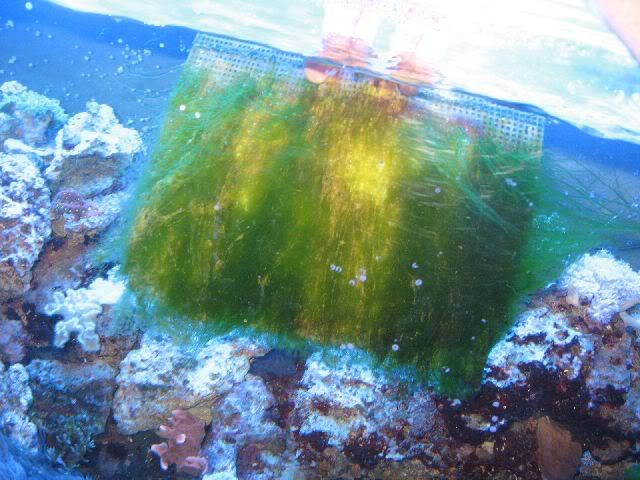
algea scrubber

I found out (though it goes against all logic) direct from Danner Mfg that the Mag12 with a 3/4 nozzle needs a 1-1/2" return hose or else the flow is restricted and you lose GPH.

---

So I'm going to increase the return hose from pump to bulkhead to 1" and see what happens. If not enough, bulkhead to 90 that leads to jet will be next.


Actually it does not defy logic as it is very logical, and extreme example perhaps, but very much in line.

http://reefcentral.com/forums/showthread.php?t=1930228
 
yes that does make sense in that respect. What I was meaning was that it seems illogical that they would put a 3/4 nozzle on the pump outlet, but say you needed a 1-1/2" return hose to maximize the flow rate of the system. I'm an engineer so I get exactly what you're saying. The issue I now have to deal with is the fact that the hole through the wall of the overflow is made for a 3/4" locline dual-jet to fit through and screw into the 90 on the other side. So no matter what, I'll have a flow restriction point down the line. However, I did hear from someone that re-plumbed a closed-loop system and increased all the pipe diameter except for a point in the system that needed the original fittings and he saw a measurable rise in flow rate. So I'm hoping that increasing the pump-to-bulkhead by 33% (3/4" ID to 1" ID) and then maybe the bulkhead to 90 diameter the same will increase my flow by another 100 GPH, then if I have to I will take 3-5 inches of width off the screen to get it above 35 G/inch. I am hoping that the flow will increase more, as I am taking an educated guess in thinking that a 33% increase in ID of return plumbing will translate to a greater than 33% increase in flow rate due to a decrease in friction, but with the fitting that goes to the locline jets being 3/4" that may offset a greater than 33% flow increase. The locline is a dual head, so the only point of restriction is the 90 at the top of the return line.

 
But, the yellow water, and the release of phenols, skatols and creosols...

I would like to see where you are getting this information from. I couldn't find anything regarding algae releasing skatols or creosols. As for Phenols:

http://www.springerlink.com/content/0jubgy6jlf55g0c3/

See Figure 3 on page 91, algae does the opposite (removes phenols)

As well as this which mentions the use of macro algae to remove Phenols

http://www.ncbi.nlm.nih.gov/pubmed/19138816

The 'yellow water' you mention also indicates to me that the systems you are referring to either use the dump-style red turf algae (which smells awful, by the way) or are not the modern type of scrubbers which utilize green hair algae. Also it could have been a system that was not properly maintained - I could see how algae would release these things into a system if the algae was not removed from the system, but the properly designed and maintained modern algae scrubber I would think would not have this issue at all.

I would greatly appreciate any info you can provide with respect to the skatols/creosols. I am a pretty open minded person, if there's something out there I need to know about, I want to learn about it.
 
I would greatly appreciate any info you can provide with respect to the skatols/creosols. I am a pretty open minded person, if there's something out there I need to know about, I want to learn about it.

I asked the same thing. The OP of the statement regarding these hasn't produced any source. Another member suggested a few books which may or may not contain information regarding these compounds, some of which were printed 20 years ago, long before ATS systems were run like they are today. So in light of the contemporary use of ATS systems, and the clearly healthy tanks they produce (yours for example :lol:), I'm going to guess that the original comment was approximately as accurate as the yellow water.
 
I did find this on "cresols" not "creosols" (I suspect that was just a typo)

http://onlinelibrary.wiley.com/doi/10.1111/j.1574-6968.1995.tb07893.x/abstract

and while I didn't read the whole study, it is the algae absorbing the cresol. Again, if not properly maintained, I would think it would reach a maximum absorbtion point and then possibly begin releasing them.

Another point on yellow water would be cleaning the screen and not rinsing properly before putting back in the system (or cleaning in the system and just removing the physical algae, but letting the liquid back in). This could also explain the presence of those chemicals. That is why the current designs mandate that you remove the screen from the system, clean and rinse in tap water.
 
yes that does make sense in that respect. What I was meaning was that it seems illogical that they would put a 3/4 nozzle on the pump outlet, but say you needed a 1-1/2" return hose to maximize the flow rate of the system. I'm an engineer so I get exactly what you're saying. The issue I now have to deal with is the fact that the hole through the wall of the overflow is made for a 3/4" locline dual-jet to fit through and screw into the 90 on the other side. So no matter what, I'll have a flow restriction point down the line. However, I did hear from someone that re-plumbed a closed-loop system and increased all the pipe diameter except for a point in the system that needed the original fittings and he saw a measurable rise in flow rate. So I'm hoping that increasing the pump-to-bulkhead by 33% (3/4" ID to 1" ID) and then maybe the bulkhead to 90 diameter the same will increase my flow by another 100 GPH, then if I have to I will take 3-5 inches of width off the screen to get it above 35 G/inch. I am hoping that the flow will increase more, as I am taking an educated guess in thinking that a 33% increase in ID of return plumbing will translate to a greater than 33% increase in flow rate due to a decrease in friction, but with the fitting that goes to the locline jets being 3/4" that may offset a greater than 33% flow increase. The locline is a dual head, so the only point of restriction is the 90 at the top of the return line.

Sometimes, I want to think that the Danner pump deal is an "oops should have put a larger output on the thing," but who knows.

Your educated guess is pretty good, as @ 20+ psi your flow increase could be up ~50, but you start shooting higher than 100 psi+/~60 something % increase, the pipes might start rattling.

The physics is physics, and you will come out ahead with the larger pipe as the pressure will not drop so much, leaving you with a higher pressure just before the restriction. The restriction will cost you, but not as much as 3/4" all the way will.
 
After cleaning the screen, do you guys rinse it in fresh water? If so, it seems like that would kill a lot of algae.
 
Yes, you have to if you don't want pods cutting algae off the screen. No, it does not seem to harm the turf.

Turf is algae that seems to be tidal region types expected to be aired out and rained on.
 
Rinsing in tap water is the current method, to kill pods mainly but also to keep any loose algae spores from getting into the DT. It is a short enough rinse to not kill off the algae, it grows back very fast.
 
As mentioned earlier, tidal algae is regularly exposed to rain water and has adapted to it so go ahead and rinse.

You certainly don't want to leave the crushed algae fragments, broken cells and juices to be washed back into the tank. It would be like putting some of it in a blender and then pouring it back into the tank. The fish would like it but it might cloud the tank a little.

On the other hand, I personally don't care about algae spores AT ALL! Algae doesn't stand a chance on my rock. Any algae in the main tank starves to death for a comparative lack of light and particularly a lack of nutrients. That's just a red herring.

Sorry for a bad pun.
 
Fragments is what I meant. We're on the same page. Cleaning in the tank/sump is what has caused the 'yellow water' issue in the past. So anyone saying algae scrubbers cause 'yellow water' is unfamiliar with current (and successful) techniques, I see it a lot, people poo-pooing the concept because of mistakes/techniques of the past. It's really come a long way form everything that I've read. I'm getting ready to build 2 or 3 more, and may pitch it to my LFS for their 1600g build in progress.
 
Yes, proper screen maintenance is thought to be new technology but Dynamic Aquaria was published in the early 90's. I read it. It had all of the rules graphs tables and designs that are getting popular today. "¦and I have never had yellow water. Johnny Carson still had his show when I started reading that book.

The two sided scrubber in a bucket is new though.
 
My screen is green!!!

My screen is green!!!

Here's this week's growth:

11/10 1 day after cleaning #4

IMG_8872.jpg


11/12 Day 3

IMG_8873.jpg


11/15 Day 6

IMG_8875.jpg


Finally!

And I tested Phosphates today - maximum 0.03 on Salifert, which ties the lowest reading I've ever seen on this tank. The other time it was this low was a few days after adding 250 mL of RowaPHOS (which is expensive as all get out) and lasted about 3 months at 0.03-0.10 before slowly climbing back up.

(pics taken with front lighting removed)
 
Thanks for the picture sequence Turbo.

williah; It's not the absorption and then release, it's the absorption then letting the pods cut off sheets of algae that then decompose. Hence, returning all the various components back to the water column. If the screens are maintained properly, the algae is always physically removed, and the pods killed before this ever occurs.
 
I find the idea of an algae scrubber introducing harmful chemicals to be pretty laughable. I've been discussing mine with the environmental engineers in my office, seems they're used on large scales to clean agricultural run off and industrial heavy metal contamination out of water ways.

Check this page out http://www.algalturfscrubber.com/point.htm
 
I find the idea of an algae scrubber introducing harmful chemicals to be pretty laughable.

I agree, given current practices. It is fair to say that certain styles of scrubber that were popular many years ago did indeed have some of these problems, but that's well in the past and completely irrelevant given current practices. It would be like saying "I don't want to buy a modern car because I hate carburetors." It just doesn't apply.

I've been discussing mine with the environmental engineers in my office, seems they're used on large scales to clean agricultural run off and industrial heavy metal contamination out of water ways.

It's interesting to note that pretty much every method of nutrient abatement we use in fish tanks (mechanically filtering out undissolved particles, biological uptake/conversion via bacteria or plant life, protein skimming, even carbon dosing) has a parallel method that's implemented in water or wastewater treatment. Years ago I worked for a firm that designed such facilities, and the first time I toured a wastewater treatment plant, I was blown away - it was basically just like my reef tank's sump, only on a vastly larger scale.
 
I have to say that it is very nice to see some veteran reefkeepers posting positive comments about ATS systems. I think it all has to do with the approach to the subject. It's come a long way in the last 2 years and I'm glad that I picked up on it at this point and was able to implement a system that is effective.

Speaking of effective...I cleaned the screen today.

IMG_8899.jpg

IMG_8900.jpg

IMG_8901.jpg


Rinsing pods into DT

IMG_8903.jpg


Using back of fingernails

IMG_8904.jpg


IMG_8905.jpg


Clean screen

IMG_8907.jpg


Let's see a vegetarian eat this. Sandwich anyone? Fertilizer?

IMG_8906.jpg


Yummy. I also made a point of noting the smell. I did not smell anything at all before I started cleaning the screen. I even put my nose right up to it, and all I smelled was a slight saltwater odor. When started scraping the screen, I did notice an algae smell, but it was much less than then smell of rinsing out a skimmer cup with hot water. Again, that is in sharp contrast to the smell of the screen when the red turf algae seed screens from Inland Aquatics were attached - those made me gag.
 
Back
Top