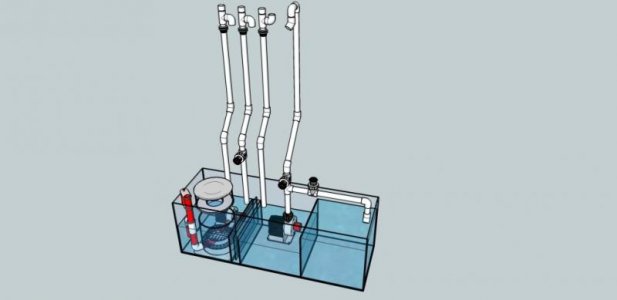
Silent and Failsafe Overflow System

I have been thinking about the lay out of my plumbing and wanted to get some feedback from ya'll before I just hop into getting everything set up. Here is just a small sample drawing of what it is that I am thinking. Let me know if this would work or if I am better off having all 3 drain pipes to have individual drop ins into the sump.

I will be running a 40 gal breeder with a 29gallon tall sump.

  • Red = emergency / fail safe
  • Green = drains
  • Purple = returns

b82a5e8dbe.jpg
 
I have been thinking about the lay out of my plumbing and wanted to get some feedback from ya'll before I just hop into getting everything set up. Here is just a small sample drawing of what it is that I am thinking. Let me know if this would work or if I am better off having all 3 drain pipes to have individual drop ins into the sump.

I will be running a 40 gal breeder with a 29gallon tall sump.

  • Red = emergency / fail safe
  • Green = drains
  • Purple = returns

b82a5e8dbe.jpg

They will have to be individual drains into the sump. It will NOT work with the drains merged into one pipe. Also I would suggest switching the return and fuge compartments and feed the fuge off of a return.
 
I have a couple of questions. I'm getting ready to set up a 140 gallon system with a reef ready, center overflow. I know that this is not the most efficient at surface skimming, but it's what I'm stuck with. The center overflow has 3 - 1" drains and 2 - 3/4" returns, so I'd like to set it up in Bean Animal fashion. I understand that I should plumb with inch and a half pipe below the 1" bulkhead, but what about above? Also, does anyone have any idea how much flow this type of setup will have? I'm wanting to pick my return pump soon. Thanks.

Doesn't seem like you ever got an answer so I'll give it a shot...

I plumbed my 120g with all 1" bulkheads pipe and valve. My return is a Eheim 1262. Pushes about 900 gph with no head. The valve on the siphon is about half open.

So with all that, IMHO, one inch would be fine unless you are pushing a tremendous amount thru the return pump. I've read (no indication if it's true!) that a 1" pipe can handle 1200 gph in full siphon.
 
I stole this off somebody but, this is how mine is done. Works very well.

From the looks of the photo is that it is pulling water into the return from both the fuge area and the return area, am I assuming that correctly?!? For the returns, would a mag 5 be enough to split it to two different outputs in the tank?

So, I would drop the emergency and the primary drain into the skimmer section and then the other drain into the fuge area. Having the fuge baffled up just like the skimmer section, but with only two baffles vs 3. Am I understanding this correctly?
 
From the looks of the photo is that it is pulling water into the return from both the fuge area and the return area, am I assuming that correctly?!? For the returns, would a mag 5 be enough to split it to two different outputs in the tank?

So, I would drop the emergency and the primary drain into the skimmer section and then the other drain into the fuge area. Having the fuge baffled up just like the skimmer section, but with only two baffles vs 3. Am I understanding this correctly?

No. Look at it again, full size:

sump3B.jpg
 
No. Look at it again, full size:

sump3B.jpg

Okay, just to make sure I am reading the photo above correctly. Two returns, the emergency and the main drain(with valve) is dropped into the skimmer section and the third drain is dropped into the return area. The retur itself is pulling water from both the fuge and the return section. Is that correct??

Sorry for the noobish questions, I want to make sure I'm fully understanding before I even venture into the plumbing of this tank. I just want to make sure I fully understand.
 
In this pic the syphon and open channel are going i mn the skimmer section I put my emergency into that section also. I don't think that really matters. 1 pump for return into a tee one side goes to display the other has gate valve feeding fuge so you can regulate flow in fuge. The fuge section overflows back into the return section.
 
I got ya!! I think. The purpose of the T off to the fuge is to provide some water movement in the fuge, so it doesn't become stagnant.
 
I got ya!! I think. The purpose of the T off to the fuge is to provide some water movement in the fuge, so it doesn't become stagnant.

Correct, however the design is becoming deprecated because the actual usefulness of an in-sump is ambiguous. Generally, due to common practices, the "fuge" does more harm than good. Also, the flow rate through such a fuge is pathetically low, by common practice, and that is a part of the problem, but by no means the entire issue. This thread deals with a particular drain system design, it does not deal with system design in general, nor the ambiguity of an in-sump fuge. And yes, the design and drawing are mine...
 
Correct, however the design is becoming deprecated because the actual usefulness of an in-sump is ambiguous. Generally, due to common practices, the "fuge" does more harm than good. Also, the flow rate through such a fuge is pathetically low, by common practice, and that is a part of the problem, but by no means the entire issue. This thread deals with a particular drain system design, it does not deal with system design in general, nor the ambiguity of an in-sump fuge. And yes, the design and drawing are mine...

That's fine, just wanting to make sure that I was understanding the photo and interpreting it as it was intended to be. I appreciate all of the feedback that you have provided me with uncle! It has been extremely valuable!

Again, thanks a lot!
 
Return to full siphon Problem

Return to full siphon Problem

Mine starts without fail no matter what speed my pump is at. My syphon starts is running in seconds then I just make adjustments with my gate valve. If your pipe is less than an inch deep in the sump you can drill a couple small hole just above the waterline in the sump. I didn't need to do that but have read in this thread where it helped the syphon start.

I'm running 3/4" below level on the return pipe, I've put the holes in that you described long ago to no avail. Yesterday after reading your reply I did two things, 1. removed the screen bag from return 2. taped those holes closed temporarily. Results after fine tuning the siphon it finally ran all night at full siphon. Just now I shut down the pumps and let everything settle and restarted. Pretty much the same with 5-6 purges before settling down to full siphon, then once more flowing out the dry pipe and then settling down. I do have the uptake side of the dry pipe neck a little shorter than the main full siphon uptake other than that they are the same except for the 1/4" siphon break. Luckily it has never used the emergency drain, the water is steady in the collection box now at 1/2 the height of the exit. So I'm ok with this but can't figure why so many cycles to settle down.
 
I'm running 3/4" below level on the return pipe, I've put the holes in that you described long ago to no avail. Yesterday after reading your reply I did two things, 1. removed the screen bag from return 2. taped those holes closed temporarily. Results after fine tuning the siphon it finally ran all night at full siphon. Just now I shut down the pumps and let everything settle and restarted. Pretty much the same with 5-6 purges before settling down to full siphon, then once more flowing out the dry pipe and then settling down. I do have the uptake side of the dry pipe neck a little shorter than the main full siphon uptake other than that they are the same except for the 1/4" siphon break. Luckily it has never used the emergency drain, the water is steady in the collection box now at 1/2 the height of the exit. So I'm ok with this but can't figure why so many cycles to settle down.

Your open channel shouldn't be below your syphon I don't think. I read some advice bean had given a guy in the early pages of this thread and he advised the guy to raise his open channel 1/2"-1" above the full syphon on the intake side then drill holes if needed. My open channel is about 1/2" or so higher than the syphon at the intake end.
 
Well maybe, I thought all three were to be the same height as they exit the collection box as mentioned I have shortened the length of the elbow so if breaks siphon before the full siphon drain. mmmmm to change will mean a new box made.
 
Two questions, one silly one not so silly:
1) I finally have the Spear Non Hardening Thread Sealant and am about to apply it to the thread that I will tighten the three pvc end caps to. How tight to make them? Hand tight seems all I can do to allow me to open the cap in the event I need to clear a standpipe.

2) (The Silly Question) Is there any reason that the order of the three standpipes matters or as it seems to me, any order is fine?

Thanks (sorry for question #2)

If there is no pressure I wouldn't worry about selling it. Maybe on the return side
 
Well maybe, I thought all three were to be the same height as they exit the collection box as mentioned I have shortened the length of the elbow so if breaks siphon before the full siphon drain. mmmmm to change will mean a new box made.

The listed "fixes" where put forth to solve a specific issue. The most common being large bulkheads with a low flow rate, a particular issue that cannot be solved by correcting other implementation errors. But on the other hand, the issue is not that "unsolvable" as the bulkheads can be bushed down to 1". In short, a properly implemented system does not require the mentioned modifications.

"I have shortened the length of the elbow so if breaks siphon before the full siphon drain."

I have been trying to decipher what you have going on, but some of what you are saying does not make sense. If what siphon breaks before the full siphon drain? There is only one siphon in the system, so there is no other siphon to break... You mentioned something about the "dry pipe" which would be the dry emergency, however, how that evolved into discussion of the open channel (a wet pipe) I don't know. There are no siphon breaks in the system, unless referring to the air vent on the open channel (which prevents siphon, rather than breaks it.)

This system does not start up instantly, not generally anyway. It can take several minutes for the system to sink in. It is normal for the system to be somewhat unstable during start up, it is normal for water to flow in the dry emergency during start up. If it continues for much more than a few minutes, there is something that needs to be addressed.

The only relative height difference that applies is the height difference between the inlet to the siphon elbow, (an easier reference point than trying to describe the "weir" of the stand pipe) and the inlet to the dry emergency. Look at this distance as the head pressure required to "purge the air out of the siphon" or "start the siphon." The problem I saw, when modelling small external boxes, was the needed height of the dry emergency was a bit close to the top of the box.

So I am not really sure what you have going on, nor certain that you have an issue that needs to be addressed.

 
Hey just looking to get some advice on my BA system sump design. DT is 75 gallons & the return pump is a mag 9.5. Thanks for any advice in advance & sorry for the sucky rendering.
image_zps6202f05a.jpeg~original
[/URL][/IMG]
 
Last edited by a moderator:
Hey just looking to get some advice on my BA system sump design. DT is 75 gallons & the return pump is a mag 9.5. Thanks for any advice in advance & sorry for the sucky rendering.
image_zps6202f05a.jpeg~original
[/URL][/IMG]


Voight:

I would make the baffle in your return area not 9" high. Otherwise it is the same height as the one for the fuge area. Which means that there is not a flow over into the return area, but everything is level. I would maybe drop it 2" to make it 7".
 
Last edited by a moderator:
There are 5 holes in my center overflow...3 - 1" drains and 2 - 3/4" returns.
My tank finally came in and my center overflow was accidentally drilled with 2 - 1" holes and 2 - 3/4" holes (I did get a discount because of the mix up). The holes are spaced out, so there is not the opportunity to drill another hole. I posted this question in another thread, but thought that I would here too because this thread gets so much traffic.

Can i still set up a Bean style drain system with this configuration? I was thinking:
Option #1...use the 2 - 3/4" holes for the full flow and siphon and the 2 - 1" holes for emergency and return.
Option #2...use the 2 - 1" holes for the full flow and emergency and the 2 - 3/4" holes for the siphon and return.
Option #3...use the 2 - 1" holes for the full and siphon and the 2 - 3/4" both for emergency. Take the return over the top.

I'm really hoping for the best of all worlds here: silence, failsafe design, and max flow. I was hoping to be able to push 8-10 x flow to the sump on a 140 gallon tank.
 
Back
Top