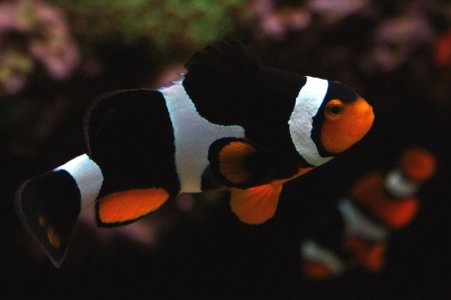
Defining the "perfect" onyx percula

Gary I really like your male, has he bred yet?
IMG_4370keeper.jpg
 
Personally, I'm more interested in factors other than genetics that might influence development of black coloration.

Do people really believe lighting plays a part in it?

I tend to believe host anemone species is a much bigger factor.

There's no doubt in my mind that light and host play a part in this. I also believe diet plays a part. I have a clarkii thats been with me for years. I can change the amount of black she has simply by exposing her to different intensities of light.

Here she is under 250 MH's.
sn850836editedsj3.jpg


Here she is under one T5, with no real reflector, positioned about 2 feet above the tank. The black on her head has faded, and her soft dorsal has turned completely yellow.
clarkii002edited.jpg
 
I also believe that lighting plays an important role. I had a juvenile ocellaris in a small 10 gallon tank for a few months by itself. The tank received very little light in the basement. When I introduced it to the reef tank, it took it 2 months to regain it's bright orange coloration that it's sibling already had.

I think light plays a huge role in all fish coloration though.
 
all very interesting

all very interesting

fwiw: I had a juvi tomato (frenatus) raised in a "pea soup thick" phyto culture that received minimal lighting develop really intense coloration (and) it grew at a far faster growth rate than it's siblings.

I also had a black clarkii that remained almost totally black under 400w halides but was never bred.

Perhaps I should have asked if (specifically) does lighting have a direct effect on the amount of black coloration A. percula develops?

Does lighting play a direct or indirect role in the retention/development of black pigments?
 
Garys Male- Rods Website

Garys Male- Rods Website

Hi Gary

It looks like he has bred ! Have you raised them up by him??

I asked earlier if anyone had a website for Rod, or a contact email??

Surely someone must have it.
 
Hi Gary

Wish you still were breeding them , I'd like some of his offspring.

Thanks SkullV for the link, I wrote him,I also interested in his foods but the nearest dealer is 4 hrs south of me, at gas prices that isnt normally doable, I asked if they do direct sales also,

his mixes are very similar on some I have used, but for discus and angel fish, I like what I read though, I will be interested in what his breeder mix is.

Thanks guys, its appreciated.
 
Hi Gary

Wish you still were breeding them , I'd like some of his offspring.

Thanks SkullV for the link, I wrote him,I also interested in his foods but the nearest dealer is 4 hrs south of me, at gas prices that isnt normally doable, I asked if they do direct sales also,

his mixes are very similar on some I have used, but for discus and angel fish, I like what I read though, I will be interested in what his breeder mix is.

Thanks guys, its appreciated.

I don't believe he's breeding any more, and I believe he's wholesale only.
 
Rods Foods

Rods Foods

Well if he isnt I will be looking elsewhere for onyx, I do like the mixes on his food labels, very similar to what I used to make for angels and discus, but mine also had beefheart or chicken hearts and livers.

I am going to be looking again for fish roe, and possibly make my own to go along with the live foods.
 
Rods Onyx

Rods Onyx

I wish the local folks well then, its a nine hour drive one way for me, the gas would be prohibitive. I sure hope some of these go to breeders.
 
fwiw: I had a juvi tomato (frenatus) raised in a "pea soup thick" phyto culture that received minimal lighting develop really intense coloration (and) it grew at a far faster growth rate than it's siblings.

I also had a black clarkii that remained almost totally black under 400w halides but was never bred.

Perhaps I should have asked if (specifically) does lighting have a direct effect on the amount of black coloration A. percula develops?

Does lighting play a direct or indirect role in the retention/development of black pigments?

Interesting concept Gary about the Frenatus. These are my 'babies', as I have had this species always since my first SW experience. I have not had this same experience as you.

I've varied the phyto, dumped hoards of rots and grew phyto and rots together in an alternating larval raising tank and have always had the intense coloration. I have never had more than a small CFL above the larvae and usually tried using a blue bulb unless it was feeding time to control the intake of rots. The only brighter variants/strains I have seen are from ORA and C-Quest. I would expect all these fish grow in greenhouse style buildings that would let huge amounts of light in to eliminate an electric bill as much as possible. My main pair are under 400W radium and have never looked better, but the huge amounts of Cyclopeeze, shrimp, minced salmon & Spectrum pellet they are fed may account for that.

Culturing methods may improve coloration, as I have seen nothing but gross colored tomatos (if they were even true frenatus) from home breeders. This could be genetics driven and not environment. I believe when it comes to frenatus, nothing will beat diet for deep coloration IME.
 
I believe when it comes to frenatus, nothing will beat diet for deep coloration
me too. I saw no correlation between light intensity (or photoperiod duration) and coloration in Amphiprion frenatus and this is why I wondered if lighting truly has a direct (or indirect) effect on the amount of black one of these percula will ultimately develop.
 
Melanism is influenced by multiple factors, and it seems to differ in all species, however nematocyst toxicity, UV radiation, genetics and perhaps diet are the most likely factors.

There is lots of anectdotal evidence showing to correlation between host anemone species and UV light, but it still needs a lot of research.

I am really interested in genetically melanistic populations, such as the McCullochi and Black Ocellaris. My understanding is that there are a very large number of melanistic animals in the Darwin region, so it would stand to reason that this is why the Melanistic mutation in Ocellaris from that area is so prevalent, additionally the rubrocinctus from that area are fairly dark as well.

I would love to know what other factors contribute to melanistic populations, any thoughts/ideas? Like I said, from what I understand, in most populations of clowns UV exposure and host species seem to play a large role in melanin production, and as we have all seen Black Perculas often lose a lot of black when imported and kept in captivity, where-as Black Ocellaris etc do not, at-least not in a single generation.

Very cool stuff. (Another cool factoid, from what I have read, there has never been a documented case of melanoma in any saltwater fish...but it is often found in many species of freshwater fish....)
 
I have a theory that the melanism we see in the darwin islands is to keep fish in these cold waters warmer.. i just pulled that outa my a$$ though
 
Back
Top