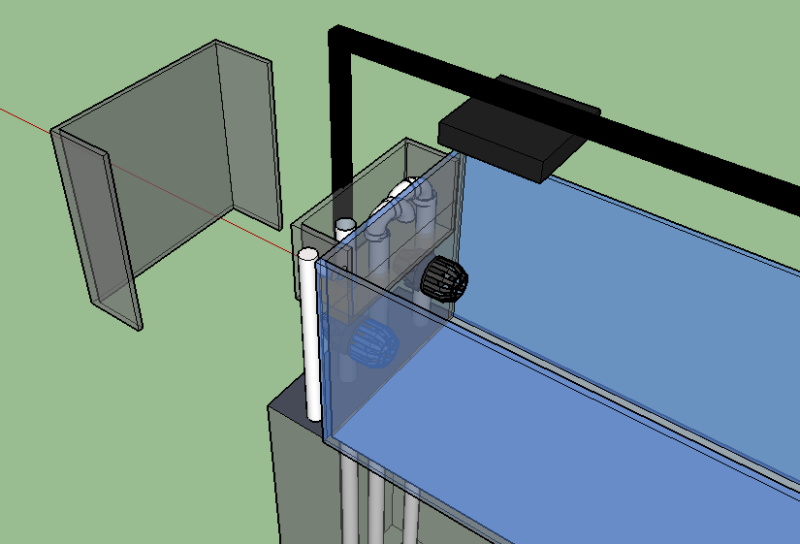
This worked perfectly. Now I'm having difficulty getting the open channel to run silent. The siphon and OC terminate 5/8" under the water line. The water in the external overflow comes up about 1/4 of the way on the U made out of an elbow and a street elbow. There is a 5/16" hole drilled in the U which effectively starts a siphon when I close off the main siphon drain via gate valve.
I'm wondering if there is something I missed or if I just need to fine tune it better. There is a small amount of air bubbles exiting the open chanel. Not many but one or two every few seconds.
Sent from my iPhone using Tapatalk
Yes you missed something, and most likely you need to fiddle with the fine tuning of the system. A gate valve, rather than a ball valve, is a great help in making fine adjustments to the water level in the overflow box, which in turn determines the operating characteristics of the drain system.
For a reference, I will briefly (hopefully) reiterate the startup sequence and a couple gotchas.
Turn the pump on. Water level rises in the overflow box. You get bubbles out of the siphon, and perhaps the open channel. Water level continues to rise until water starts flowing in the dry emergency. This can continue for several minutes. Once the air is purged from the siphon, the water level will drop suddenly. Water flow in the open channel will drop to next to nothing, if any at all, because air is allowed to enter. Adjust the valve on the siphon till water just starts flowing in the open channel. The water level will be in the upper half of the elbows. (Above the point in the "standpipes", regardless of design, where the water starts heading down.)
The gotcha 1: if the air inlet to the open channel becomes occluded before the air purges from the siphon line (e.g. water level does not rise and flow in the dry emergency, and there is no sudden drop in water level,) the system is probably not going to start properly, and the open channel will take too much flow, cause air locks, etc. This can delay starting (why some feel it is necessary to raise the open channel above the siphon, drill holes in the siphon, such as with the Synergy/Ghost overflows.)
This is a very common problem found throughout Bean's thread, spoken of as the "air vent line inlet is too low in the overflow, or the air vent line is not present at all," and a simple hole in the top of the "elbow" is used without the vent line.
The air vent line is essential to the proper function of the system. The inlet to the air vent line (a length of LLDPE--Linear Low Density Polyethylene--tubing is best) should be placed above (higher) than the inlet to the dry emergency. The reason the inlet is placed higher than the inlet to the dry emergency, is that it should never become occluded (trip the open channel to siphon) unless
both the siphon and dry emergency have failed.
The second gotcha, is the small external boxes folks are fond of trying to use, do not allow sufficient head height (water level) to purge the air from the system causing air locks, etc. Synergy found this out the hard way, and had to raise the open channel and drill a hole in the top of the siphon (makes it a second open channel, which defeats the whole point of the system) to keep it from air locking. System such as this do drain water.
Systems that follow the basic design principles (e.g. height relationships in particular, and startup characteristics) work properly out of the box.
What you missed: the air vent line; I do not know if your height relationships are good or not.





 The explanation is always the same; consistent. This is part of the basic trouble shooting steps, almost from day 1. It follows right after the "pipe outlets being too deep in the sump (over 1")" and just before air leaks in the siphon line. There are no mysteries here, and a very finite number of possible issues, and the solutions are always the same: adhering to the design principles that were not adhered to in the first place.


